Enclosure and Resistance in the State Housing Struggle (Voices of Women and Gender Minorities)

Article originally published in Fightback magazine’s special issue dedicated to paid radical writing by women and gender minorities.

Save Our Homes is a research and praxis collective based in Tamaki Makaurau. We believe that liveable housing is a human right and should be accessible to all. We run a website saveourhomes.co.nz as a resource and information base to support communties that are resisting against the state housing reforms, 90 day eviction notices and the ultimate destruction of their communities. More importantly, each of us in the collective work and stand in solidarity with the Tāmaki Housing Group, who are made up of the most militant kuia we have ever had the privilege to fight alongside, learn from and love.

Karl Marx in Capital Vol. I (1990) argues that so-called primitive accumulation involved the violent expropriation of people from the land and their means of subsistence, and the enclosure of that land for the purpose of private property. This process, that displaced peasants in fifteenth century Europe, is the same process that underpins colonisation, and new forms of enclosure such as the privatisation of state assets (Hodkinson 2012). Capital accumulation manifests today in Aotearoa in the form of privatisation of state houses, enclosure of ‘state’ land, and the gentrification of communities such as Tāmaki. These processes involve the displacement of people for the purpose of accumulation by private developers, and the implementation of particular discourses that the National government and property developers use to provide a publicly palatable justification. The resistance of state housing tenants, in particular, the Tāmaki Housing Group, has emerged from this situation of displacement by development, to speak a narrative which ruptures the discourses of those in power, bringing about new possibilities for change.  

Social Housing Reforms and Social Mixing Policy

In order to have an understanding of what is happening in Glen Innes, it is important to outline the policy shifts that facilitate capital accumulation in the community. The National government have implemented policy and legislative changes that significantly alter the landscape of state housing in Aotearoa. The fifth National-led government’s solutions to the housing crisis are centred on selling state houses, restructuring the social housing sector and redeveloping state owned land. The social housing reforms that began in 2013 have created the conditions for privatisation of state housing, and rest on the liberal capitalist logic of government avoiding interference in the market in order to facilitate competition in the creation of affordable housing. This follows international public housing reforms which posit privatisation as a solution to a crisis in unaffordability, a ‘solution’ that actually drives up house prices and leads to the displacement of low income tenants to the fringes of the city.

The government argues that selling state housing to Community Housing Providers (CHPs) will improve the conditions of state housing, however in the UK these stock transfers have led to an increase in rents, a lack of maintenance, and eventually full privatisation. This is because many of these community groups do not have the financial resources necessary to sustain the housing stock, as seen with the Salvation Army rejecting the government’s offer to buy stock (Feek 2015). The extension of the Income Related Rent Subsidy (IRRS) to community housing groups involves the direct transfer of wealth from the government to the private market.

The privatisation of state housing has been coupled with Reviewable Tenancies (RT) which involves reviewing state tenants on their eligibility for social housing based on their income and other factors such as room to tenant ratio. If tenants are no longer eligible they will either be transferred or forced into the private market. In an economic landscape where rents are increasing and wages as well as benefits remain stagnant, state tenants will be placed in competition with private renters and are likely to be displaced from their communities in search of affordable accommodation.

The transfer of state housing to community and charity groups materialises in the built landscape through urban policy, which aims at radically transforming state housing communities into ‘mixed’ tenure communities that consist of private, affordable and social housing. Leading up to the sale of state housing was a significant disinvestment in the stock (Johnson 2013), this devaluation, coupled with an increase in land values, creates the ideal conditions for a privatisation of the stock into a new market and a gentrification process of state housing communities. Marxist geographer Neil Smith (2010) argues that when there is a gap between the ground-rent of a particular geographical space and the potential ground-rent, it creates the ideal conditions for capital to move in and redevelop, capitalising on the speculated land value increases. There are state housing communities around Aotearoa situated on valuable land which are becoming ideal for state-led gentrification in the name of urban renewal.
Housing New Zealand in their urban renewal framework argue that ‘No community will have more than 15 percent of state housing presence’ (Housing New Zealand 2013, p. 10). Urban Renewal is the language used as a disguise for state-led gentrification. The government’s urban renewal programme is premised on the idea of mixed communities, an international trend which aims to have a mix of tenure in the same community. The logic of social mix is premised on solving the problems associated with the concentration of poverty such as crime and anti-social behaviour, however international research (Bridge, Butler, Lees 2012) has suggested that it is a front for state-led gentrification of communities seen as having high land values. The classical liberal rhetoric behind social mix is that the middle-class that move into these communities will bring with them resources and teach the poor how to better live, but what occurs in social mix is the erasure of the poor all together. This state-led gentrification process is occurring in the East Auckland community of Glen Innes.
A Celebration of Whores at Work – On Being a “Good Ally” and Supporting Workplace Organising (Voices of Women and Gender Minorities)

Article originally published in Fightback magazine’s special issue dedicated to paid radical writing by women and gender minorities.

By Vita.

Aotearoa’s sexual services industry is yet again in the international media spotlight, this time because our country’s sex work lobby-group, the New Zealand Prostitutes Collective, described New Zealand as “the best country in the world” to work as a sex worker.  Given this quaint pride that Aotearoa is now world-famous happy hookers as well as hobbits, it’s not surprising that activists and progressive thinkers are examining our collective understanding of how a commercialised exchange of sexual services for money fits in with our beliefs surrounding class, power, labour relations and the commodification of sexuality and human bodies.  What’s disappointing is that this rhetoric seldom goes beyond arguments that classify prostitution as empowerment and that every sex worker lives the life of glamour portrayed in Secret Diary of a Call-Girl, pitched against tropes of trafficking, under-aged workers, poverty and drug and alcohol dependence.  

The quiet, but genuinely exciting truth, is that while (often male-presenting) activists argue on internet about whether there will still be demand for transactional sex in a post-revolution utopia, in private homes, street-front brothels, escort agencies and hotel rooms, sex workers are on the frontlines of negotiating complex power dynamics all across Aotearoa.   Every day, sex-workers use their bodies and minds to provide companionship and pleasure to another human-being, usually a total stranger, within a set time-frame.  Whether the individual workers who do this are empowered or victimised, working by ‘choice’ or coerced, or occupying the myriad of grey areas in between, sex workers do extraordinarily skilled work that demands a labour of both body and mind.

Despite this, many activists, while arguing that their problem with sex work, and by extension sex workers, lies not in moral prudishness but in an ‘objective’ assessment of power relations under capitalism between men and women.[1] Aside from such an ‘objective’ analysis overlooking the way that gender, race, class and other situated perspectives inform the power relations in every working environment (and seemingly overlooking the fact that many sex-work providers are men or trans* workers, and that many service consumers, particularly of pornography, are cis-women), it attributes a ‘false-consciousness’ to sex workers – that at a fundamental demographic level, sex workers lack the ability to understand the power dynamics they work under, and continue to perpetuate their own oppression.

Such a patronising attitude towards a group of people whose job literally relies on subverting the power dynamic of human’s entitlement to sex would be endearingly funny if it wasn’t coming from a group of people supposedly committed to supporting workplace organising.  If you, as a person who is committed to worker’s struggles, understands that the fast-food worker is the person who best understands the nuances and dynamics of his/her work-site, and that that person, in conjunction with other fast-food workers, is the best person to organise and agitate for change in that particular site and in the industry as a whole, then you can extrapolate that sex workers should not be dismissed as having ‘false consciousness’ or ‘lacking true understanding’ when they talk about their working lives.

As activists who want to support all workplace self-determination and organising, I believe there are two things very simple things we can do to support sex workers.  The first is to support a model of full-decriminalisation of prostitution – where the transaction of sex for money is legal, and not the so-called Swedish/Nordic model, which criminalises the client/purchaser and therefore drives the entire industry underground and submits the transaction to police regulation.  The second of these is to listen to sex workers – with studies estimating the number of prostitutes/escorts alone at between 40 and 42 million,[2] it is simply inexcusable for sex worker voices to be missing from activist debates about sex work.  If we cannot find allies to speak to and educate our movements, the onus is on us to examine ourselves for why this may be.

[1] See, for example Lisa Macdonald et al. “Is Sex Work Just a Job like Any Other? A Contribution to the Discussion” Socialist Alliance no. 1 April 2015 < http://www.socialist-alliance.org/&gt;

[2] Gus Lubin, “There Are 42 Million Prostitutes in the World, And Here’s Where They Live” Business Insider, 28 Jan 2012 <http://www.businessinsider.com.au

‘Flag debate’ – Still an expensive distraction

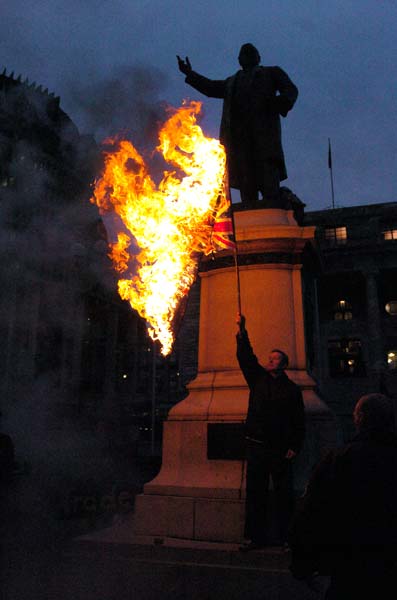
hopkinson nz flag burns hopkinson

Paul Hopkinson burns NZ flag in opposition to military occupations, 2004.

By Ian Anderson, Fightback.

It’s not news that New Zealand Prime Minister John Key has arbitrarily announced a ‘flag debate,’ consisting of two referenda in November-December 2015 and March 2016. Or rather, the ‘flag debate’ is news; reports circulate daily on the latest developments. However, in all the debate about which design is best, or why certain designs were picked and not others, the debate about why this process is happening has largely been left behind.

Critics of the process come from a range of perspectives. Some defend the existing flag, featuring the Union Jack. The Union Jack has also been termed the ‘Butcher’s Apron’ – covered in blood as it waved over a bloody process of global colonisation (including in Aotearoa / New Zealand) which has only recently ebbed.

One conspiracy theory, circulated widely on social media, holds that changing the flag would change New Zealand’s constitutional relationship with the British Crown, laying the basis for the secretly negotiated Trans Pacific Partnership Agreement (TPPA). This theory invokes terms like “due authority,” a term which has no legal constitutional meaning. Proponents of the theory hold that the TPPA is an attack on sovereignty. This has an element of truth to it – transport giant Veolia is currently suing the Egyptian government under a similar trade agreement, for raising the minimum wage. However, sovereignty of this kind, the chance of justice and self-determination, rests with the people. The Crown is no defender of popular sovereignty. The forces that imposed capitalism by force will not defend against its excesses. In any case, most flags of the British Commonwealth do not have a Union Jack – the flag design does nothing to alter our constitutional status.

If the flag design were as important to New Zealand capitalism as the TPPA, Key and National would not offer this level of democratic oversight – compare two expensive referenda with secret negotiations. Granted, the ‘democratic’ process is arbitrary and more than a little corporate. Asking for a preferred alternative before asking if voters want to change the flag is manipulative and unnecessary. Key’s obvious preference for the corporate Silver Fern symbol was cemented by a corporate panel, with 3 out of 4 finalists featuring the Silver Fern.

However, it didn’t take much of a fight for National to add the popular Red Peak design to the list of finalists. After a petition with 34,000 signatures and some parliamentary rumblings, Key backed down expressing democratic sentiments:

“I don’t want to be the one that stands in people’s way of having a choice. If people want me to alter the process, I’ll be happy to alter the process – I would have preferred to stick to the one the officials wanted, but you know.”

Compare this with the TPPA, which is opposed by trade unions, criticised by local councils and parliamentary opposition (albeit in a tokenistic way – considering Labour initiated the process), by tens of thousands mobilising in the streets nationwide – and Key has dismissed this opposition as ‘misinformed.’ Popular input on trade deals would much more fundamentally undermine Key’s power base than popular input on an isolated symbol.

The problem with the ‘flag debate’ is precisely that it doesn’t have anything to do with our constitutional status. Te Tiriti will continue to be dishonoured in favour of the English Treaty, a document intended to ensure Crown sovereignty and a stable basis for capitalism. Governments will continue to rush for ‘settlement,’ while the previous settlements haven’t even begun to address the historical violence that has impoverished indigenous communities. Successive Labour and National governments will continue to entrench integration with ‘free trade’ and US-led military occupations. The flag design, on its own, makes little difference.

In fact, the incorporation of the Red Peak, by some degree of ‘popular demand,’ can be considered a kind of victory for Key. Opponents of the process previously called it a $26 million dollar distraction, with public money that could be better spend on feeding or housing people. Now, a particular design has attracted the support of Key’s critics (among others). This is an ironic success for Key’s arbitrarily announced nation-building process. If Red Peak succeeds, the symbol used to justify troops in Syria and Iraq, used as a brand for international trade, will better represent progressive aspirations.

In a widely circulated blog entry entitled ‘Why I Support the Red Peak Flag,” Oxford philosophy professor Josh Parsons (who once graded every flag in the world) articulated this desire:

“New Zealand needs a flag that represents the bicultural nature of our society (never mind whether biculturalism or multiculturalism is more desirable); that reflects the historic contract between Māori and Pakeha that founded our society (whether just or unjust); that represents the unique geography and land-forms that have played an important part in our history and shared culture. It also needs a flag that is not revolutionary, but shows continuity with the past; that is independent of any sports code, and most important of all, is simple, iconic, and unique.”

Parsons’ phrase “whether just or unjust,” perhaps accidentally, echoes the old slogan “my country, whether right or wrong, but my country.” Parsons articulates a form of liberal patriotism, founded on the myth of reconciliation between settlers and indigenous people. Many on social media have similarly expressed a preference for the tino rangatiratanga flag, which represents the struggle for Māori sovereignty. While these intentions are probably noble, there is one fundamental problem – ‘we’ haven’t earned such a flag. In lieu of justice for indigenous and oppressed people, a bicultural flag would represent another kind of rebranding for capitalism, colonisation and imperialism. Reconciliation is impossible without justice

A serious movement for constitutional transformation could challenge this historical, continuing injustice. This movement may demand land redistribution, rather than paltry financial settlements for corporatised iwi; may demand a relationship of kaitiakitanga, or guardianship, with resources, rather than exploitation; may demand a true partnership between tau iwi and tangata whenua, collective self-determination, the end of domination by financial elites (including the unelected Brown Table). Fightback also advocates that such a movement should articulate an alternative kind of internationalism – on the basis of solidarity and mutual aid, rather than economic competition. Recent popular sentiments supporting Syrian refugees represent this possibility of an alternative internationalism.

While the movement for constitutional justice occasionally explodes from the potential into the concrete; the 1975 Māori Land March; the re-occupation of Bastion Point (supported by a trade union green ban); hikoi against the Foreshore and Seabed legislation, against asset sales and the TPPA; this is an interrupted, discontinuous process. In the words of Marxist theorist Walter Benjamin, “the history of the oppressed is a discontinuum.” Radical organisations support and prepare for these outbursts of historical possibility, which offer far more than a rebrand for ‘Team New Zealand.’ A movement for constitutional transformation may demand a flag change, but this would have to be connected to further-reaching demands for justice and resources. Without these more far-reaching changes, a better design for our national flag amounts to rebranding injustice. The ‘flag debate’ remains an expensive distraction.

Your Problematic Fave: Confronting friends about abuse (Voices of Women and Gender Minorities)

Article originally published in Fightback magazine’s special issue dedicated to paid radical writing by women and gender minorities.

Anne Russell is a public health student with an ongoing interest in the politics of intimate relationships.

A welcome narrative has recently sprung up about how society needs to teach men (and others) not to rape or abuse people, rather than teaching women (and others) to avoid rape and abuse as though it’s an unchangeable fact of life. Many people are aware that this means men have to talk to other men about their abusive/predatory behaviours. However, they often baulk when it comes to actually doing this with their friends and peers, going into denial about their loved one’s behaviour and/or declaring the situation is too awkward or complicated. Dealing with cases of abuse is always a fraught and complicated process for everyone, including for those trying to be a middleman without veering into abuse apologia. The lack of coherent narratives around dealing with queer abuse or women’s abuse of men doesn’t help the overall situation. This is thus a brief, rough attempt at a guideline for how to start trying to hold one’s friends of all genders accountable for their abusive behaviour.

For the most part, abusive behaviour can only be revealed by someone talking about it, creating what many people refer to as a he-said-she-said situation. As such, many people refuse to believe those who talk about being abused, as they believe or want to believe that this information contradicts what they know of the accused person. He’s so kind to his mother, or she’s such a good feminist leader—how could they possibly have been abusive? The denial of this often extends to victim-blaming; surely the abuse must have been provoked by her short skirt or annoying behaviour. People will go to extraordinary lengths to avoid accepting the knowledge that someone they respect, care about or even love dearly has done something terrible, and needs to be told to stop doing it. In a culture that portrays Rapists and Abusers only as people who hide in bushes sporting I Hate Women T-shirts, it is hard to reach the more accurate standpoint of “people we love and admire can do really fucked up things”. Natalie Reed’s analysis of systemic misogyny makes this clearer:

There really isn’t any such thing as “sexists”, “transphobes”, “racists”, etc. There are only actions, statements and beliefs that are sexist, transphobic, racist, etc. And we’re all susceptible to them.

Likewise, sexism is not a social problem that can be located, isolated, quarantined and then eliminated. It is an emergent system of attitudes about sex and gender that derives its power from the bottom up, from all corners of our culture.

Given how common rape and domestic abuse are, the idea that only supervillains commit abuse is simply not true. But while the more accurate narrative of “people we love and admire can do really fucked up things” can be pretty depressing, it can also be a source of hope; intimately abusive people aren’t incurable psychopaths after all! The question does get more complex, though; in each case, you ask yourself, can I continue to love this person while still condemning these parts of their behaviour? What would that love look like? How do I balance it out with caring for the victims of their behaviour, and making sure those people’s needs are met?

Sometimes it’s too unsafe or emotionally hard to work on one’s abusive friends; when an acquaintance who had sexually assaulted my friend showed up at a protest I’d organised, all I could do was cry in a corner and tell a couple of other people about him. However, the Incurable-Psychopath narrative of abusive people would hold that cutting them off completely is the only ethical way to condemn their actions. If and when one is physically and emotionally safe to do so, attempting to hold abusive friends responsible is always, always a good idea. The accountability process will decide whether you want to cut them off anyway—if you want to stay friends with someone who can’t take criticism, who can’t accept responsibility, who lies to you, who promises to change and then doesn’t, and so forth. Some care may need to be taken if the person has been accused of violence or is generally prone to it—confronting them in a public place with support from other people can thus be a good safety measure.

Perhaps at this point it’d be good to list a few initial phrases you might use to confront someone about their abuse, since many people feel awkward or unsure about that step. It is important to note that every friendship is unique, and you may have varying approaches that work for different dynamics.This could include age gaps, power imbalances, cultural differences and closeness of friendships. These prompts are just to start you off, as it’s important to find your own way of communicating about abuse that will be effective within your particular friendships.

  • Hey, can we talk? I’ve been hearing some bad things about your behaviour [towards X] and I’m really not comfortable with it.
  • Hi, your creepy behaviour is making some people feel unsafe, and I think you should leave this event. It’d be good to talk more about this later; maybe we could meet up next week?
  • Hey, I’m pretty uncomfortable about you having a leadership position in this organisation; the way you’ve been treating and talking about women isn’t okay.
  • Mate, it’s really not cool for you to talk about trans women like that, knock it off
  • What is this, I thought I signed up for “lesbian coven”, not “lechbian coven”

At this point the person could apologise and agree to start changing their behaviour. However, they could also go into denial, or become defensive and angry. Either way, it is a very good idea to call in support from one’s friends. Doing this has at least three benefits: it shows a united front against the person’s abusive behaviour, it helps keep everyone’s emotional energy up, and it helps share details and tactics. When a friend of mine told me she hadn’t harassed her ex in a long time, other friends let me know she was lying, which made me better equipped to keep confronting her.

Prioritising the victims’ needs often determines the first step in adjusting to a new sort of relationship with the abusive/predatory person in question. If that person is still a risk to their surrounding population, and/or if their victims still feel unsafe around or triggered by them, keeping them away from group events is very important. It’s a step people are often unfortunately unwilling to take, as at best it’s an awkward process, and will often be met with a lot of resistance from the abusive person and their supporters. However, many people can maintain friendships through individual hangouts like meeting up for coffee or watching films together; if your friendship isn’t intimate enough for something like that, turning that person away from a party should hardly be a major issue. As for their presence in organisations, their value to any group is questionable if, for example, they continually prey on women.

With enough social pressure, an abusive person may feel motivated to apologise and start making amends. As a friend said, a good litmus test of whether a person’s remorse is genuine is whether or not they’ll let their behaviour be named to others; whether they accept that they’ve broken trust and need to repair it. Trust takes time and continuous work to rebuild; trust that the person is truly sorry for their actions, and that they are taking steps to make sure it won’t happen again. Even then, the abused party is under no obligation to forgive them or be around them; recovery also takes time, and victims need to be able to move at their own pace.

Since abuse is a practice, not a personal identity, anyone is capable of doing it. Seeing abuse for the terrifyingly routine event that it is may help demystify the issue, and thus make dealing with it a more routine practice. While doing this is difficult in isolation, it gets easier when there are support networks to maintain it. As a friend said, politics is what we do together; everything else is just survival strategies.

Christchurch: Fightback study group

revolutionary fist

Fightback Christchurch would like to welcome all those interested to be involved with our recently formed, regular, radical study group. Fightback is acting as facilitator for the study and discussion of radical theory – both leading and presenting discussions, and inviting participants to recommend and lead study of ideas they have found useful or profound.

We meet fortnightly at the WEA Canterbury Workers Educational Association (59 Gloucester Street) starting from September 24th at 6.30pm [Facebook event]

All are welcome to attend, and reading ahead of time is not required to be involved as we will cover key elements of the reading in our sessions. As many of us lead busy lives and attending meetings like this can be difficult, we are also providing food to make attendance easier. We also aim to make our events child friendly and welcome any advice to make for a more accessible and nourishing environment.

Koha is greatly appreciated to help with the cost of room hire. We will also have our magazine ‘Fightback’ available at all meetings for purchase.

If you would like to be involved, included on emails about events in Christchurch, or want to know more about the events contact: fightback.chch@gmail.com or 021 155 3896

Theory is a tool for our collective liberation, and if you are interested in learning and discussion please join us!