George Soros, ‘Globalism,’ and Grassroots Revolt: How the Right Uses Conspiracy Theories to Appear Revolutionary

(reposted from It’s Going Down. This article is from an anarchist viewpoint and thus Fightback does not necessarily agree with all its conclusions. However, it effectively demolishes many of the most important conspiracy theories on which modern fascism and Right-wing populism depend, and show why the Left must fight such ideas even when they claim to be “anti-establishment” or “anti-corporate”.)

In the 1990s and into the early 2000s, a global movement against corporate globalization and neoliberal capitalism developed, with anti-authoritarian and anarchist politics at it’s head. In 1994, the Zapatista insurrection in Chiapas, Mexico against NAFTA made the world sit up, as indigenous people began self-organizing their communities after taking land back from the State in an armed uprising, blending indigenous Zapatismo with Mexican anarchism. Soon, a tidal wave of actions, indymedia projects, and grassroots groups began to be formed across the US, which fed into the growing anarchist movement. When the protests in Seattle of 1999 hit in November against the World Trade Organization, they famously popularized the black bloc tactic, however in truth the anarchist movement in North America had already been growing for years and exploded within the ascending anti-globalization movement, and was much bigger than simply one single tactic. Regardless, along with the anti-globalization movement, anarchism and its ideas grew.
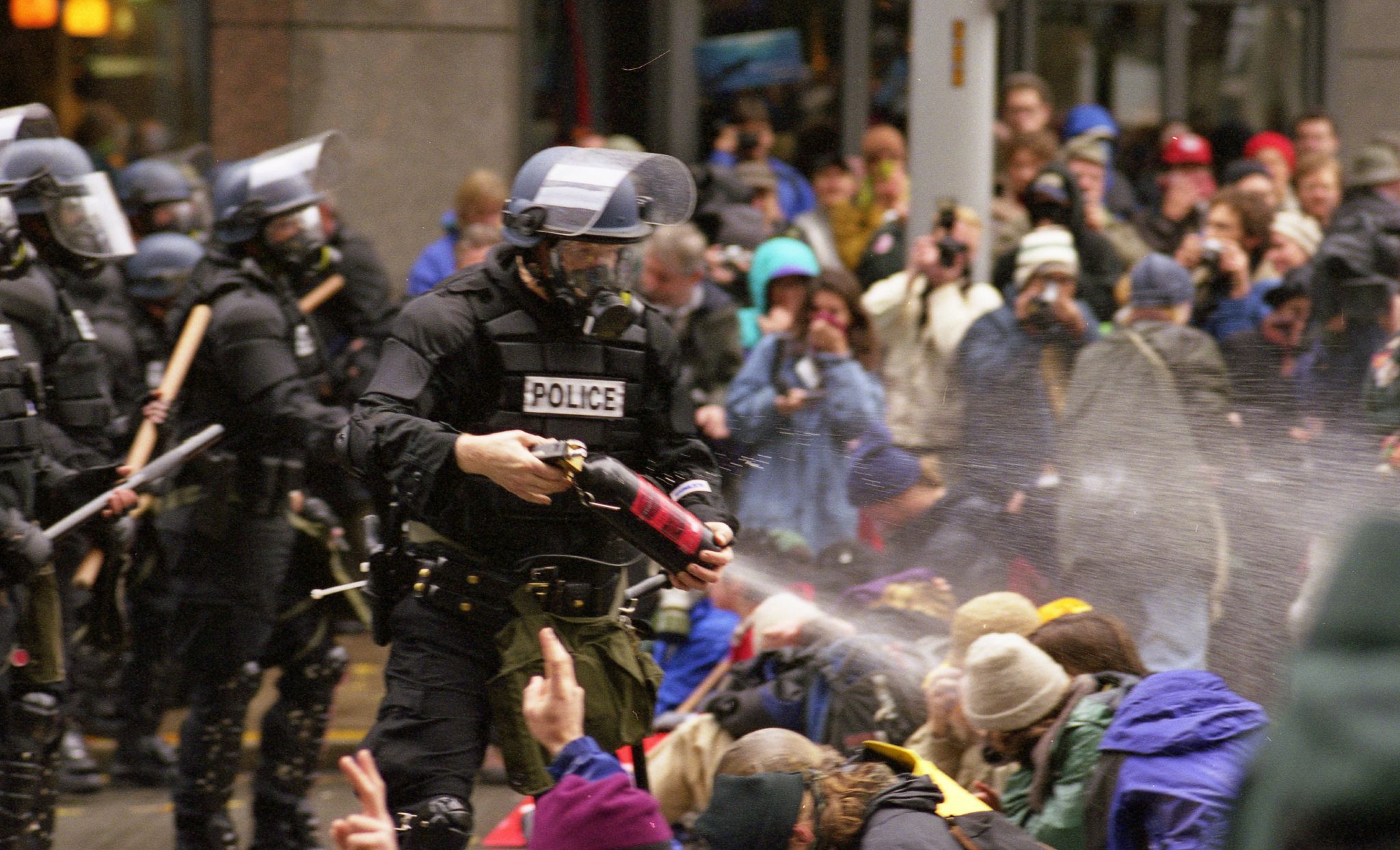
Paid terrorists attack volunteer revolutionaries in the service of global capitalists.

The anti-globalization movement became in many regards, de-facto anarchist; from the ways that people made decisions to how people organized themselves to take action. Moreover, the mobilizations in Seattle were also important because it saw thousands of people join in confrontational demonstrations that disobeyed the leadership of union bureaucrats and NGOs, to say nothing of the Democrats in power or the police. As the government called for a curfew on demonstrations and even brought in massive amounts of body bags, and President Clinton demonized the black bloc as only wanting to attack “small businesses,” the riots grew into popular revolts as whole neighborhoods stood up against the police and began looting stores. Moreover, the combination of street clashes and blockades shut down the WTO meeting; the protesters won. Seattle set in motion a chain of events, as the anti-globalization upheavals continued, not only in size and scale, but also as popular confrontations between the State, it’s security forces, and the general population. While the events of September 11th in many ways sunk the movement, it remains a high point of anarchist organizing in recent memory.

Ironically, when large scale demonstrations like this break out across the social terrain in today’s world, as they often have in the last several years under another Democratic President, Obama, the far-Right simply writes them off. But how and why the write them off is very telling. Generally this first takes the path of conspiracy, as one section of the Right dismisses any kind of popular uprising or resistance as the work of “paid protesters,” almost always under the direction of billionaire George Soros. Another section of the Right will take this even further, and claim that those facing felonies and military grade police weapons are in fact soldiers of the “Zionists,” and are the foot soldiers of the “globalist” order.

But the far-Right did not always see things this way.

As the riots of 1999 in Seattle against the WTO played out, many on the far-Right actually saw what was happening in a favorable light. Beyond that, they even chastised their own movement for failing to live up to the same standard as the people that rioted and shut down the WTO meetings. Although the far-Right framed these actions in terms of conspiracies of the “Zionist Occupied Government, or “New World Order,” they still strangely enough, supported it. Matthew Hale, then the leader of the World Church of the Creator, stated in an essay after the riots:

What happened in Seattle is a precursor for the future—when White people in droves protest the actions of world Jewry not by ‘writing to congressmen’, ‘voting’, or other nonsense like that, but by taking to the streets and throwing a monkey wrench into the gears of the enemy’s machine.

Did the right wing hinder the WTO? No. They were too busy ‘writing their congressmen’—congressmen who were bought off a long time ago, or waiting for their ‘great white hope’ in shining armor who they can miraculously vote into office.No, it was the left wing, by and large, which stymied the WTO to the point where their meeting was practically worthless, and we should concentrate on these zealots, not the ‘ meet, eat, and retreat’ crowd of the right wing who are so worried about ‘offending’ the enemy that all too often, they are a nice Trojan Horse for the enemy’s designs.

Others agreed. Louis Beam, a former member of the Ku-Klux-Klan, and an almost a Subcomandante Marcos figure on the racist far-Right, as well as the person who popularized the concept of ‘leaderless resistance’ wrote:

…My heart goes out to those brave souls in Seattle who turned out in the thousands from both Canada and the U.S. to go up against the thugs of Clinton and those who put him in office. I appreciate their bravery. I admire their courage. And I thank them for fighting my battle…“Soon, however, there will be millions in this country of every political persuasion confronting the police state on streets throughout America. When you are being kicked, gassed, beaten and shot at by the police enforcers of the NWO you will not be asking, nor giving a rat’s tail, what the other freedom lovers’ politics ‘used to be’—for the new politics of America is liberty from the NWO Police State and nothing more.

We mention this history, just as Don Hammerquist did in Fascism and Anti-Fascism, not to imply that there can be some sort of ‘unity’ between white supremacists and anarchists, but simply to point out that the far-Right, at this time, recognized that one of their enemies – anarchists, were actually political agents in a battle against the State and the economic system it is designed to protect. They also understood that this struggle made their own movement appear weak due to inaction and reformism. Also, keep in mind that this was happening at a time of increased anti-fascist organizing, mostly under the banner of Anti-Racist Action (ARA), the very group that were breaking up meetings and beating the shit out of Matt Hale’s Nazi supporters, so these comments were not made without hesitation or reflection.

Things are much different now. For instance, when the African-American community of Ferguson rose in revolt against the police in the summer of 2014, the far-Right across the board condemned the uprising as the work of paid Soros protesters, or an example of the black threat to white civilization. One far-Right group actually even went to Ferguson to help put down the rebellion, the Oath Keepers, a Patriot/militia group, and attempted to act as an auxiliary force to the police. However, upon arrival, some in the group decided they instead wanted to march with guns with the protesters in order to show the police that the citizens were not afraid of them. This about face in position among some members, from wanting to support the State to wanting to support the black citizens of Ferguson, caused a split in the group. Needless to say, the march never happened, but the point remains clear: stand up to the State and its police, especially if you’re black, and the far-Right does not support you. In fact, it demonizes you as the enemy for doing so, or portrays you as a stooge to powers far beyond your control.

The current myths around Soros as the “Puppet Master” mirror the previous views of groups such as the John Birch Society and the American Nazi Party.

These extreme simplifications go back to the 1950s on the far-Right, where anti-communist groups like the John Birch Society painted a world where communists in the service of the USSR infiltrated every group with sizeable influence that was trying to change conditions for poor, working-class, and oppressed people. Moreover, they strongly opposed the civil-rights movement because they saw it as a stepping stone to socialism. Neo-Nazis like George Lincoln Rockwell took these ideas a step further, and proclaimed that civil-rights groups such as the NAACP were actually run by the Jews. African-Americans, Rockwell argued, were not smart enough to organize their own organizations, and thus had to have Jewish leadership. Such leadership, he went on, was proof of Jewish communist plans to ‘race-mix’ white people out of existence. Such ideas continue today on the far-Right, as Neo-Nazis like Matthew Heimbach repeat the same tired lines, while also heralding black nationalist groups such as the Nation of Islam. For the Right it seems, black struggle and organization is always dismissed, unless those involved have anti-Semitic and nationalist politics which mirror their own.

Despite downplaying grassroots resistance, community organizing, and revolt of any kind, the far-Right in the past 8 years has growly increasingly militant and at times, even insurrectionary. It called for Obama to be tried as a traitor. It called for Hillary to be fired and jailed as well. In an armed occupation of a federal wildlife refuge, a far-Right militia occupation in Oregon called for the end of the federal government and the replacing of the State with the power of the Sheriff and the opening up of all federal lands to mining, ranching, and resource extraction. At the same time, the racist far-Right grew in street militancy, clashing with anarchist and left-wing demonstrators, leaving several people injured, and in some cases, even attempting to kill them.

Throughout it all, if the far-Right was sure of one thing, it was the illegitimacy of any resistance that did not come from the Right itself. Any grassroots mobilization, any strike action, occupation of land, or insurrection against State authority was seen as suspect; written off as the act of provocateurs in the service of globalist elites. While it is easy to laugh off these ideas as the fantasy of twitter warriors, or tin-foil hat Alex Jones fans ranting about “the Lizards,” with Trump now echoing many of these positions, they become less easy to dismiss with a slight of hand.

From Globalization to “Globalism”

“Globalism” has now replaced “communism” and even Islam, as the boogeyman of the Right, while at the same time, still encapsulating both of them as threats within its worldview. The far-Right, and the Right in general is very good at taking very complex systems and reducing them down to simple problems caused by a select group of people. As we will show, the idea of globalism both seeks to attempt to appear populist or even revolutionary, while at the same time, singling out select groups of people who the Right claims further the ‘globalist agenda.’

But where did the idea of globalism come from and what the hell does it mean? After NAFTA was passed, and globalization allowed capital to move freely across national borders while locking workers behind them, as structural adjustment programs slashed social services, took away land, and restructured economies in the service of international capital, the mood began to change in the US among everyday workers against globalization. This anger helped feed into the anti-globalization movement, as large segments of labor joined the fight against free-trade deals. But it wasn’t long until sections of the right began to bring critiques of globalization into their talking points as well, Pat Buchanan being a key example.

On the Right, discussion of global capitalism was turned on its head; into a conversation on the problem of “the globalists.” In short, the problem wasn’t a system, but a set of people, and this problem is almost always described along the lines of a conspiracy. In short, those on the far-Right framed the problem in terms of American nationalism, sovereignty, and power, pitted against the “globalist agenda.” Furthermore, the far-Right, of whatever stripe, always described the elite globalist system as being supported and maintained by a set of non-State actors, which work in it’s service to destabilize sovereignty and attack the ‘Native’ population. For some this is immigrants, for others Muslims, for the racist far-Right, it means black people being controlled by Jews, among others. But for all, it means anti-capitalists and grassroots communities in struggle which fight against the dominant social order and power structure. As Liam Stack wrote:

Globalism is often used as a synonym for globalization, the system of global economic interconnection that has been critiqued for decades by liberal groups like labor unions, environmental organizations and opponents of the International Monetary Fund and the World Bank. But for the far right, the term encapsulates a conspiratorial worldview based on racism, xenophobia and anti-Semitism…

The term also often explicitly rejects any sort of anti-capitalist analysis of the systems of power and moreover, and instead replaces a class analysis with racial and national overtones:

Lauren Southern, a host on the right-wing Canadian media site Rebel Media, explicitly rejected its use as a synonym for globalization in a video she posted online in September. She said the word meant rule by autocrats — such as President Obama, former President George W. Bush and the United Nations — who value “the false flag of diversity” and “unchecked immigration from the third world.”

Hope Hicks, Trump’s spokesperson defined globalism as such:

An economic and political ideology which puts allegiance to international institutions ahead of the nation-state; seeks the unrestricted movement of goods, labor and people across borders; and rejects the principle that the citizens of a country are entitled to preference for jobs and other economic considerations as a virtue of their citizenship.

For the ‘anti-globalists’ then, the major problems facing everyday people are not pollution, repression, or poverty, but the pooling of State power into umbrella organizations, such as the United Nations, and “the flooding” of countries by immigration. For the Right, this results in a perceived attack on Western Civilization.

And for some on the far-Right, these ideas take extreme forms. For example, Alex Jones (who called globalism “the ultimate form of slavery”) contends that the globalists ultimate plan is a one world government and that they use immigration to flood sovereign States in order to destroy them and rig elections. Jones then goes on to contend that globalist elites also have plans to kill off a massive amount of the population through genocide and extermination for the sake of consolidating their power. Jones also preaches a set of even more hardcore conspiracy theories, some of which are paranormal in character and outright fucking crazy. But in the last year, Jones has crossed over as a Trump supporter, having Trump on his show, and we’ve even watched as Trump has parroted much of what Jones says in his radio broadcasts. It’s easy to laugh Jones off, but clearly his myth of ‘globalism’ is selling.

An image of George Soros from InfoWars’ article on globalism.

The Oath Keepers, one of the biggest Patriot groups also label globalism and globalists as their chief enemy. From the Oath Keeper page:

Arising out of the writings of Immanuel Kant and Georg Wilhelm Friedrich Hegel (the Hegelian dialectic), and even further back to Plato, Globalism is a belief in a Utopian world run by wise men who care for the masses with a kind, benevolent hand. This we know is a bunch of crap, because those who are leading, (and have led), the world into this collective dystopia have murdered, “collectively”, hundreds of millions of people, through wars, genocide, ethnic cleansing and eugenics.

Fascism, socialism, communism and crony capitalism are all globalist at their core. meaning the collective is supreme over the individual. It is the battle between collectivism and individualism that we should be focused on, not left versus right,republican versus democrat, or fascist versus communist, but, rather, the collectivists vs. the individual, for collectivists hide in all the political persuasions. If someone wants to take your Creator-given, natural rights from you “for the greater good”, you can be assured they are collectivists. Those who would create the New World Order, are collectivists.

In many ways this critique of globalism simply continues cold-war opposition to communism, or inserts new enemies, such as immigrants or Islam, to make it fit into this idea of globalism as anything that threatens American nationalism and ‘sovereignty.’ The Conservativpedia post on globalism again makes this point:

Globalism is the failed liberalauthoritarian desire for a “one world” view that rejects the important role of nations in protecting values and encouraging productivity. Globalism is anti-American in encouraging Americans to adopt a “world view” rather than an “American view.”

Globalists oppose nationalism and national sovereignty, and instead tend to favor on open borders, free trade, interventionalism, and foreign aid. Globalists virulently opposed Donald Trump in 2016. Instead, globalists preferred Marco Rubio and Ted Cruz for the nomination, both of whom have voted in favor of the globalist agenda as senators.

Liberals support globalism because it leads to centralized power, thereby providing liberals with an easier way to gain control. It is far easier for liberals to persuade a handful of people in centralized government to rule in their favor than it is for liberals to push their agenda on a decentralized form of government.

The conspiracy theories of Alex Jones and his critique of “globalism” has been mainstreamed by Trump, who not only came on Jones’ show, but parrots much of his talking points.

This is why immigration is such a huge point on the far-Right, because they see it as “a tool of the globalists” to destroy State sovereignty. Of course, this myth hides the fact that mass migration of people is caused largely by the globalization of the capitalist economy, US involvement in the drug war and foreign policy, and now, climate change and lack of access to water. As The National Interest expands the far-Right position clearly:

Nationalists believe that any true nation must have clearly delineated and protected borders, otherwise it isn’t really a nation. They also believe that their nation’s cultural heritage is sacred and needs to be protected, whereas mass immigration from far-flung lands could undermine the national commitment to that heritage. Globalists don’t care about borders. They believe the nation-state is obsolete, a relic of the 1648 Peace of Westphalia, which codified the recognition of co-existing nation states. Globalists reject Westphalia in favor of an integrated world with information, money, goods and people traversing the globe at accelerating speeds without much regard to traditional concepts of nationhood or borders.

The overall logic of those opposed to globalism can best be reiterated and understood in simplicity by the Neo-Nazi Matthew Heimbach, who stated that the coming period will be defined by a war between globalism and nationalism, where nationalists of all stripes will fight against the globalist elites, which in Heimbach view, are manifested as a racialized Jewish global ruling class. If the nationalists are successful Heimbach contends, they will then create fascist States for each of their own races. While Heimbach’s position would be seen as extreme even on the Right, in many ways, this is just the logical conclusion on an idea founded on anti-Semitism. As Stack wrote:

Far-right groups in the United States began to refer to globalism at the end of the Cold War, when it replaced communism as an idea that was an ever-present danger to the nation, Mr. Pitcavage said. They have also referred to it as the New World Order, and soon they saw its tentacles everywhere.

The shape of that conspiracy had distinctly anti-Semitic overtones, in part because many of communism’s foes had historically seen communism as inextricably linked to Judaism, Mr. Pitcavage said. Members of the far right became fixated on prominent Jews like the businessman and philanthropist George Soros.

Those conspiratorial beliefs were bolstered when former President George Bush celebrated the end of the Cold War in a 1991 speech by saying it was the dawn of a “new world order.” His use of the phrase was taken as proof by many that a globalist conspiracy really was afoot.

The problem with all of this talk of ‘globalism’ vs nationalism is that it holds half-truths and full lies. Neoliberal finance capitalism is a global system. Neoliberalism and globalization have left behind billions of people, destroyed the environment, and attacked the living standards of the majority of people at the benefit of a small set of elites. However this is not conspiracy, it is not the creation of a cabal of Jews, and moreover, globalization is not designed to destroy the power of national States in order to create a one world government, nor is it the project of ideological liberal/Jewish/Islamics/Communists, or ‘globalists.’ Globalization and capitalism in general needs States. It needs them to manage and control their populations and lock them in place, even as capital and goods move freely. Finally, States are needed by elites on a variety of levels in order to bring about stability and prevent revolution when revolt and crisis break out. Moreover, just because capital is more globalized, does not mean that there are not competing visions among elites themselves.

But while the myth of globalism exists to explain the world in a way that allows the Right to actually make sense to people, and moreover, to make themselves appear to actually have political agency, it has other myths to describe everyone who resists in the here and now.

The Myth and Reality of George Soros

If there’s one thing Right loves to throw around, it’s the idea that George Soros is behind any sort of social movement, organized protest, or dissent in general against the status-quo. This is something that is held dear by all parts of the far-Right and even the center right-wing. It seeks to make sense of popular struggles and dismiss them as simply the work of people who are paid off by an evil financial capitalist. The myth has links back to anti-Semitic works such as the original fake news piece, The Protocols of Zion, and Soros being Jewish only adds icing to the far-Right’s cake. Moreover, it also side steps the issue of the very real stranglehold that non-profits and foundation money does play in resistance movements, which is negative, that seeks to channel social movements back into politics and the State, as opposed to building autonomous power on a community level.

But who is Soros? George Soros is the chairman of Soros Fund Management and is one of the 30 richest people in the world, making billions on hedge funds and currency speculation. Far from being an anti-capitalist or revolutionary, he’s most known for as “the man that broke the bank of England,” after he neted over $1 billion in currency speculation. Along with being one of the richest capitalists alive, Soros also donates to and funds many liberal non-profits that promote the Democratic Party and it’s bureaucrats. Soros has also backed many Democratic candidates, such as Hillary Clinton and Barack Obama. In 1984, Soros set up the Open Society Foundation that acts as a grantmaking network, further expanding the amount of non-profits who took on the role of providing social services; filling gaps that were created after Reagan began slashing various programs.

Because Soros does have expansive wealth, donates to what the far-Right describes as “left-wing” groups such as MoveOn.org (a front for the Democratic Party), the ACLU, Human Rights Watch, and MediaMatters.org (a large liberal non-profit), along with Democratic career politicians, on top of coming from a Jewish background, those on the Right love to use the image of Soros as a wealthy Jewish elitist to further a wide range of anti-Semitic conspiracy theories and in the eyes of the far-Right, every riot, strike, occupation, and disruption ultimately has one man behind it: Soros.

This is also a myth that like The Protocols of the Elders of Zion or shows like Ancient Aliens, gets ratings, clicks, and votes. One of Donald Trump’s last campaign adds attacked Soros, along with the head of Goldman Sachs (where ironically Trump’s top advisor Steve Bannon formerly of Brietbart used to work), and the Federal Reserve, along with Clinton, in what many described as having anti-Semitic undertones. In 2010, Glenn Beck released a two part series on Soros, calling him “The Puppet Master,” claiming that he wanted a one world government and for himself to rule it. Again, this reduction of struggle, dissent, and unrest boils down complex situations into easy solutions; and Soros as a wealthy Jew makes an easy devil for the far-Right.
soros-leaks-575x575

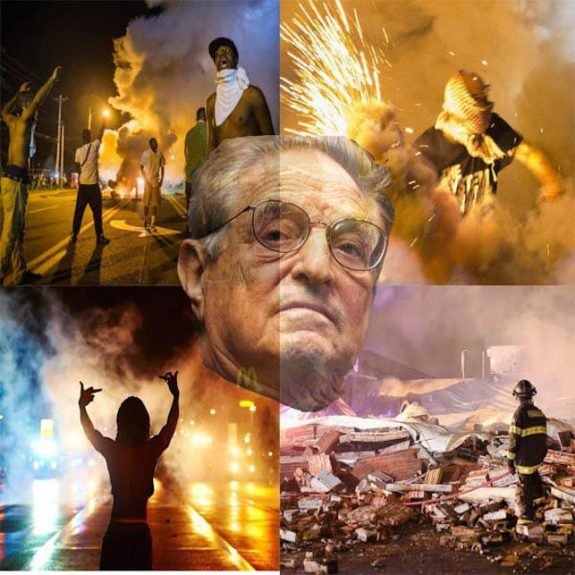
The far-Right portrays Soros as behind the organic struggles of poor, especially black people, as a way to demonize and downplay them. This plays into the myth that a Jewish cabal controls the world and moreover, that black people are unable to organize themselves without “puppet masters.”

For instance, during the fall of 2014, the far-Right again used the myth of Soros to claim that he was behind the Ferguson riots, and paid people tens of millions of protesters to “riot” in the wake of police murder of Mike Brown, Jr. Later, as black insurgency spread to Baltimore, the far-Right again pushed the line that Soros was bank-rolling the Black Lives Matter movement, which many on the Right simply equated part and parcel with the self-organized uprisings that were organically coming from the black community itselves. As the Movement for Black Lives (in many ways the “official” Black Lives Matter organization) tried to reign in the expanding movement that was becoming more and more militant, it also became awash in grants from the Ford Foundation as Soros’ Open Society Foundation. Not surprisingly, some of the leaders of the official organizations of Black Lives Matter, and its push for policy reforms, Campaign Zero, and ended up endorsing Clinton.

For those on the far-Right, this is evidence that the entire movement was itself funded by Soros, and that the rebellions, protests, mass organizing, and uprisings were all his doing. But what this really shows is that wealthy liberals and powerful non-profits were trying to bring popular and self-organized movements back into politics; to smother them of any revolutionary potential. For instance, in a recent article on Left Voice by Julia Wallace and Juan Ferre argues that this relationship between wealthy donors (like Soros) and non-profits actually moved revolt out of the streets and back into more ‘acceptable forms’:

We may ask ourselves, how did a platform of a movement that swept the streets throughout the US become a set of policy briefs meant to lobby Congress? The undersigned names and organizational affiliations give us a hint: most belong to the world of nonprofits, many are sponsored by the Ford Foundation, George Soros, the Black-Led Movement Fund, and other capitalist funders.

Wealthy philanthropists like George Soros are not friends of popular struggles, foolishly bankrolling their own demise. Organizations like the Ford Foundation are not interested in “liberation,” but rather, appeasement and co-optation. There is a long history of US capitalists intervening in social movements (ie., the Civil Rights movement) with the effect of steering them away from militancy and towards compromise. Philanthropy is a strategy of the rich, who may give up some wealth to fund progressive projects in order to quell social unrest, maintain their position of power, and maintain the capitalist order.

Many organizations that form part of the M4BL have taken donations from corporations, including a $500,000 grant from Google (Ella Baker Foundation). There is plenty of lip service to opposing capitalism, but how much challenge is really being made when the same organizations are accepting money from millionaire capitalists and billion-dollar corporations?

The ever-burgeoning nonprofit industry has a key role to play in contemporary US society. It contains the outrage of the disenfranchised, the most exploited and oppressed. It diverts the thrust of militant activism from disruption to civic procedures. The money and logistics funneled into these movements have a determining influence. In exchange for precious resources, they shape the demands and methods of the organizations they fund to fit the likes of the funders. As progressive as it may seem, the generous influx of money into these movements causes terrible harm. A significant layer of activists becomes “professionalized,” embraces the modus operandi in these settings and reproduces a strategic framework and discourse that leads nowhere.

The far-Right portrays Soros as behind popular revolt because it wants to paint grassroots organizing and resistance as illegitimate.

In short, Soros along with a host of other wealthy and powerful liberals were part of a push to pacify and contain Black Lives Matter and bring it back into the Democratic Party, but had nothing to do with “funding riots,” as the far-Right likes to imagine. The elites that attempt to control social movements with money want them to be political not disruptive.

But these are also myths that aren’t going away anytime soon. Recently, far-Right social media accounts proclaimed that Soros would “use black hate groups to bring down America.” Not surprisingly, these quotes were quickly shown to be completely made up and false. Most recently, the far-Right claimed that Soros owned various electronic voting machines in a variety of states, and thus was possibly rigging the election, while these myths were quickly exposed as simply “fake news.”

Why the Right Needs These Myths

At the end of the day, the myth of Soros and the globalists is helpful to the far-Right because quite simply it explains why people revolt; for the Right, it’s simple: they are paid to and on their own, are too dumb or incapable of organizing anything. This myth goes back to the anti-Semitic and racist views of old, and the anti-communist lines held by the John Birch Society that a select group of puppet masters are playing the good workers and poor in an elaborate scheme for world domination.

But most importantly, the Right has a direct and real need to explain why revolt comes out of human communities because by attacking and discrediting it, it makes itself appear to be revolutionary and at the forefront of a worldwide struggle against “globalism” and overall, justifies themselves taking State power (or supporting it). This combination of dismissal of the capacity of human beings to run their own affairs and struggles, especially the poor and the colonized, while at the same time valorizing one’s own need to rule over those people, runs throughout both the authoritarian Left and the Right, and should recognized as the filth that it is and attacked.

In fighting the far-Right we can’t simply dismiss these ideas, we need to confront them head on.

Trump, Brexit, Syria… and conservative leftism

By DAPHNE LAWLESS

poorpenny

Penny Bright, perennial Auckland mayoral candidate and conservative leftist, proudly promotes the Assad regime and Russian-backed conspiracy theories on the streets of Auckland. Photograph by Daphne Lawless.

In the 10 months since I introduced the concept of “Conservative Leftism” to the NZ Left, only one argument has been raised against it that seemed to take the idea seriously and be worthy of taking seriously in return. This argument – which has been raised by more than one sincere socialist, at greatest length by Ben Peterson at leftwin.org – is that Conservative Leftism is an “amalgam” which doesn’t really exist, that there is no necessary connection between the conservative strands of thought I identified in the contemporary activist movement.

Ben argued:

While “Conservative leftism” is a thought provoking concept, it doesn’t measure up in reality as a coherent ideological perspective.

“Against Conservative Leftism” lists a range of examples of political positions that derive from its ideological perspective. These including but are not limited to opposition to local council amalgamations, opposition to intensive housing developments, legal crank such as ‘freemen’ theories, backing the Assad dictatorship, anti-Semitism, homeownership and opposition to the NZ flag referendum.

This just doesn’t fit together. It doesn’t make sense to suggest that a person who opposes intensive housing developments is more likely to be an anti-Semite or conspiracy theorist. It doesn’t make sense to put leftist homeowners, and the not very often homeowning ‘freemen’ into the same ideological tendency just doesn’t make sense.

One way of responding to Ben’s argument using Marxist jargon would be to say: “there is a contradiction, but the contradiction is in reality.” I strongly believe that the evidence has in fact become clearer over the course of 2016, that the strands of reactionary opinion among self-identified “Leftists” that I have identified do, in actual reality, go together as a set of propositions which support each other, if not necessarily logically “coherent”.

For the record, I identified three conservative reactions on the self-identified “Left” to neoliberal globalisation:

  • opposition to globalisation in and of itself (nationalism, xenophobia, obsession with “sovereignty”, one-sided opposition to Western imperialism in particular aka campism);
  • opposition to the social changes which have happened in the neoliberal/globalised era (opposition to cosmopolitan urbanisation, anti-immigration, idealisation of “traditional” rural/small-town/working class life, scepticism of newer identities around gender/race which are smeared as “identity politics”);
  • one-sidedly deep scepticism of neoliberal media/academic narratives, reflected in an embrace of conspiracy theory, traditional “common sense” and health quackery.

We might use the following shorthands:

  1. CONSERVATIVE ANTI-IMPERIALISM;
  2. CONSERVATIVE POPULISM;
  3. ANTI-RATIONALISM (or perhaps “intellectual populism”).

The original article – and Ben’s response – was written before what a radical internationalist Left viewpoint would see as the massive catastrophes for people and planet of 2016: the Trump victory; the victory of British exit from the European Union (Brexit) which has led to an explosion of racist violence; the growing strides of neo-fascist movements across the world, from the French Front National to the online lynch-mobs known as the “alt-right”; and the ongoing genocidal destruction of Syria by its own government backed up by Russian imperialism.

It is my contention that this series of disasters has vindicated the Conservative Left idea, in that New Zealand leftists who were expressing Conservative Left ideas at the beginning of the year have either welcomed these developments, or at least seen them as potentially positive developments. To give a few examples from the New Zealand Left in particular:

  • Mike Lee, the Auckland Council member on whom I focussed in my article on the Auckland local body elections as the chief local promoter of conservative-left ideas, issued a Facebook message after the election which expressed thankfulness for the Trump victory, seemingly based on the idea (assiduously promoted by both Trumpist and Russian sources) that Hillary Clinton would start World War 3.
  • Prominent veteran NZ leftist writer Chris Trotter – who was, indeed, one of our major models when we elaborated the idea – announced that “I proudly count myself” as a conservative leftist. Most of this post either ignored the substance of my article, or was an apologia for the Russian-backed Syrian regime destruction of Aleppo, which can be quickly debunked by a quick flick through the resources on any Syrian Solidarity website or Facebook page.
  • Daily Blog proprietor “Bomber” Bradbury, who previously promoted Mike Lee’s anti-intensification and anti-youth politics, has now come out with an explicit anti-immigration screed. He even characterizes pro-immigration policy as an “elite cosmopolitan” viewpoint – a snarl-phrase which could be taken directly from a Stalinist or fascist rant.
  • Bradbury’s co-thinker on Auckland local body politics, perennial mayoral candidate Penny Bright, has been counter-protesting Syrian solidarity demonstrations supporting the Assad regime’s “sovereignty” (see image), and is reported to be sharing links on social media from David Icke, doyen of “Lizard People” conspiracy theory.

From where I sit, this is convincing data. In general, the sections of the New Zealand left whom I had in mind as either “conservative leftist” or heavily influenced by that ideology have been unanimous in – even if not outright supporting Assad/Putin, Trump and Brexit – arguing that these phenomena are not in fact that bad, that they can be seen as expressions of resistance to imperialism and neo-liberalism. This insight has been reproduced by British radical academic Priyamvada Gopal, who said recently on Facebook:

This cleavage in left circles that has arisen over the last six months is a pretty neat and sharp one, with only a few zigzags and crossovers and that generally only around Brexit. How do we read it? On one side:

  • Anti-Assad/Anti Putin/Anti-Massacres
  • Anti-Trump
  • Anti-Brexit

On the other side:

  • Assad Apologetics/Anti-Western Imperialism Only
  • Trump is No Worse than Hillary
  • Lexit

Priyamada’s schema snugly fits two out of the three points of my schema. The Assadist “Left” are clearly conservative anti-imperialists, taking the “campist” position that the main leaders of opposition to neoliberal globalisation are the leaderships of various states, who range from authoritarian to totalitarian in their internal regimes – thus excluding any role for mass action in changing the world, and indeed smearing the Arab Spring uprisings as CIA-sponsored attempted coups. Meanwhile, conservative-left reactions to the Trump debacle have ranged from welcoming it as a blow to neoliberal globalisation (ludicrous, given the identity of the various plutocrats whom Trump is naming to his cabinet), to the less wild-eyed interpretation that a “revolt of the white working class” defeated Hillary Clinton. This latter interpretation conveniently lends itself to calls for a more “traditional” left politics targeting “ordinary” (read: white, male) workers, and throwing not only the feminist movement but oppressed queer, ethnic and religious minority workers under the bus.

Meanwhile, the “Left Brexit” (Lexit) phenomenon showed a combination of both these tendencies. On one hand, it “whitewashed” (we can use the term in full irony) the Brexit movement led by reactionary tabloids and the Trump-like UKIP, seeing it as a working-class revolt rather than a reactionary populist uprising. On the other, it one-sidedly attacked the EU’s neoliberal institutions, trying to put a “left” face on British nationalist isolationism, and ignoring the fact that freedom of movement for workers between EU countries is a vital progressive gain for migrant workers. The consequences of this position were that Lexiters had to argue away the rise in racist abuse and violence after the referendum, either as “exaggerated”, something that was happening anyway, or even outright fabricated by the mainstream media[1]. This rhetorical move was a precursor to the breath-taking denials of reality we have become used to from supporters of the Putin/Assad axis in Syria.

The Morning Star, the daily newspaper traditionally associated with the Communist Party of Britain, has shamefully led the conservative-leftist charge on both these issues, both cheerleading the ongoing massacre in Aleppo as “liberation” and opposing freedom of movement for workers. Some have taken this to mean that conservative leftism is really a reappearance of Stalinism – and certainly there are similarities to the old Western Communist backing of Russian tanks and Eastern Bloc nationalism. However, it is also vital to note that the leadership of the British Stop the War Coalition – who have shamefully refused to promote the cause of Free Syria – are dominated by people who came from the anti-Stalinist revolutionary tradition, mainly former leaders of the British Socialist Workers Party. If the problem was originally a Stalinist one, then the rot has spread.

Where then is the “third leg” of the tripod, anti-rationalism/intellectual populism? Whether someone on the conservative left believes in traditional conspiracy theories, health quackery or other kinds of crank thought or not, the common move in both conservative anti-imperialism and conservative populism is to reflexively reject “mainstream”, “elite” or “establishment” viewpoints, and yet be willing to believe any alternative promoted as “alternative”. This might – for example – lead from an accurate perception that capitalist banking helps increase the gap between rich and poor and makes capitalist crisis more intense, to an advocacy of a fantasy alternative based on a misunderstanding of the real problem such as Social Credit or Positive Money.

In particular, the use of the terms “elite” and “establishment” is a sign of intellectual surrender to Right-wing populism (see Bradbury, above). These are totally empty signifiers which the listener can apply to whichever bogey-group they think are really running things. While a sincere leftist might envision the capitalist oligarchy as “the elites”, a Right-populist will think of liberal academics or gay/female/ethnic minority professionals whom they blame for “keeping them down”; others will think of the “cultural Marxists”, the Elders of Zion, the Illuminati, or hostile UFOs.

Recent analyses have suggested that the intelligence services of the Russian Federation under Vladimir Putin are engaged in actively promoting this kind of “radical scepticism”. They argue that Russian propaganda does not aim to promote its own narrative, but simply to undermine the consensus narratives of Western-aligned media and academia. By a staggering coincidence, this is also how conspiracy theories such as “9/11 Truth” also work – not by attempting to prove their own point of view, but by picking at threads in the “establishment” narrative, so as to imply that their own is equally valid. This strategy has also been used in the attempt by Christian fundamentalists to get anti-evolution pseudo-science taught in public schools.

Being prepared to dismiss out of hand any report appearing on the BBC website, yet unquestioningly forwarding videos from the RT website, is essentially little different from the health crank’s high-powered scepticism of “Big Pharma”, combined with a willingness to believe anything presented by alternative-medicine profiteers (what rationalists sometimes call “Big Placebo”). The argument here is not a conspiracy theory that conservative leftism is some kind of Russian plot. The argument is merely that Russian intelligence has deftly exploited the growth of populist anti-elitism in Western countries to promote themselves as the good guys -in the same way that traditional Nazis have exploited the meme culture of 4chan and similar online forums to produce the “alt-right”.

It seems clearer as time goes on that these three strands of conservative anti-imperialism, conservative populism and anti-rationalism/intellectual populism go together, that holding one of these viewpoints is a very good predictor of holding the others. There is thus a clear cleavage between the Conservative Left which rejects globalisation per se and refuses to engage with the new social forces thrown up by it; and the radical international Left which wants ANOTHER kind of globalisation, a workers’ and oppressed people’s globalisation. The latter sees the new proletarian forces and oppressed communities thrown up by existing globalisation as the vanguard agents of change, just as Karl Marx saw the industrial workers as the gravediggers of capitalism, rather than wanting to send them back to the farms. I only wish I had a better word for this necessary alternative tendency than “radical internationalist Left”. Suggestions are welcomed.

[1] Personal experience from Facebook discussions.

Nuit Debout: polishing precious stones…

by Denis Godard, translated by Daphne Lawless for Fightback.. Originally published at  Contretemps (http://www.contretemps.eu)

Nuit Debout: polishing precious stones….

nuit-debout-place-de-la-republique-paris_5575027

The movement occupying public squares in France is two weeks old today. Its evolution is difficult to foresee, as it is influenced by many unpredictable factors, even though it has deep roots. There is also no indication, at the time of writing, if the symbolic occupation of the Place de la Republique in Paris will really be able to endure, nor in what form.

It is a characteristic of movements challenging the dominant order that they do not follow a linear trajectory. On one hand, because their very advances lead to new stakes, new objectives, new questions. So after 15 days of occupation, the movement faces questions of strategy on its relationship to repression, its relationships with movements of struggle, its need for expansion, etc. On the other hand, because after the element of surprise wears off, the dominant order reorganizes. Thus, the powers that be are openly seeking to retake possession of Place de la Republique.  All the major parties, from the [centre-left] Socialists to the [fascist] National Front, are now demanding its evacuation by the police. But this unpredictability is also due to deeper reasons involving the crisis of power, as well as the nature of the movement of which Nuit Debout is one of the forms of expression, and which is developing largely outside traditional frameworks.

1-  A movement which came from nowhere

Nuit Debout is the result of several dynamics: general anger, the more or less underground development of different struggles, the emergence of a general struggle against an anti-social law (the El Khomri law, named after the Minister of Labour, also called the “labour law”) and the decision to occupy Place de la Republique on the evening of 31 March, taken outside traditional channels.

Understanding this does not require the work of a movement archivist. It allows us to anticipate the depth and the capacity for reaction of the movement and indicates trajectories for its future.

General anger against the system and the powers-that-be has been expressed for months in different ways: disaffection with the government, but also disaffection with all the major parties. This anger is not necessarily progressive, when it is expressed by voting for the far right. But it is not unambiguous. It is also expressed by the popularity of Air France workers manhandling their director of human resources (tearing his shirt off) last autumn, or the success of a petition supporting Goodyear unionists sentenced to prison.

And over the past year local and isolated struggles have multiplied in the workplaces, a sign of a return of combativeness after years of decline following the failure of the last big social movement in September 2010. These experiences have helped progressively rebuild combativeness, confidence and the need for a global movement.

Subsequently, the last few months have been marked by specific struggles: a movement of solidarity with migrants, and by occupations resisting major projects of the powers-that-be, notably the airport project at Notre-Dame-des-Landes. It should be noted that, during the weeks before the beginning of the movement against the labour law, two significant demonstrations took place. One, at Calais for open borders, resonated nationally without being massive. The other, at Notre-Dame-des-Landes, united tens of thousands of demonstrators in support, significantly, of the occupation of land by farmers and activists. We must add to this, after the paralysis caused by the terrorist attacks of 13 November, the beginning of a fightback against oppressive policing measures taken by the government.

It is in this context that the government decided to attack workers even harder, with a law dismantling the labour code even further.

2-  A response launched outside traditional channels

The response to this law was launched outside traditional channels, while the trade union leaderships were preparing, once more, to retreat. At the start of this response, a petition demanding the complete withdrawal of the law was launched on social media, obtaining more than a million signatures. Youth organisations then called, on the same basis (the withdrawal of the law), for 9 March to be a day of general mobilization. The welcoming reaction to this response forced the unions to join in, and to call for a national day of strike action and demonstrations on Thursday 31 March. But it was among youth, in the high schools and universities, that the movement found its motor, with regular days of demonstrations and blockades.

On 23 February in Paris, a meeting of convergence of struggles was held around an independent journal associated with the radical left (“Fakir”), economists (notably Frederic Lordon) and casual entertainment workers. In the same period a film called “Merci Patron” (Thanks, Boss!), supported by the same forces, was showing in numerous places, with debates organised after screenings, to sold-out audiences. The meeting at Paris packed a room at the Labour Exchange (the trade union building in the centre of Paris, near Place de la Republique), which even had to close its doors to overflowing crowds! After this success, its initiators called for a meeting of those who wanted to move on to practical action. While about 50 people were expected, more than 200 attended. At this meeting, the idea was launched that on 31 March, after the demonstration, “we won’t go home”! Progressively, the idea spread of occupying a public place at the end of the demonstration. This would become Nuit Debout and the occupation of Place de la Republique.

3-    Nuit Debout is underway!

More than a million people demonstrated on 31 March all over France. Despite the rain, hundreds of demonstrators came to Place de la Republique. An association for the defence of the homeless, Right To Housing, joined the call-out and decided to remain in the square for several days with their tent, at least until the demonstration which they were organising for the following Saturday. And the ball started rolling after Thursday, with more and more people every day. Assemblies were held with thousands of people on Saturday and Sunday. Committees were put in place, debates with freedom of participation. Place de la Republique made the headlines.

On Sunday, the initiators decided to only call for mass occupation of the square on the following Tuesday and Saturday, which were the days for demonstrations. It was in fact difficult to hold on at nights, with only a few dozen hard-core after the closedown of public transport between 1 and 2 am. They felt that it would be even more difficult during the week when people went to work.

But after Monday afternoon, hundreds of people met again in the square and more than a thousand held an assembly that same evening. A demonstration planned for the square in the afternoon even shared the square with a conference which Prime Minister Manuel Valls was holding right next door. Delegations arrived at the demonstration: refugees, casual and precarious workers… The square was held. On Tuesday, after the demonstration, thousands participated in the popular assembly. This was now the case every evening.

And right from that first week, a qualitative leap was made which grew even larger in the second. Multiple committees were organised on themes and areas of activity (for drafting a manifesto, to take care of logistics, to “organise” democracy, to carry out activities, a medical centre, a kitchen, etc.)

To these were progressively added radio, television, a garden (!). Every morning, the police evacuated the square. Every afternoon, with amazing ingenuity, a village of tents, tarpaulins, and wooden pallets was reborn, and thousands of people participated for hours in a popular assembly. Thematic meetings were held in parallel, stalls for associations, publishing houses and alternative bookstores. The hearing-impaired held assemblies in sign language, popular universities took place in the open air, activities for children, poster workshops, legal training, etc.

But above all, in this square, the movement began to avoid one of the possible stumbling blocks: disconnection from the struggle against the labour law. It established links with the movement which had served as its fuel. Contacts were established with places of struggle, university and high-school students of course, but also railway workers, posties, etc. Delegations were organised from the square to workplaces to organise for the demonstration planned for 9 April against the labour law. Added to this were multiple actions organised in the framework of convergence of struggles which left the square, supporting casual entertainment workers, in solidarity with refugees, to “repaint” the storefront of banks or occupy branches of [the major bank] Société Générale, supporting the homeless, etc.

The cherry on the cake: a practice evolved of wildcat demonstrations every evening, especially at night, to go to police stations to retrieve arrested demonstrators, after an action to dismantle the fences preventing refugees from camping in certain areas or, more simply, to go for “a nightcap with Valls”. While the powers-that-be wanted to close off the space for any protest with the proclamation of a state of emergency, the movement reoccupied the space and joyously made it their own.

And the movement spread with the organisation of Nuit Debout and attempts to occupy squares in many other towns, notably after the 9 April demonstration. On various levels, about 60 towns are involved.

4-  Relations with the police

These successes, as well as the repression which the movement attracted (and also sometimes fatigue), now led Nuit Debout to several immediate questions on its future, which were also strategic questions: that of expansion, of its relationship with the movement and of its relationship with the police as well as violence.

The powers-that-be attempted in various ways to put an end to the occupations of squares, and especially that of Place de la Republique, which played a symbolic role. Media attacks began to multiply on the theme: “place of disorder and organisation of violence”. The police attempted progressively, more every day, to retake control over the square. Demonstrations, especially those of youth and wildcat demonstrations, were more and more violently attacked by the police. Two responses arose within the movement.

The first response, which must be challenged on a principled basis, called for the end of violence and proposed, in different forms, making an appeal to the police to join us. This response risks disarming the movement in the face of repression. It must not be forgotten that at the last (regional) elections, the National Front got more than 50% of the vote among the police and army, rising to 70% among cops in active service. The police and the army are at the heart of power, and their direct violence is the practical expression of the violence of ruling class domination. Without a strategy of confronting the police, the movement will have to abandon its gains and, above all, the squares it has occupied. Moreover, promoting the idea that there could be a possible alliance with the police would become an obstacle to the necessary expansion of the movement to working-class neighbourhoods, to migrants, refugees and the undocumented, to radical unionists, all those directly and very concretely affected by police violence.

The second response is that of direct confrontation with the police. This, coming from various sectors, often called “autonomous”, advocates systematic and violent confrontation with the police and even aims to provoke it. Proof of general radicalisation, especially among youth, this attracts more and more young people at the very heart of the demonstrations and draws increasingly wide support, even if passive more often than not. This strategy aims directly at the heart of the State and tends to deny all those mediations by which a majority of society might be drawn into a general confrontation with the ruling class and its State. To organise a direct and systematic confrontation with the police, in all places, could lead not only to marginalising a minority, rendering it easier to suppress, and intimidating the rest of the movement.

But – and this is characteristic of the movement – the dominant ideas and strategies are extremely fluid. An anecdote may illustrate this. This Monday, while the popular assembly was debating these kinds of questions in particular, the riot police tried to prevent a pick-up truck for logistics entering the square. Quickly, several hundreds gathered to push back the cops, who had to retreat from the square under the pressure of numbers and determination. Among those who yelled “Everyone hates the police” and pushed back the cops, some had been complaining a few hours before, saying “the police should be with us”!

5-  The question of expansion

The second question immediately raised is not unrelated to the first. Weakening the capacity for direct repression of the movement requires its extension and dissemination, geographically as well as “socially’ and politically.

Geographical extension through multiplication of Nuit Debout locations. Nuit Debout events have been launched in different cities. As opposed to Place de la Republique, the initiative seems to come much more in this case from organised activists, in particular members of the (more or less) radical left in the broader sense. The future of these initiatives will depend on the capacity of these militants to let themselves be bypassed and to not “channel” the expression of anger.

Social extension, by the development of Nuit Debout in working-class layers and neighbourhoods, which will occur as much through the themes and demands raised than through places of development. This concern is present at Place de la Republique in Paris, in particular, and is very positive. But this will only happen through breaking with every form of paternalism. The working-class neighbourhoods are not “missionary zones” for militants, places without politics. The connection with Nuit Debout can only be made through the motivating force of the inhabitants of these neighbourhoods themselves, and existing networks in these areas. This question is raised in similar terms regarding solidarity with the undocumented and refugees.

Political extension, finally, by the refusal of any “institutionalisation” of Nuit Debout and its objectives. The idea of drawing up a new “Constitution”, raised originally by Frederic Lordon, was rapidly taken up in the assemblies. The seductive aspect of this initiative is the radicalism underpinning it. There would be nothing more to draw from existing institutional frameworks; it would be a matter of refounding real democratic legitimacy “from below”. But there are great risks of a new kind of formalism, forgetting that the rules of a new world cannot be written by a minority, but will be based on the insurrection of a majority. Thus the necessity of political extension to the questions raised in the neighbourhoods, of antiracism, internationalism, struggles against sexism, homophobia and transphobia, etc. Thus the necessity of questions around the role of work, a vector of alienation but also potentially a collective place of struggle and social power.

6-  Relationship with the movement

The dynamic of Nuit Debout is strictly dependent on the movement of struggle and very directly on the struggle against the labour law. This was its first fuel, and an essential fuel. Outside the dynamic of setting in motion, of enlargement, of collective experience and radicalisation, the Nuit Debout phenomenon risks turning in on itself, of losing itself in abstract debates and in minority dead-ends, and/or of falling back, through lack of strength and experience, onto forms of institutionalisation. The risk is there. More than ever, the future of Nuit Debout lies in its capacity to link itself with the struggle against the labour law, to contribute to building a general strike.

Some already spoke of exhaustion and predicted defeat after the demonstrations of 9 April were between two and five times smaller than those of 31 March, even during the high-school and university holidays. But these analyses suffered themselves from the absence of dialectic between the movement of struggle and Nuit Debout. It is significant that it was in Paris, where Nuit Debout is most firmly rooted, that the demonstration against the labour law of 9 April was not significantly weaker than that of 31 March.

On one hand, because Nuit Debout is beginning to potentially represent an alternative “leadership” to the trade union leaderships which retreated, faced with a movement beginning to escape their control and of total confrontation with the government. After 9 April, the trade union leaderships called for a mobilisation… on 28 April. The leadership of railway workers belonging to the CGT [union federation], considered “leftist” (in comparison to the CGT leadership), is now betraying the movement by opposing to it a different “partnership” agenda. The student union UNEF, previously at the forefront, now calls only for intermediary days of mobilisation and congratulates itself on the progress obtained from the government.

On the other hand, because the movement against the labour law is crystallising a much more widespread anger than simply resistance to attacks on labour rights, and any wish to limit this movement to the sole objective of the withdrawal of the law and to channel it will cripple its potential and combativeness. If Nuit Debout depends on the movement of struggle against the El Khomri law, the movement depends on the expression of a global revolt which Nuit Debout is crystallising.

The movement began outside the usual channels. Nuit Debout has substantially extended the possible scope of “outside-channels” activity. If it can link itself more with the more combative forces in the unions, to high-school and university students, it will be able to contribute to a new step beyond the struggle against the labour law, to a strike which would then become a political strike.

7-  The future is not written

While the movement advances and raises these questions, the dominant trajectories of power continue to operate in the direction of reinforcing the police state, in the direction of racism and nationalism, in the direction of social attacks. The monsters are not figments of our imagination, they are really there. One of their forms is the far right. This is also why the trajectory of the movement places it necessarily in radical confrontation with the politics of the ruling class and with the State.

Once more, this confrontation will not progress in a linear manner. The movement will no doubt experience partial defeats and apparent setbacks. Without doubt it will change form more than once. It will sometimes be necessary to know how to change direction in massive and spontaneous flows, to cease beating its head against a wall so as to learn how to demolish or jump over the wall. Sometimes it will depend on initiatives taken by a minority, but which will give a lead to greater numbers.

What is certain is that after years of apparent apathy and advance of all the reactionary tendencies in French society, something has changed which renews hope. The precious stones buried under the hardened lava of previous movements have been brought to the surface by fresh-flowing lava, shining even more brightly.

The times which are coming will be no less hard. But now we are not condemned to take them lying down.

Our contents are placed under Creative Commons licence (CC BY-NC-ND 3.0 FR). Any publication may be freely reproduced and shared for non-commercial ends, on condition that it is not modified and the original author(s) and URL are not modified

date: 16/04/2016 – 13:45

Denis Godard 

URL source: http://www.contretemps.eu/interventions/nuit-debout-faire-briller-pierres-pr%C3%A9cieuses


France: Anti-multiculturalist academic chased away from Nuit Debout


Original article by Dounia Hadni here: http://www.liberation.fr/france/2016/04/17/nuit-debout-alain-finkielkraut-chasse-de-la-place-de-la-republique_1446766. Translated by Daphne Lawless for Fightback. For background information on the “Nuit Debout” movement, a movement currently occupying public squares throughout France and elsewhere in Europe, see https://en.wikipedia.org/wiki/Nuit_debout. For background information on Alain Finkielkraut, an anti-multiculturalist and Zionist writer, see https://en.wikipedia.org/wiki/Alain_Finkielkraut.

Nuit Debout: Alain Finkielkraut chased away from Place de la Republique


868980-finkelkrautYouTube screen capture of Alain Finkielkraut.

The philosopher was booed at the gathering of protestors on Saturday evening. Videos of his altercation with the participants have been circulating since then on social media. The right and the far right have used this incident to condemn Nuit Debout.

Several dozen “Nuit-Deboutists” on Saturday were clearly not happy to see Alain Finkielkraut, the controversial philosopher, at Place de la Republique [a public square in central Paris] which they have occupied. And they let him know with violence.

In a video posed on social media, cries of “piss off”, “fascist” and insults rain down. Spitting can also be heard. The philosopher, accompanied by his wife, decided to leave very quickly, not without losing his cool. You can hear him shout “bullshit”, “fascists” and “blah blah blah, dumb bitch” at a young woman who insulted him. A person speaking to him asks him to “not make it worse”, to which he replies: “If they insult me, I can respond. I am a human being.”

Some minutes after leaving the square, the philosopher posted to the conspiracy-theory site  “Circle of Volunteers” explaining that he went “to listen” to the demands of the Nuit Debout movement. “I was expelled from a place where democracy and pluralism were supposed to rule, so this democracy is a fraud, this pluralism is a lie. Though I only went to listen, I didn’t go to intervene or to promote my ideas, they wanted to purify Place de la Republique of my presence, and so I submitted to this purification, with my wife,” he added. And his wife added: “It must be said that if there had been no security, you would have been lynched.”

However, according to witness accounts received by Europe 1 radio this Sunday, Alain Finkielkraut was accompanied at the Popular Assembly, before being expelled, at a short distance away in the square near the statue by “a group of ‘aggressive’ persons”. This incident would therefore not have occurred as soon as he arrived, as claimed by a journalist from “Circle of Volunteers”. It should be noted that a few people made an effort to calm the crowd, by surrounding the undesirable intellectual until he left the square.

On the night of Saturday and Sunday, #Finkielkraut reached the top of Trending Topics France, pitting his supporters against his critics.

That same night, the Young Communists congratulated themselves on Twitter for having “thrown out” Alain Finkelkraut. On Sunday, the journalist and essayist Caroline Fourest denounced these “actions of bastards”:
cgphlbuxeaae_wc

You can disagree with Alain Finkielkraut, and I do very often, on many issues, but to chase him telling him to “get lost”, insulting him and physically intimidating him, just because he came to Place de la République to hear for himself, these are the actions of bastards.

These collective lynchings are already common enough on the web for us to not want to see them starting on the streets, in our public squares. Not at the Place de la Republique which belongs to all of us, where have our candles of mourning, and which must not be privatised by a few sectarians… Especially not if we want to create a better world.

[Translator’s note: Caroline Fourest is known as a neoconservative and Islamophobic journalist and was formerly associated with the Charlie Hebdo magazine.]

Voices from the right and the far right have taken advantage of the incident to try to discredit the Nuit Debout movement, such as Eric Ciotti: “Hate and intolerance, participants in Nuit Debout show their true face by insulting and expelling Finkielkraut from the Place de la Republique”

Or even Mario Maréchal-Le Pen [niece of National Front leader Marine Le Pen]: “When Nuit Debout chases away Finkielkraut, it shows its true face”.

The president of the “pro-sovereignty” party France Arise, Nicolas Dupont-Aignan, also rushed to the rescue of the academic: “Total support to Finkielkraut. Intelligence faced with stupidity!”

Write for the Fightback Youth Issue: Redefining Activism

The upcoming issue of Fightback magazine will be giving a platform for young voices to talk about what activism means for us.

The issue will explore narratives of survival and resistance under capitalism, colonialism, patriarchy, and homophobia/transphobia/biphobia/interphobia.

It asks the questions: what do we see as “real” or “legitimate” activism and why?

How do we challenge negative narratives around youth activism?

Why are older activists so cynical about youth activism and the future of activism in Aotearoa?

At the core of this issue is searching for a redefinition of activism. To do this we are looking at narratives of survival and resistance by youth under capitalism,

colonialism, patriarchy, and homophobia/transphobia/biphobia/interphobia. We want to challenge the idea that youth are disaffected and show the ways in which youth are transforming activism in Aotearoa.

If you’re a young person under the age of 25, who is keen to share their ideas on what survival, resistance, and activism means to you, send us a pitch of what you’d like to write about.

We need 2-3 sentences describing your idea – whether it’s a poem, article, interview or artwork. Please send this pitch in before the 22nd of April, 2016. We’ll let you know soon after that whether your pitch has been selected for the Fightback Youth Issue. You’ll then have three weeks to work on your contribution and send it to us to be published. Each contributor will receive a small koha for your time and work.

You don’t need to have experience with political writing or publishing to submit. If you would like some extra support in getting your idea off the ground, let us know and we can help out.

We are also looking for a cover designer, so if you’re the creative type – flick us a line.

Contact: fightback.aotearoa@gmail.com by 22nd of April, 2016.