GERMANY: Blockupy – resistance in the heart of the European crisis regime

From 20 to 23 November, leftists from all tendencies assembled in Frankfurt (Germany) for a festival of discussion, workshops and action against capitalism and the Troika.

By Joe Nathan

About 3000 activists with banners and signs are gathering next to the Christmas market at St. Paul’s church in Frankfurt, Germany. A few of them came from as far as Spain, Italy and Greece. It is 22nd November, almost winter, but still quite warm. After a few speeches, the demonstration sets off for the new building of the European Central Bank (ECB) – the organisation partly responsible for the austerity policies imposed on Greece and other European countries affected by the debt crisis.

The slogan under which the activists assemble is “Blockupy”, the name of an alliance formed in 2012 to take the crisis protests into the heart of the European regime – to Germany and, particularly, Frankfurt. In this alliance, different tendencies of the left came together, including: radical leftist groups such as Interventionistische Linke (“interventionist left”, IL); the anti-authoritarian communist alliance “Ums Ganze!” (“everything is at stake”); parties, youth and student organizations, unemployed movements, unions, Attac (a network which supports a financial transactions tax) and the Occupy movement.

This was quite a new thing for the left in Germany, where the Left has been mired in separatism and dogmatism for years. However, the need was clear for a broad left movement against the ruling class’s authoritarian and neoliberal responses to the Euro crisis. Many activists were inspired by the mass movements of the Arab Spring and in Spain, the Occupy movement, and of course the struggle against austerity in Greece.

Frankfurt was chosen mainly because of the ECB, which forms – together with the EU Commission and the International Monetary Fund (IMF) – the Troika (a Russian word for “trio”). The Troika imposes austerity policies on European countries that are in debt crisis, such as Greece or Ireland, forcing those countries to privatise state-owned companies, sack public sector workers or cut their pay, and dismantle social welfare and health systems, in return for help with paying government debt. This does not help the population at all, but only the banks that lent money to the government.

These austerity policies deepen the economic crisis and cause unemployment, poverty and lower life expectancy. The government of Germany, as the most powerful EU state, has always strongly supported the Troika and promoted austerity – although it partly caused the Southern European crisis itself with its strong focus on exports, weakening other Eurozone countries.
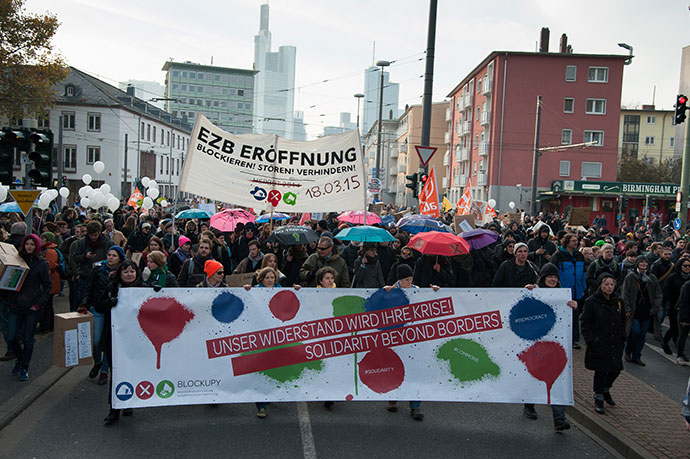
“Our resistance is THEIR crisis!”

The first Blockupy days of action took place from 16 to 19 May 2012, greeted by huge police repression. A few weeks earlier, in another leftist demonstration in Frankfurt organized by “Ums Ganze!” and IL, many bank buildings had their windows smashed.

The strategy of the Blockupy alliance was to occupy public squares in Frankfurt to use them as a camp and venue for workshops, discussions and cultural events. The activists were organised in various “fingers”, representing different political issues connected to the crisis, such as ecology, migrant rights, militarization, social revolution, food sovereignty, and gentrification. This also included “CAREvolution”, a feminist campaign focussing on unpaid care work, often performed by women.

This strategy brought together activists from different backgrounds and made clear that the protest was not only against the ECB and other banks, but against the whole system of capitalism and other forms of oppression such as patriarchy and racism that are connected to it.

The police banned all demonstrations and gatherings, and even searched buses and trains before they reached Frankfurt. Nevertheless, the activists succeeded in occupying Paul’s Square and Römerberg, the square in front of the town hall, and disrupted the operations of the ECB and other banks. On the last day of action there was a huge rally of 30 000 protesters, the only event allowed by the police.

During the action there were a total of 1430 arrests. The media could not ignore this repressive police response towards peaceful protesters and so – even in conservative newspapers – the reports were quite friendly to Blockupy and condemned police brutality.

It was clear for the alliance that Blockupy could not be a single event, but that there was need for continuing resistance. So they organised a second Blockupy from 30 May to 1 July 2013. They slightly changed their tactics, to creating a stable and legal camp outside the city centre for better infrastructure and coordination.

On the morning of 31 May, the activists set out from the camp in various fingers to the building of the ECB and successfully disrupted its operations again by blocking the roads and stopping employees from going to work. Afterwards, the protesters spread around the city for other actions – such as blockading the main shopping streets in solidarity with sweatshop workers in Bangladesh, or protesting inside the airport, from where many refugees are deported.

The police tried to prevent the rally inside the airport by declaring that only 100 people were allowed in the airport, and that these people should be named by the organizers. But after the airport’s train station had been blocked, the police agreed to just count the protesters and then let them in. Refugees took part in the demonstration as well and spoke about their personal experiences. Many of them came from a refugee protest camp in Berlin that was established after a protest march from Bavaria to Berlin. Solidarity came from a Frankfurt citizens’ movement against aircraft noise.

On the following day there was supposed to be a big demonstration through the bank district, like the year before. However, shortly before entering the bank district, the rally was stopped and the anti-capitalist bloc at the front was surrounded by police – allegedly because a protester had thrown a paint bomb. But this happened after the police had already stopped the rally. It was clear that they just didn’t want to let the anti-capitalist activists, many of whom wore black-bloc-style clothing, into the bank district.

They offered to let the more moderate parts of the rally continue the demonstration, but they refused and stood in solidarity with their comrades, who were being beaten up and arrested one after the other. So even though the demonstration could not happen as planned, there was a really good atmosphere of broad left solidarity.

In May 2014 there was no central Blockupy event in Frankfurt, but instead decentralized actions were held all over Europe. The opening ceremony for the new ECB building was expected in autumn, which was set as the date for a central Blockupy action. The programme for this “May of solidarity” brought activists from the radical left through to reformist groups together – building democracy from below against the Troika’s authoritarian rule, defending and taking back common wealth, and struggling together in solidarity. In Germany, there were demonstrations and direct actions on 17 May in Berlin, Hamburg, Stuttgart and Düsseldorf.
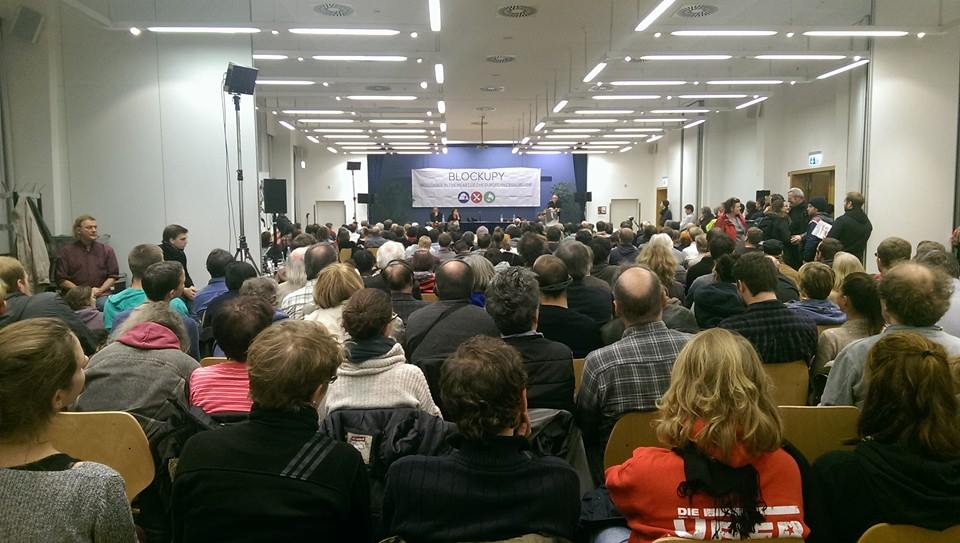
Discussion and action together

The ECB did not hold its opening ceremony in autumn, but postponed it to 2015. So instead of organizing a huge action against the opening ceremony, Blockupy decided to hold a festival with workshops and discussions, but also parties and actions from 20-23 November. During these days, working groups with international participants theorised on issues such as transnational networking, struggles on social infrastructure or the reformation of the extreme right as a weakness of the left.

There were theoretical workshops on crisis theory or the role of animals within capitalism, workshops about strategy such as how trade unions could be better integrated into Blockupy or similar movements, or how social and ecological struggles could be connected. Some workshops were also practical, like working on materials for the rally or learning about different kinds of direct actions.

There were also two panels with international guests. On Thursday, Costas Douzinas from the University of London, Sandro Mezzadra from Euronomade (Italy) and Andrea Ypsilanti from “Institut Solidarische Moderne” (a left think tank) discussed left parties participating in parliaments and governments. Andrea Ypsilanti was received sceptically as she is also a member of the SPD (Social Democrats, the Labour Party equivalent). However, she was quite critical of her own party, though she said she “did not want to lose hope”.

When the first Blockupy action days took place in 2012, protests against the Troika in Southern Europe mainly formed an extra-parliamentary movement. But now in 2014, the movement has also formed political parties such as Podemos in Spain or Syriza in Greece. It is possible that Syriza could form a government of the left after elections this coming January. The panel guests discussed how this could be successful. It became clear that whilst many on the left agree that it is good when left parties take over the government, this is not enough. We also need a strong movement and self-organisation outside of parliament.

On Friday, Ulrike Herrmann, writer and journalist, and Janis Milios from TU Athens, a Syriza member and economist, debated “seven years of crisis in Europe – controversial explanations and perspectives”. On the role of the ECB, Ulrike Herrmann argued that it had done some things quite well under its new president Mario Draghi, like buying government bonds, and therefore should not be targeted by protesters. She added that Blockupy should protest in Berlin, since the German government is the main agent pushing for austerity. Members of the audience, however, argued that the ECB is still part of the Troika, and the moderator suggested that protests could be held in both Frankfurt and Berlin.

When it came to perspectives to end the crisis, the question arose again how a government of the left in Greece, which would repudiate its debt to ECB and thus end austerity, could be successful. When Janis Milios was asked whether a Syriza-led government would be an anti-capitalist project or maybe just another class compromise, he answered honestly “I don’t know”. A member of the audience criticized Syriza stating that its leader, Alexis Tsipras, already said that his government will be a danger to neither the EU nor NATO. Thus, this comrade argued, we shouldn’t put our trust in Syriza but instead argue for real revolution. There were many questions left open at the end of the theoretical part of the Blockupy festival, and maybe they can only be answered in practice.
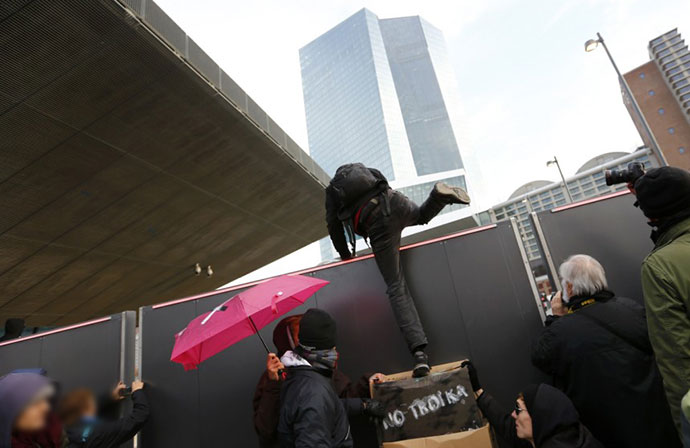
Over the wall at the European Central Bank!

But the Blockupy festival was not only about theory, but also action. So let’s get back to the 3000 activists marching towards the ECB’s new building. It is not in the city centre, where the old one was, where homeless people hung out and where the Occupy Frankfurt camp took place. Instead it is on the outskirts of the city, away from disturbing elements. At least, that’s what they hoped.

When the rally reaches it, it is announced through the speaker that the demonstration is now officially over. This is the signal. The activists throw packing boxes over the building fence, labelled with things that the ECB represents, such as “austerity” or “poverty”. This is Blockupy’s participation in the ECB’s moving process. But that’s not enough. About 100 activists climb the fence – the police try to stop them with pepper spray, but soon give up – and run towards the ECB. They decorate its front with paint bombs in the Blockupy colours of blue, green and red. During the last few days, the ECB has also announced the date for the official opening ceremony: 18 March 2015. Some activists in front of the ECB are holding a banner saying “18 March – We’re coming!”. Before the police can arrest them, the activists climb back over the fence to their comrades.

This action today was just a little taste of a big Blockupy action in March next year against the opening of the ECB. It will be an interesting time. By then, Greece could already have a Syriza-led government. It is not clear if this will be a real progressive project, but in any case it will be important to have a strong international leftist movement, to fight against austerity and neoliberalism and for self-organisation from below, and to defend the left (especially in Greece) against attacks from the right.

More info on Blockupy (also in English) here. Photos courtesy of German Indymedia.

Joe Nathan is an activist based in Germany who has visited Aotearoa/NZ twice and took part in some Fightback events.

Leslie Feinberg 1949-2014: revolutionary communist, transgender warrior

An obituary offered to The Advocate by Minnie Bruce Pratt, Leslie’s spouse.

Leslie Feinberg, who identified as an anti-racist white, working-class, secular Jewish, transgender, lesbian, female, revolutionary communist, died on November 15. She succumbed to complications from multiple tick-borne co-infections, including Lyme disease, babeisiosis, and protomyxzoa rheumatica, after decades of illness.

She died at home in Syracuse, NY, with her partner and spouse of 22 years, Minnie Bruce Pratt, at her side. Her last words were: “Remember me as a revolutionary communist.”

Feinberg was the first theorist to advance a Marxist concept of “transgender liberation,” and her work impacted popular culture, academic research, and political organizing.

Her historical and theoretical writing has been widely anthologized and taught in the U.S. and international academic circles. Her impact on mass culture was primarily through her 1993 first novel, Stone Butch Blues, widely considered in and outside the U.S. as a groundbreaking work about the complexities of gender. Sold by the hundreds of thousands of copies and also passed from hand-to-hand inside prisons, the novel has been translated into Chinese, Dutch, German, Italian, Slovenian, Turkish, and Hebrew (with her earnings from that edition going to ASWAT Palestinian Gay Women).

In a statement at the end of her life, she said she had “never been in search of a common umbrella identity, or even an umbrella term, that brings together people of oppressed sexes, gender expressions, and sexualities” and added that she believed in the right of self-determination of oppressed individuals, communities, groups, and nations.

She preferred to use the pronouns she/zie and her/hir for herself, but also said: “I care which pronoun is used, but people have been disrespectful to me with the wrong pronoun and respectful with the right one. It matters whether someone is using the pronoun as a bigot, or if they are trying to demonstrate respect.”

Feinberg was born September 1, 1949, in Kansas City, Missouri, and raised in Buffalo, NY, in a working-class Jewish family. At age 14, she began supporting herself by working in the display sign shop of a local department store, and eventually stopped going to her high school classes, though officially she received her diploma. It was during this time that she entered the social life of the Buffalo gay bars. She moved out of a biological family hostile to her sexuality and gender expression, and to the end of her life carried legal documents that made clear they were not her family.

Discrimination against her as a transgender person made it impossible for her to get steady work. She earned her living for most of her life through a series of low-wage temp jobs, including working in a PVC pipe factory and a book bindery, cleaning out ship cargo holds and washing dishes, serving an ASL interpreter, and doing medical data inputting.

In her early twenties Feinberg met Workers World Party at a demonstration for Palestinian land rights and self-determination. She soon joined WWP through its founding Buffalo branch.

After moving to New York City, she participated in numerous mass organizing campaigns by the Party over the years, including many anti-war, pro-labor rallies. In 1983-1984 she embarked on a national tour about AIDS as a denied epidemic. She was a key organizer in the December 1974 March Against Racism in Boston, a campaign against white supremacist attacks on African-American adults and schoolchildren in the city. Feinberg led a group of ten lesbian-identified people, including several from South Boston, on an all-night “paste up” of South Boston, covering every visible racist epithet.

Feinberg was one of the organizers of the 1988 mobilization in Atlanta that re-routed the white supremacist Ku Klux Klan as they tried to march down Martin Luther King, Jr. Ave., on MLK Day. When anti-abortion groups descended on Buffalo in 1992 and again in 1998-1999 with the murder there of Dr. Barnard Slepian, Feinberg returned to work with Buffalo United for Choice and its Rainbow Peacekeepers, which organized community self-defense for local LGBTQ+ bars and clubs as well as the women’s clinic.

A WW journalist since 1974, Feinberg was the editor of the Political Prisoners page of Workers World newspaper for 15 years, and became a managing editor in 1995. She was a member of the National Committee of the Party.

From 2004-2008 Feinberg’s writing on the links between socialism and LGBT history, “Lavender & Red,” ran as a 120-part series in Workers World newspaper. Her most recent book, Rainbow Solidarity in Defense of Cuba, was an edited selection of that series.

Feinberg authored two other non-fiction books, Transgender Warriors: Making History and Trans Liberation: Beyond Pink or Blue, as well as a second novel, Drag King Dreams.

Feinberg was a member of the National Writers Union, Local 1981, and of Pride at Work, an AFL-CIO constituency group. She received an honorary doctorate from the Starr King School for the Ministry for her transgender and social justice work, and was the recipient of numerous other awards, including the Lambda Literary Award and the American Library Association Gay and Lesbian Book Award.

During a period when diseases would not allow her to read, write, or talk, Feinberg continued to communicate through art. Picking up a camera for the first time, she posted thousands of pictures on Flickr, including “The Screened-In Series,” a disability-art class-conscious documentary of her Hawley-Green neighborhood photographed entirely from behind the windows of her apartment.

Diagnosed with Lyme and multiple tick-borne co-infections in 2008, Feinberg was infected first in the early 1970s when little was known about the diseases. She had received treatment for these only within the last six years. She said, “My experience in ILADS care offers great hope to desperately-ill people who are in earlier stages of tick-borne diseases.”

She attributed her catastrophic health crisis to “bigotry, prejudice and lack of science”—active prejudice toward her transgender identity that made access to health care exceedingly difficult, and lack of science in limits placed by mainstream medical authorities on information, treatment, and research about Lyme and its co-infections. She blogged online about these issues in “Casualty of an Undeclared War.”

At the time of her death she was preparing a 20th anniversary edition of Stone Butch Blues. She worked up to within a few days of her death to prepare the edition for free access, reading, and download from on-line. In addition to the text of the novel, the on-line edition will contain a slideshow, “This Is What Solidarity Looks Like,” documenting the breadth of the organizing campaign to free CeCe McDonald, a young Minneapolis (trans)woman organizer and activist sent to prison for defending herself against a white neo-Nazi attacker. The new edition is dedicated to McDonald. A devoted group of friends are continuing to work to post Feinberg’s final writing and art online at Lesliefeinberg.net.

Feinberg’s spouse, Minnie Bruce Pratt, an activist and poet, is the author of Crime Against Nature, about loss of custody of her sons as a lesbian mother. Feinberg and Pratt met in 1992 when Feinberg presented a slideshow on her transgender research in Washington, D.C., sponsored by the local Workers World branch. After a long-distance courtship, they made their home for many years in Jersey City, NJ, where, to protect their relationship, the couple domestic-partnered in 2004 and civil-unioned in 2006. They also married in a civil ceremony in Massachusetts and in New York State in 2011.

Feinberg stressed that state authorities had no right to assign who were or were not her loved ones but rather that she would define her chosen family, citing Marx who said that the exchange value of love is — love.

Feinberg is survived by Pratt and an extended family of choice, as well as many friends, activists, and comrades around the world in struggle against oppression and for liberation.

The Whale Oil leaks: Anti-politics from above

Prime Minister John Key (centre) with bloggers David Farrar (left) and Cameron Slater (right)

by Daphne Lawless

As we go to press, the election campaign has been turned upside down by a new book by investigative journalist Nicky Hager. Dirty Politics is based mainly on a leak of 2 gigabytes of emails and Facebook messages from “Whale Oil”, the vicious right-wing scandal-mongering blog edited by Cameron Slater.

The book lays out convincing evidence that leading figures in the National Government – including Justice Minister Judith Collins and staff in the office of Prime Minister John Key – have actively worked with Whale Oil and other right-wing blogs to conduct personal smear campaigns on Labour and other opposition parties, including Internet Party founder Kim Dotcom. Nicky Hager is himself presented as one of the targets – another right-wing blogger, according to the book, tried to pass on Hager’s personal details to angry Chinese billionaires.

But it’s crucial to identify the real problem. Hager is not saying there is anything wrong about the National Party feeding information to friendly blogs. Certainly, this is something “they all do”. The “dirt” in Dirty Politics is the reliance on personal attack, vilification and smear. When Cameron Slater declares that he wants evidence of “[opposition MPs] Andrew Williams or Winston Peters drunk… [Auckland mayor] Len Brown rooting in brothels”, he is in fact practising a kind of “anti-politics from above”.

They’re all the same…” – really?

Anti-politics” is a term which has been used for an attitude which has arisen in many protest movements. It’s summed up in the slogan from Argentina, ¡que se vayán todos! (Get rid of them all!) It’s cynicism that electoral politics can do any good; it’s the idea that all politicians lie, that all movements are corrupt, that the whole system of media and democracy is a fraud. Unfortunately, it often slides into “conspiracy theory” about aliens, Jews, or some other bogey being the “real enemy”.

But what we have in Dirty Politics is different from the justified disgust of a repeatedly disillusioned mass. Slater’s anti-politics is a deliberate strategy used by the Right to demobilise and demoralize opponents and potential opponents. Simon Lusk, a National Party strategist and a close collaborator of Slater, argues in a strategy document previously leaked but reprinted in the book that left-wing activists can be best “demoralised”, and their voters demotivated, by personal attacks on their leaders rather than dealing with their politics.

So the strategy is: get some mud to stick to an activist or politician in the news, get people believing “they’re all the same, politics is too dirty, best not to get involved”. And of course that’s what John Key is doing right now, repeating that Hager is a “screaming left-wing conspiracy theorist”, whether those words make any sense or not. And National have been doing this since before Whale Oil became a household name – for example, when cabinet Minister Paula Bennett released personal information to try to discredit protesting welfare beneficiaries.

Dirty Politics recounts Slater’s role in whipping up manufactured political controversies – like how many times various politicians visited Kim Dotcom’s mansion – which effectively distracted attention from policy debate or scrutiny on the Government. More recently, Slater has smeared Dotcom as a “Nazi” who hates John Key for being Jewish and Hollywood corporates for being “run by Jews”. If the purpose of attack-blog anti-politics is to make people quit and disengage from activism, then it makes sense that the German millionaire, who is attempting to rally a new constituency to electoral politics via the Internet Party, should be a major target.

Personal attack

Another target of attack blogging is to personally smear the leaders of opposition parties. Dirty Politics tells one farcical story of Slater desperately trying to get video footage of Winston Peters “drunk” in a Wellington bar. Meanwhile, Labour leader David Cunliffe has apparently been followed around by operatives who record his every word and action, and put anything vaguely embarrassing online for use against him. The book even describes associates of Whale Oil putting embarrassing information on Wikipedia about Labour MPs’ sex lives.

Slater’s buddies apparently gave him the admiring nickname of “The Rush Limbaugh of New Zealand politics”. But Limbaugh – an nasty right-wing radio host in the US – is perhaps a less appropriate parallel than Andrew Breitbart, the recently deceased founder of the Big Government blog and its associated websites.

Breitbart’s websites have become notorious for exactly the kind of personalised attacks based on misleading evidence which Slater is bringing into play in New Zealand. For example, in 2011 they forced the resignation of Shirley Sherrod, an African-American agriculture civil servant, after publishing a video of her deceptively edited to make it look like she was biased against whites. Sherrod is currently suing the Breitbart websites. But probably the people at fault in that case were the Obama Administration themselves, who dumped Sherrod without a proper investigation for fear of this Right-wing attack blogging.

The book also discusses how Slater turns his filth-cannon against enemies in the National Party – such as people who get in the way of Simon Lusk’s grand plan to get hard-right candidates selected for safe rural seats. Once this is done, Whale Oil publishes an “utu post” – more or less an explanation of how the victory was carried out, and advertising for political hopefuls to become “clients” of himself or Lusk.

Smears for sale

But Slater isn’t just a political activist – he makes his living by doing the same job for corporate PR merchants. Corporate lobbyists, including the son of a former National cabinet minister, have paid Slater thousands to publish, under his own name, personal attacks on their targets. So, activists for plain packaging tobacco are targeted by cigarette companies. An association of cleaning services who had signed a union contract were mercilessly attacked to break them up. Maritime Union leaders had their details leaked to Slater by Ports of Auckland; and anti-obesity campaigners are smeared and belittled by the Food and Grocery Council. By a staggering coincidence, the latter is also headed by a former National cabinet Minister.

The process of public vilification of those targeted by paying customers is helped by Whale Oil’s regular blog commentators. If Whale Oil is the National Party’s attack dog, then the comments section is Whale Oil’s private school of piranhas. Slater’s personal attacks do not usually extend to death threats and stalking – these come out of the comments boxes instead. Some of the blog’s regular denizens are revealed in the book to be corporate lobbyists under pseudonyms, commenting on the articles they themselves planted.

The last part of the formula is the aggressive and misogynist language used by Whale Oil and his fan club. This atmosphere of continuous rage has the effect of whipping up a lynch-mob atmosphere among readers and commentators, and repressing any tendencies towards reflection or nuance. Hateful language against health advocates as “troughers” sucking at the public teat, or environmentalists as “the green Taliban”, boils over into fanciful macho tough-talk about someone with “a big set… slapping Helen Kelly around the face [with them]”, or – worse – “a bullet in the head” of an MFAT public servant who was (wrongly) identified by Judith Collins as the source of some embarrassing leak.

Thus, Hager’s book lays out a well-thought-out scheme by Slater and other Right-wing bloggers to actually prevent substantive political debate; to drive voters away from all politics and activists away from fighting corporate malfeasance. Personalised attacks demoralise their targets (especially when the commenters add death threats) and evoke uncertainty among their supporters. No-one wants to deal with the “mad dogs” who inhabit the comments of Whale Oil or Kiwiblog on a daily basis. Slater and his mates want you to think that all politics and activism is dirty and everyone trying to change things is a venal scumbag. Then you won’t bother their mates and paymasters any more.

Pollies, journos and bloggers – you scratch my back…

The mainstream media have taken diametrically opposing attitudes so far. Some, like John Armstrong or Fran O’Sullivan – usually reliable National supporters – have declared themselves shocked by the information and firmly stated that John Key has questions to answer. Others, like Sean Plunket or Mike Hoskings, have sneeringly dismissed the idea that there’s “anything in” Hager’s book, and suggested that Hager himself is a “criminal” for using leaked information.

The latter attitude is very similar to the hypocrisy shown by Whale Oil itself. Cameron Slater is quoted in the book as making nastily sexualised comments about women to his National Party mates, but suddenly turns into a morals crusader when trying to force Len Brown out of office for adultery. The attitude, then, is: whatever crime it is, it’s okay when our side do it. This is the politics of total warfare.

But there’s also the problem of what Americans call “the Beltway”. Many of the commentators who are now saying “but we knew all this already” probably did know it already, although only now is the evidence in the public domain. But the general public does not know this. It has not been publicised or printed. It’s only been swapped as gossip among “political insiders”, press, PR flacks and party hacks, who think it’s normal because they make a good living from it.

Cameron Slater is successful because he has realised a simple truth, which is quoted elsewhere in the book as coming from the US Young Republicans: “Reporters are lazy and ill-informed.” Or – to put it kindly – reporters are under-resourced and under intense pressure from their employers to provide copy quickly and cheaply.

It’s much easier to chase up a “hint” from Whale Oil – or Kiwiblog – than it is to do investigative reporting. It’s fair to suggest that those journos who are dismissing Hager’s book enjoy having someone like Slater around to do the dirty work. They can then say they’re “just asking questions” – those questions having been fed to them by political or corporate bigwigs, via the attack blogs – as they make a good living cosying up to the powerful in the Beehive or in the boardrooms.

The media runs on Whale Oil

So what makes Whale Oil tick? Slater is – as anyone who has paid him attention in the past knows – a deeply unpleasant fellow. He is sexist, racist and openly contemptuous to those less fortunate. He has been open in the past about his clinical depression, which often expresses itself in rage. And his rage is directed not just at the Left or at the less fortunate, but at other insufficiently right-wing Nats, or the people who cost his father his job as National Party president (or who failed to get him a knighthood!)

But perhaps most importantly, Cameron Slater loves power. He describes himself in the third person as “the whale”, glories in his influence over MPs and journalists, and is never happier than when he “destroys someone”. When his campaigns succeed, he makes grandiose pronouncements like “I own the news!” or “I’m a one-man union wrecking machine!”

It’s not just about the personal issues of one man, though – David Farrar’s less abusive but cleverer Kiwiblog plays a similar role, as did the now defunct “Cactus Kate”. But it’s also about class. Cameron Slater is the son of a former National Party president, born into privilege, and his distinction is that he says openly what is usually muttered over a brandy in quiet rooms. The people he talks to in these communications – Simon Lusk, Jordan Williams, Aaron Bhatnagar, Judith Collins – never once challenge his assumptions about how the world works, or which human beings are of value.

Power without responsibility, said the British politician Stanley Baldwin, was a perogative misused by the press. But that’s even more so in the age of blogging. One weakness in Nicky Hager’s excellent book is his argument that bloggers – who openly mix “opinion and fact” – are unaccountable for what they do in a way that the mainstream media are not. But it’s the mainstream media, as we’ve argued above, who have lifted Slater from being “a jerk with a laptop” to someone who is relied on by the powerful and feared by their enemies.

The mainstream media do not abide by traditional standards of fact-checking and objectivity, to the extent that they ever have in commercialised journalism. They are under intense pressure to deliver clicks and advertising revenue with stories that grab the attention and are easy to tell. Cameron Slater only has power to the extent that he is used as the middle-man between, on one hand, political and corporate bosses with a story to feed to the public and the ability to pay (in money or prestige); and a news media who have gotten used to stories handed to them on a plate, who have found that telling the stories that the élite like to hear is the best way to make a living.

Learn 2 Internet

Slater is is a symptom, not a cause, of the sick culture of neoliberal ideology reproducing itself in the news media. But in the same way that Slater has run wings around the “old media” and old-fashioned ways of doing politics, so too has he been tripped up by even newer forces. When “anonymous” Internet forces crashed his website in January this year in revenge for his mocking a young man’s death in a car crash, the hard evidence of who asks him or pays him to do what job fell into the hands of those forces and was passed on to Nicky Hager.

Radical forces desperately need our own citizen journalism, supported by institutions who don’t have a vested interest in keeping the public demoralised, apathetic and angry. But to an extent, we already have a surfeit of engaged writers. What we need now is to extend the population of engaged readers. The book reveals that Slater’s attacks often begin as “concern trolling” – posing as a supporter of something who is “concerned” about some manufactured problem, in order to put doubts in the minds of real supporters.

Attack blogging tactics require secrecy and surprise – as Hager says, the victim often doesn’t even know there’s an orchestrated campaign against him until it’s too late. One problem of contemporary internet use is the tendency to believe any information which comes down the pipeline – this author herself has fallen prey to passing on misinformation because it “sounded real”. The Left must support skeptical reading and thinking, even about stories which we would like to be true. The day when we allow ourselves to tell lies because it promotes our cause, we become the equivalents of Whale Oil.

Slater’s supporters yell that “the Left does it too”. This is of course just anti-politics in itself. But if the Labour Party or any other party have also engaged in smears, personalized abuse and other “anti-politics” against their opponents as detailed in Dirty Politics, we should look forward to hearing all about it, as we should the dirt which Slater purportedly has on Dotcom. Progressive and radical forces have no interest in attack blogging, destroying activists or discouraging political participation. The systematic deceit practiced by Whale Oil, his clients and his pet journalists, benefits only the powerful and rich. Only a principled Left, standing with the majority and guided by a skeptical quest for truth, can undermine this strategy.

The Anonymous forces who gave Hager his material are owed our thanks – as is Nicky Hager himself, for putting it in a way that the mainstream media can dismiss, but cannot ignore. Hacktivists and left journalists, in exposing the abusive and deceitful way power maintains itself, are a necessary part of achieving true justice and democracy.

Miriam Pierard of the Internet Party: speaking the language of youth

Miriam Pierard of the Internet Party: “Speaking the language of youth”

by DAPHNE LAWLESS, Fightback (Auckland)

Miriam Pierard (left) with Internet Party leader Laila Harré


Miriam Pierard, the 28-year-old Internet Party candidate for Auckland Central, is no stranger to Fightback – “a very good magazine”. She compliments us in particular on our “really amazing article” explaining our decision to support the Internet Party-MANA Movement alliance, and she attended our “Capitalism: Not Our Future” conference last Queen’s Birthday in Wellington.

After qualifying as a teacher, Miriam backpacked around the world in 2013. “Thinking that I might want to get into politics, I wanted to see how the rest of the world worked.” In the process, she experienced places like Iceland and Bolivia where local popular movements have rejected business-as-usual neoliberal politics and created space for alternatives.

In Iceland she met with Jón Gnarr, comedian and former mayor of the capital Reykjavik, who led a populist electoral challenge which unseated the conservative local council. “He stood up and said, our political system doesn’t work, let’s bring something new in…. they got overwhelming support because they brought humour into politics, made it fun again – and they gave people hope, because they were normal people who Icelanders knew.”

After spending time in Colombia learning Spanish, she went to Bolivia, occupying herself with “looking after pumas”. “I was interested in the indigenous movement, how they had expelled McDonalds from their country and tried to do the same with Coca-Cola.

“I spoke to miners in Potosí, drinking hideous alcohol and chewing coca leaves. That was a horrific place – I felt really strange afterwards. In some ways, conditions haven’t changed in 300 years. All the mines are worker co-operatives. Even in these dark dangerous places there is still hope, and it’s about personal relationships.

“Experiencing all this across the world, especially in places like that, made me realise just how special New Zealand is and how important it is to take back our proud history of leading the world in progressive change. Looking at the current situation, I’m so ashamed.”

Dawn of the Internet Party

Returning to New Zealand, says Miriam, she was particularly “angry at our country’s involvement with the United States and the NSA”. She was sympathetic to both the Greens and the MANA movement, but “I stayed away from political parties because of that tribal, territorial culture – fighting over votes without seeing the bigger picture.”

When German internet millionaire Kim Dotcom founded the Internet Party, she was originally “more skeptical than I should have been… I had only been reading the mainstream media! But I was excited that there was something new coming to shake up the election.”

Miriam was impressed that the Internet Party managed to reach the requisite 500 members “virtually overnight” and understood that “there was something serious about this party”. However, like Fightback at the time, and like veteran left activist Sue Bradford, Miriam was initially sceptical about the alliance with MANA.

“The mainstream media was trying to paint it as Kim Dotcom buying the Left. I still support Sue in that she made her decision based on her values. But on the day of the rally against the TPPA (Trans-Pacific Partnership Agreement) in late March, I discussed this with [left blogger] Martyn Bradbury, who explained the strategy… I sat on the floor astounded by the genius of this.”

Not being totally convinced, she decided to attend the MANA AGM which would discuss the alliance. “I was really impressed by the level of debate. I was a little bit wary of what Kim had said, but proud of the MANA leadership and the Internet Party for having the guts to have the conversation.”

Miriam feels that Hone Harawira showed leadership in presenting the debate, and that Kim Dotcom dealt well with questions from the various rohe. “I remember that the Fightback people were nervous about the proposal – but every single person in that room was heard. And now I see that same thing is happening in the Internet Party, except that we do it online.

“By the end of the night I came away feeling really emotional. I ran into Annette Sykes, and I said ‘Thank you so much for this day, the democratic process and debate was so impressive and overwhelming.’ I started crying … I really felt empowered by that debate.”

Sue Bradford has said that the debate was conducted in an “authoritarian and patriarchal” way, but Miriam doesn’t agree. “Perhaps because I wasn’t so involved with the politics of MANA, I didn’t pick up on that. Sue was vocal and public about her stance, and perhaps people were responding to that.” However, Miriam stresses “the Left in New Zealand is much better for having Sue”, and more recently talked to her about how to “stay true to yourself” as an activist in Parliament. “I’m so glad we were able to have that conversation of solidarity.”

Two parties, one vision

On the other side of the debate, Miriam thinks that some Internet Party supporters “see MANA as a hardcore socialist organization which wants to burn down the houses of rich people. Of course MANA has a strong socialist element, but some people are stuck in a kind of 1950s Red Scare mentality about what socialism means.

“The people in MANA with socialist leanings don’t necessarily think that a Stalinist state is a good idea. They don’t want top-down totalitarian control. Both Internet and MANA are interested in using the Internet, this incredible tool, to harness the incredible wealth of knowledge to enable democratic participation.

“Real democratic participation, that is, not just limited to ticking a box every three years.”

Miriam mentions her great respect for the MANA movement, and its leaders such as Hone Harawira, Annette Sykes and John Minto.

“Hone Harawira needs friends in Parliament to raise a voice for the excluded. Hone is seen as this radical Maori separatist, but why is it radical to feed the kids? To want equal opportunities, or a warrant of fitness on State homes? It’s so sad that these ideas are considered fringe.

“But joining MANA would be disingenuous for me, because I’m so Pakeha! I love people like Annette and John, but they have a different way of doing things than I do. John Minto… what a guy!”

As Miriam sees it, Internet and MANA are two parties with the same vision – but different ways of working and talking, and appealing to different audiences.

“The two parties are speaking to different but vital groups in our society, which have both been excluded. My generation realise that if tangata whenua and the poor are falling behind, we all fall behind. And thirty years of neo-liberalism has only widened the gap.

“Because the Internet Party has quite a different constituency to MANA, it is able to bring my generation into activism on issues where we agree, such as climate change, inequality and mass surveillance. These are the issues that will define my generation, and the Internet Party is handing us the power and responsibility to have some say in these decisions.

“This alliance brings credibility to both sides. We have a really good relationship and I’m amazed at how well it’s working.”

The programme of the Internet people

So who exactly are the Internet Party’s constituency? Miriam returns to the day of the rally against the TPPA.

“We were down at the US Consulate [in downtown Auckand], and there were pools of young people wearing purple T-shirts with Internet Party on them. It was the first time I’d seen Internet Party marketing and I was suprised.

“I chatted with these young guys, and what they were saying made me think – wow! I had never seen a political party engage with young people like this. One said he had never been interested in politics or voted, but finally there was a party which spoke their language.”

Miriam names.concerns around the TPPA, threats to national sovereignty from trans-national corporations and foreign powers, mass surveillance, the Five Eyes data-sharing arrangement, and the unaccountable GCSB (Government Communications Security Bureau) as issues that have brought young IP activists into politics.

“This made me feel – this is what we’ve been waiting for,” Miriam explains. “We are trying to engage and empower those who have been excluded and disaffected by the system, such as the million people who didn’t vote at the last election.”

Isn’t a concern for national sovereignty a bit strange for those devoted to the globalised, borderless world brought by Internet technology? Miriam argues that the real issue is “fear around multinational corporations being able to sue our government if we have laws that are not in their interest. There’s a strong concern on the Internet around the power and influence that big corporate bodies have – their legal influence, and how they’re able to bankroll politicians.”

Miriam argues, for example, that “Hollywood corporates” bankrolled the campaign of US Vice-President Joe Biden – “which is perhaps one of the reasons America wants Kim Dotcom extradited – they want their money’s worth.”

Miriam agrees with Fightback‘s stand against the international copyright regime as a tool of this global corporate dominance. “It’s quite crippling on creativity. There’s an idea that Kim Dotcom just wants to be able to steal other people’s content. But we’ve got people in the Internet Party, artists, musicians, who’ve felt excluded and ripped off by these major labels and Hollywood corporates.. And royalties are such a messed-up system.

“Corporations are terrified of being cut out of the money flow for digital content – which is why they’re trying to get Kim with this ridiculous civil case! Our policy is about giving more power to content creators. Even the National Business Review wrote a grudgingly positive review of it!”

Laila and Kim

What of the leading personalities of the Internet Party? Miriam is upfront about her huge personal admiration for party leader, and former leftist Cabinet minister, Laila Harré.

“I remember as a teenager driving through Auckland, seeing Laila on Alliance billboards and thinking ‘I want to be like her!’”

Ten years later, when Miriam sold Laila raffle tickets at a Green Party fundraiser, she didn’t recognize her teenage idol at first. A week later, Miriam was catching up with Unite union secretary Matt McCarten, “and we all went out for dinner with Laila – this was well before the Internet Party – and it was lovely to talk to her, and I felt happy that I was able to keep up with the conversation! Talking to her husband Barry and her son Sam, I was impressed by how committed a political family they are, and also how personable.

“One thing that some people can’t understand about MANA is that Hone, Annette and John are strong and loud personalities and come from a protest background, which can put people off. In contrast Laila is so softly spoken, and yet she can have people like Paul Henry under her thumb in such a beautiful, graceful manner.”

Miriam also cites Laila’s achievements in the 1999-2002 Cabinet, such as paid parental leave and fighting against New Zealand troop deployment to Afghanistan. “I’m so happy to have her as my boss. Who better to work with and learn from?”

Some people would think that it’s Kim Dotcom, not Laila Harré, who is Miriam’s boss. And the Internet Party founder has a track record of regularly alienating progressive activists with such things as owning a copy of Mein Kampf autographed by Hitler himself, “racist day” hijinks while recording his album, and most recently an offensive joke about “killing hookers” on Twitter.

But the Internet Party, Miriam assures us, is very far from being “Kim’s” personal plaything.

“Just because he provides a good chunk of our money doesn’t mean he’s in control. A lot of it is John Key’s spin about Kim ‘buying his way into politics’. And that’s bullshit.

“People think we’ve got all this money, but we’re actually on a very tight budget. It’s not a slush fund that we can dip into whenever.

“Without Kim’s funding or vision for the party – around things like easier access and cheaper internet, taking democracy back to the people, a digital economy rather than relying on agriculture, extractive industries or tourism – we wouldn’t exist. He’s a generous donor and he’s really committed to the vision. He’s got his own sense of humour, which doesn’t reflect what the rest of us think.

“John Key says he’s just trying to keep himself from being extradited. No Labour justice minister is going to help him with that, so that has nothing to do with the party at all. But the idea for the Internet Party came in part from the deep resentment, hurt, and fear that Kim and his family felt with the raid on his house. It also showed how deep our Government is with the NSA, how we’re just bending over for America.

“Kim has very little to do with the daily running of the party, and doesn’t want to. He polarises people – the 18-24 year olds seem to really like him, while older voters are wary, but then they respond better to Laila or our other candidates. Our policy is not dictated by Kim – the agenda comes from the Internet Party executive, on which Kim has only vote.

“I have no questions as to whether Kim is to be trusted. I’m grateful for the opportunity that we all have – our generation, our country – because of this new party.”

Online democracy

Miriam is at pains to point out what she believes to be the revolutionary democratic nature of Internet Party online decision-making and policy making.

“A lot of our policy is developed through discussions with our members via Loomio and Google Docs applications. Our environment policy had 300 people working on it. Our health policy was written almost entirely by members – including doctors and pharmacists, as well as ordinary members of the public who visit their GP.

“In contrast, the existing politicians and parties bypass the experts and the people that they represent. Sometimes there’s consultation, but in education there was little to no consultation on charter schools or national standards, and it’s been a complete cock-up.

“And why are the Government spending all the money from asset sales on roads, or the leaky roof of Parliament, rather than Auckland’s City Rail Link? Let’s talk to the experts, let’s have evidence-based policy.”

One problem with Internet-sourced policy formation is the power that moderators and policy committees have as “gatekeepers” of bottom-up initiatives. But Miriam doesn’t see this as a problem.

“It’s fairly self-moderated at the moment. For a while I thought it was inappropriate to get involved myself, but now candidates are getting more involved. I’ve never seen such a high level of intelligent discussion on an Internet forum – it’s not like YouTube comments! A number of people are very involved and we’d like to get more people involved, but we have to think about how we make that happen.

“Loomio is a discussion forum. If an idea gains traction it will get moved into policy development. But we’re on a very tight time frame, so we have to move a bit faster at the moment. One criticism I’ve heard from some members is they’re not aware exactly how the Incubator material gets turned into policy – so we have to make those links clear.

“So we’re having teething issues, but this is really revolutionary… as far as I know we’re the first party in the world to have this. It’s about bringing democracy back to the people, and making it easy to access.”

So is the Internet Party internally democratic?

“It’s early days yet. That’s certainly the aim we’re going for, but there’s so little time before the election, so we have had to push things through more quickly than we’d like. As a candidate and leader, I rely on my friends and our voters and members to keep us true to what they want. If it’s democratically decided on, I’ll fight for that, even if I don’t agree.

“The party is owned by everyone. The members have more say than in any other party I’ve heard of. Candidates talk regularly on our own forum, and the Executive team are very open for us to come and talk to them.”

Openness, conspiracies, and cat ears

Isn’t there a problem with being too open? For example, the recent Aotearoa Not For Sale demonstration had to deal with Nazis turning up. Could the Internet Party be “entered” by people with a vile agenda?

“We’re really committed to free speech,” allows Miriam. “But in the forums if someone comes up with a question about whether we should reject Holocaust deniers as members… Anyone can join, but the hateful won’t get much traction, and the other members will jump on them and slam them in the forums.

“Again, it’s self-moderation of the membership. Internet Party members and supporters are not going to let us be taken over by conspiracy theorists or Holocaust deniers.”

Miriam warms to the theme of conspiracy theory. “When people put emphasis on things like chemtrails, it totally derails the conversation – it takes away the conversation from real issues. Can we focus on the causes of climate change, or on the manipulation of governments by big business – which sounds like a conspiracy theory, but is actually happening?

“We’ve got too much to fight for that we can do real, practical things about. People can talk about things like chemtrails or vaccines causing autism, but we’re not going to have a policy on things like that. There are too many real things to be scared of.”

Quite opposed to the fear and negativity of conspiracy theory, Miriam hopes to bring hope and “a sense of humour” to New Zealand politics, following the example of Jón Gnarr’s “Best Party” in Iceland. “We don’t take ourselves seriously, but we take what we do seriously.”

Accordingly, part of Internet Party strategy is the big “Party Party” dance events held in various centres, featuring popular hip-hop and rock artists. These are part of a general trend of strong Get Out The Vote activism at this election, including the similar “Rock Enrol” campaign. “We also need ways to get young people to the polls,” adds Miriam. “17% of non-voters say that they just couldn’t get to the polls.”

The night before our interview, Miriam attended Auckland’s “Party Party”, and her outfit drew comment from NZ Herald right-wing gossip columnist Rachel Glucina.“She made some nasty comment about me, saying I was ‘inexplicably tarted up with cat ears and whiskers’.”

Miriam Pierard at Auckland’s Party Party, 25 July 2014

Actually, Miriam was representing Harold, the Internet Party’s cat mascot. “And people loved it! The Internet Party is about positive politics – you’ve got to have fun. Our Party Parties have been off the chain. These musicians really care about getting young people out to vote. We don’t care who they’re voting for, as long as they’re voting.”

Hostile Greens

Miriam is less distressed than put-downs from gossip columnists than she is by the negativity from the party which she still “really loves” – the Greens.

“The Greens have been hating on us. I suspect they don’t really get it. We’re not trying to take Green Party votes – most Greens I know like what we do, but they’re not going to vote for us. The first generation of Green voters are now middle-aged and less radical than they used to be.

“I don’t blame the Greens for moving towards a more establishment image if it gets them wider support. But we are trying to bring a more ‘radical’ element to progressive politics. We don’t have political baggage where we have to appeal to older voters.”

In contrast to Internet-MANA, whom Miriam argues have realised that “it’s not in anyone’s interest to be so possessive over your own votes,” the Greens seem to sense a threat to their political “brand”.

“Russel Norman came out and said that Laila Harré took the Greens’ intellectual property for our environment policy. If we have two parties with similar policies, that complement and support each other, isn’t that a good thing? That the policy has more power and we can effect change more easily?

“I’d met [Green Auckland Central candidate] Denise Roche before and she seemed like a nice lady. I went to go and give her a hug and talk to her about Auckland Central – I actually don’t want to split the progressive vote, I myself am voting for [Labour’s] Jacinda Ardern. But she was really unhappy to see me – quite short with me and pushed me away. That upset me a lot – I can take whatever the Right throw at me, but if we can’t can’t work together on the Left, we’re through.”

However, Miriam hasn’t let this make her bitter in return. “I hope the Greens get 15% – a strong coalition including them, Labour and Internet-MANA could be really amazing.

“National are talking about ‘the hydra of the Left’ and the instability of all these different parties. I completely reject that. We celebrate diversity on the progressive side because that’s what democracy is all about. It’s unhelpful to bag each other over personal issues.”

She also has some advice for Labour:

“In 1935, when the Savage government brought in the welfare state, Labour was radical, with Ministers who’d spent time in jail, seen as disruptors. Cunliffe could be more progressive, if the Anyone-But-Cunliffe mob would just shut up. We need more disruption.”

Is this the future?

Does Miriam think that the Internet Party could survive without Kim Dotcom? That brings a quick “yes”.

“I’ve put the same question to Kim myself – what happens if you’re extradited? Now we have actually gotten big enough, and have enough credibility, to continue without Kim if that happened, touch wood that it doesn’t. I have faith that he will continue to support us – not necessarily financially – in the future, but we’ve got enough momentum that we can keep going.

“As a teacher, I see the power and the passion and the perceptiveness in my my students every day, and in so many political arguments I wish I had the 14 year olds in my class to back me up, because they’re so onto it. Young people are excluded from political conversations until they’re 18, and then suddenly the political parties are trying to make themselves appealing.

“But it’s not about making parties appealing, it’s about making the issues relevant, easier to understand, and giving young people something to vote for. Policies aren’t aimed at helping the young – they’re about maintaining the status quo.

“ Young people don’t have a tradition of voting so they’re ignored, and policies are created for them. We’re neglected, so we neglect to take part.

“The Internet Party recognize that our generation has a different way of participating in politics, like sharing a petition on Facebook. That might be armchair activism, but it’s as valid as going to vote. Young people think – why should I vote, when politicians lie, break promises, and don’t listen to us? And they understand that Labour and National are pretty much the same thing.

“I wonder, what would have happened if the Labour government hadn’t taken us down that neoliberal track 30 years ago? My whole life has been dictated by this bullshit neoliberal trickle-down theory. But we’re young, progressive and educated, and with the advent of the Internet, we can’t go back to old models.

“Our world isn’t going to be built on nostalgia. We need creative, innovative thinking. We have to reject this old mindset and these old ideas which clearly don’t work. People ask us, ‘So what’s the alternative, a Stalinist government?’ But show a little creativity! There are alternatives, and if my generation works together with those other groups in society who don’t quite fit in, we could change the world.”

“We’re about building a new vision, and a new movement, with optimism.”

Will the Internet-MANA alliance last past the election? “Everyone is open to that as a possiblity. It depends on what the members think, how many MPs we get.”

And will Internet-MANA get the 4.5% of the vote necessarily to elect Miriam herself, number 6 on the joint list? “The polls are going up and up, even those based on landlines. What young, poor or Maori people have landlines, anyway?” She looks forward to the big meeting on September 15 in the Auckland Town Hall, with Kim Dotcom and US radical journalist Glen Greenwald, “where Kim will drop a political bombshell about John Key’s lying, and just how much we’re involved with the American spy network.”

For someone who doesn’t really want to be a politician – because as a teacher, her occupation gets a lot more respect – Miriam sounds ready and willing to commit to the struggle.