COVID-19 and the alt-right media ecosystem

Screenshot_2020-04-07 What is the coronavirus 5G conspiracy The dumb theory circulating the internet rn
Image from The Tab.

This article will be published in Fightback’s upcoming magazine issue on Media. To subscribe click here. NOTE: While NZ is under lockdown, print issues cannot be sent out, however e-publications are being sent out, and we will print and mail issues when it becomes possible.

“A mainstream media article, written by an academic from Massey university who has not gulped down koolaid to fawn over the government? We are taken aback, greatly.”

That was how the New Conservative Party (New Zealand) introduced an opinion piece by Steve Elers that was published on Stuff, New Zealand’s largest news website, stating the country should have closed its borders in February. The fringe right-wing party, outside of parliament and polling around 1%, has spent the past year telling their Facebook followers-  an audience comparable in size to the following of more mainstream political party pages- to distrust mainstream media and academia.

“Time to get rid of the China virus that’s infected our government. #chinaliedpeopledied”, comments one of their followers, a man with a profile picture proudly declaring hs support for the party. Another man comments with a link to a YouTube video claiming that telecommunications workers destroyed a cellphone tower to warn the public about 5G. “5g being set up during LockDown!!!! I do not consent to radiation”, comments a woman with a “top fan” badge.  “UN agenda 21 can only be implemented in a climate of fear”, states another follower.

While some comments are supportive of the government’s decision to place New Zealand on lockdown, closing all but essential services and banning gatherings of people in an attempt to stop the spread of Covid-19, the above comments are not atypical. For some followers, the New Conservative praise for Steve Elers isn’t convincing: “If you take a closer look at this guy, he is an Alt left Maori activist.”

Posting a link to an RNZ article about coming job losses at NZME, Stuff’s major rival and owners of the New Zealand Herald, a New Conserative follower comments “bye bye fake news.” While a number of NZME’s redundancies are occurring at Radio Sport which has ceased broadcasting as globally the pandemic puts a halt on sporting competitions, the email to staff from NZME Chief Executive Michael Boggs indicates a reduction in the number of news journalists is coming: “The ongoing decline in revenue caused by the impact of COVID-19 continues to be significant. This is uncharted territory, and no one knows when that will change.

We must now make changes to the scope and scale of our business and do so quickly. This will inevitably result in job losses.”

The pandemic is speeding up the decline of professional journalism, already well underway in New Zealand as elsewhere. Traditional media has struggled to maintain advertising revenue, in particular due to the shift in advertising to Facebook, which has become one of the primary platforms for the spread of misinformation.

In March, Wired published an article headlined Coronavirus Conspiracy Theories Are a Public Health Hazard: “Anti-vaxxers think the virus is an effort to force vaccines on them, possibly orchestrated by Bill Gates. Others blame 5G networks”, writes Wired’s Emma Grey. Ellis, showing linking the virus with 5G conspiracy theories is not unique to the supporters of a fringe right-wing party in New Zealand. In the UK people influenced by conspiracy theories claiming symptoms of Covid-19 are actually caused by 5G mobile towers have abused technicians and even destroyed telecommunications infrastructure.

There has also been a documented increase in racist incidents against Asians and Chinese in particular in a number of countries, including New Zealand and Australia. In February, before New Zealand had any confirmed cases of Covid-19, parents of children at a Canterbury school received an email stating “our Kiwi kids don’t want to be in the same class with your disgusting virus spreaders.” In Western Australia, shoppers who appeared Asian were removed from a supermarket, and in Tasmania a student from Hong Kong was assaulted by a man who first shouted “you’ve got the virus” and “go back to your country.” Notably these incidents occured after headlines like “China Virus Panda-monium” and “China kids stay home.” appeared in mainstream Australian newspapers in January. Politicians and pundits have continued to racialise the the virus with terms like “China virus” “Wuhan virus” and “kung-flu” the latter appearing in the title of an Australian alt-right podcast episode in February.

While new Facebook pages have emerged to take advantage of growing Sinophobia, other far-right pages have used the pandemic to spread false information about their usual targeted groups. A page primarily Islamophobic in nature has repeatedly claimed Muslims “were the first to bring the plague to NZ from Iraq”, possibly confusing Iraq with Iran, where an infected New Zealand citizen returned from (notably neither the ethnicity or religion of this woman is publically known).

Another post on the same page claims a private jet owned by a Saudi billionaire, which landed at Christchurch airport to repatriate Saudi citizens, was there to bring COVID-19 “to the hookers and street workers of Christchurch”, adding “No one else can travel to NZ, except Jacinda’s wealthy handlers.” One commenter suggested the plane was there to pick up the Christchurch shooter, who according to a baseless conspiracy theory pushed by the tiny One Nation NZ party was not part of the far-right, but actually a Muslim convert. One Nation NZ stood in a by-election in 2018, but otherwise barely existed beyond Facebook page- which has since been removed for violating policy of hate speech and graphic violence.

”All over the world, from Iraq to the United States, people have been spreading anti-Semitic memes and messages suggesting that Jews, or Jewish stand-ins like George Soros, the Rothschilds, and Israel, are to blame for the outbreak”, writes Ellis in Wired. “In the internet’s darkest corners, the scapegoating is being used to stir a movement that is less conspiracy theory than actual conspiracy.”

According to Oren Segel, vice president of the Anti-Defamation League’s Center on Extremism, white supremacists have discussed deliberately infecting ethnic minorities and exploiting tensions between ethnic groups to hasten “the boogaloo” an alt-right slang for race war. In the USA the FBI stopped a man who was planning to bomb a Missouri hospital treating COVID-19 patients. NBC News reported that he had done so to further the goals of his white supremacist ideology, and had told an undercover FBI agent he had chosen a hospital as a target due to “the increased impact given the media attention on the health sector.”

In the USA, polls showed that 42% of Republicans were “very worried” or “somewhat worried” about COVID-19, compared to 73% of Democrats. 83% of Republicans who consumed only a diet of outlets with right-leaning audiences believed the news media had exaggerated the risks of the virus. Comparable poll data is not available for New Zealand, but clearly a similar far right echo-system exists, though its reach has not been adequately investigated.

In Australia, the far-right have used the government’s Covid-19 response to stoke distrust in state institutions and encouraged mobilisation and violent action as a response to the crisis, according to Sydney based think tank The Lowy Institute. In the lead up to the first anniversary of the Christchurch shooting, Australian counter-terrorism police in New South Wales arrested a 21-year-old man for an alleged terrorist plot. The man had allegedly tried to buy military equipment and firearms and was planning to blow up an electricity substation.

“The situation is ripe for exploitation by the far right”, Cynthia Miller-Idriss, American University sociologist and expert on the far-right, told Al Jazeera “the uncertainty the pandemic creates creates fertile ground for claims about the need for change or the solutions the far right purports to offer.”

This is certainly evident in recent Facebook posts from New Zealand’s alt-right adjacent New Conservative Party, such as a picture of laughing women captioned “when someone who wants open borders sounds worried about the coronavirus spreading” and a screenshot of a BBC headline about the EU closing borders to non-citizens  with the comment “so nationalism is back and borders are good?” (This rhetoric ignores the fact that the borders of Europe were far from “open” prior to the pandemic- last year, over a thousand migrants drowned attempting to enter Europe on their southern sea border).

But New Conservative are, relatively speaking, moderates. On a page run by a Christchurch based man who in the months following the Christchurch shooting threatened to “destroy mosque after mosque until they take me out” an article from a known fake news website, alleging that France is not subjecting predominantly immigrant neighbourhoods to quarantine is shared with the comment “r@pe and sickness are just a part of the rich diversity pill we are all going to have to swallow.” (The @ replacing the a is likely an attempt to avoid Facebook algorithms removing the post).

Misinformation and conspiracy theories can move quickly from the far-right fringes to more mainstream social media with larger audiences. In April Buzzfeed reported that numerous lifestyle and parenting influencers on Instagram were “seamlessly weaving in evidence-free far-right conspiracy theories that are usually found in the significantly less Instagrammable parts of the internet, such as 4 and 8-chan, in between their usual idyllic family snaps.”

With millions of people confined to their homes there is also concern that more people will be susceptible to the kind of online rabbit holes that lead people to the far-right. Mak Kapetanovic, a young man who had previously been influenced by alt-right narratives encountered on 4chan and has since left the right, told Time of his concerns that the pandemic could lead people down the same path. “Feelings of isolation, anger, grief and frustration, all of those things are happening. A lot of people are scared, and people are not sure what to think.”

“It is the far right who always seem to take advantage of these insecurities.”
SWERF and TERF: The Red-Brown alliance in Policing Gender

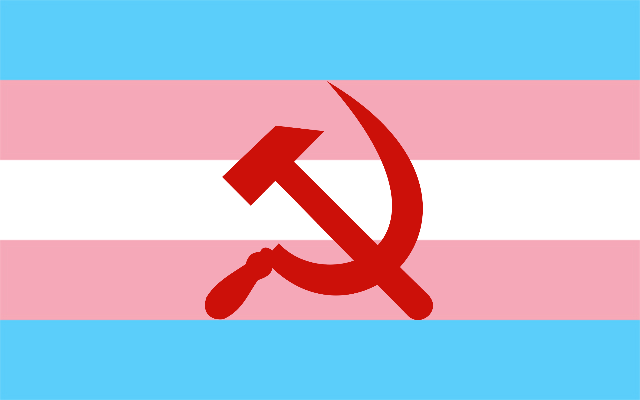
Trans communism
Transcommunist flag by NinjaDrawsDBZ

by DAPHNE LAWLESS, from Fightback magazine’s upcoming issue on Socialist Feminism. Subscribe here.

Late last year, a veteran of communist politics in Aotearoa/New Zealand decided to contribute to a march for the traditional working-class demand for reproductive rights by standing outside it with a sign bearing only the words “WOMAN = ADULT HUMAN FEMALE” – a dogwhistle for anti-trans feminists (or “trans-excluding radical feminists”, TERFs). Another veteran from the same organisation now has the same phrase at the head of her Twitter biography – displacing all mention of her record as a socialist and a union organiser. And they’re not the only ones. How has the motivation to punch down on trans people – and defend the “free speech” of fascists and others who do so – come to substitute for the fight for workers’ power and a post-capitalist world in the minds of veteran activists?

Freeze peach

Daphna Whitmore and Don Franks are veteran socialists and union organisers, who were founding authors of the blog Redline when it was set up in 20121. Whitmore’s Twitter account identifies her as part of the “Left Network for Free Speech” (LNFS). The Redline post in which this “Network” was announced says:

As partisans of the working class, we know that the working class has historically been denied democratic rights, including free speech. Even after hundreds of years of struggle, workers today face being fired for expressing, in their own time and on their own computers, views which their employers disapprove of.

Leaving the power to decide what is acceptable speech in the hands of employers and the state disempowers workers and oppressed sections of society such as women, Maori, gay people and migrant workers… Free speech is necessary to expose racism, sexism and bigotry. In contrast, ‘hate speech’ restrictions don’t challenge these ideas. ‘Hate speech’ laws in practice are an arbitrary tool that are used to impose social regulation. They can be used to silence progressives on a range of issues.2

Given their defence of free speech as a weapon in defence of the interests of workers and gay people, it is strange that almost all the articles posted by the LNFS on their Facebook page since it was founded are in defence of Israel Folau – the millionaire athlete who was released from his contract with the Australian Rugby Union after violating his contract by making religiously-based homophobic social media posts – or of “gender-critical” (i.e. transphobic) commentators and academics. The link between these and working-class activism seems thin, to say the least.

Free-speech absolutism on the Left has had a historical record of degenerating, first into tolerance for Right-wing ideas, then actual sympathy with them. The classic historical example of this is the Revolutionary Communist Party in Britain, originally a split from the Socialist Workers Party. This organisation – always somewhat of an outlier on the British far-left – began to be distinguished in the mid-1980s by opposing the consensus that fascist movements such as the British National Party should not be given platforms on campus. This clearly prefigures the LNFS’ insistence that state action against “hate speech” in fact makes things worse, as well as its concern about “academic mobbing” of professors who promote transphobia.

The subsequent transformation of the RCP into an outright Right-wing libertarian outfit is quite notorious. Opposing the liberal consensus had become for them an end in itself, detached from socialist principle. The organisation itself wound up in the 1990s, as their Living Marxism magazine was sued out of existence for denial of the horrors of attempted genocide during the Yugoslav civil wars. They cropped up later in the form of the “Institute of Ideas”, promoting climate-change denial through documentaries such as The Great Global Warming Swindle. They continue to exist as Spiked, a libertarian Right-wing website funded by American billionaires the Koch brothers, some of whose writers have recently been elected to the European Parliament for the Brexit Party.3

It is interesting to note that the place where this degeneration began – minimising the threat of fascism in favour of the supposed greater threat of liberal “thought policing” – is a very common trope on the anti-liberal Left, the kind of people whom Fightback has criticised in our previous articles on Conservative Left and Red-Brown tendencies. As we have previously stated, this kind of underestimation of the fascist threat – or even seeing fascist movements as having a positive side, in mobilising opposition to a centrist/liberal consensus – was the kind of thinking from Communists which led to the victory of Hitler in Germany.

The most shocking and disturbing thing on the LNFS Facebook page, however, is the un-ironic posting of this image4:

This is an extremely common meme in online “free speech” circles (and was recently quoted by none other than Donald Trump Jr. on Twitter). But this is not a quote from the 18th century French writer Voltaire at all. It is in fact a quote from Kevin Alfred Strom, an American neo-Nazi writing in 1993. The clue to whom he was really referring is given in the following, full version of the meme:

There is no reason to believe that Whitmore, Franks et al. were aware of the true nasty nature of this meme. But in a way, that makes it even worse. Fightback has previously characterised the spread of “Red-Brown” ideas as like a “zombie plague”, in that socialists or others on the Left who start descending into Right-populist or even fascist politics don’t even realise that they’re doing so. It is a case of losing one’s political (or even moral) compass.

“Progressive” transphobia

Unfortunately, trans-exclusive ideas are not confined to the comrades of Redline/LFNS. TERF politics are very strong on the British left, and one union activist recently arrived from Britain tried earlier this year to defend the free speech of transphobes on the “Unions NZ” Facebook group.6 Prominent veterans of the socialist movement in New Zealand – such as Unite Union stalwart Mike Treen and retired academic David Bedggood7 – have also made social media or blog posts opposing “transactivism” or defending local anti-trans activists such as Renee Gerlich. Such comrades often try to justify themselves by arguing that they are against discrimination against trans people, but that “transactivism/the transgender movement” goes too far. These are not dissimilar in form from the arguments against Gay Liberation from 1970s Communists, which are still used by fringe Stalinist groups like the “Communist Party of Great Britain (Marxist-Leninist)”.

This is particularly ironic in an era where some of the staunchest young communists in Aotearoa/New Zealand identify as trans, non-binary or in some other way “genderqueer”.9 As we noted in “Against Conservative Leftism”, incomprehension of new ways of living which have become common among young people in the era of neoliberal globalisation is a common feature among many veteran activists.

Beyond that, many activists have pointed to an extremely strong link between anti-sex-worker (sex-worker-exclusive radical feminism, or SWERF) and anti-trans politics. English sociology professor Sally Hines put it like this on Twitter:

If someone is a trans exclusionary feminist they will almost certainly have anti-sex work and anti-porn politics – and vice versa. The constant is a denial of body autonomy and a feminism that insists it knows what is best for other women (even when told otherwise).11

It is no coincidence that, due to social exclusion from other work, trans women have been disproportionately represented among sex workers. It is rumoured that several prominent TERFs in New Zealand developed their hostility to trans people after getting a hostile response to their anti-sex worker activism.

English trans musician “DeadBitBabe” also comments:

SWERF’N’TERFS can’t acknowledge the autonomy of sex workers because to them power only comes from maintaining the integrity of their fantasy construction of a female body… Are the cries of Lesbian erasure not strangely reminiscent of the fascist’s cries of white genocide?

The “lesbian erasure” trope is an interesting one. The AfterEllen website recently published an article entitled “A Butch Eradication, Served With a Progressive Smile”, claiming that the network of lesbian spaces and business which had been built up since the 1980s had collapsed due to an increasing tendency of “butch” (masculine-appearing) lesbians to identify as trans men. The author laments:

Our lesbian spaces are already dead. Our bookstores, our dances. Everything we built is dead and taken over by the trans nightmare.

If nothing else, this is a change from the usual TERF narrative, which tends to ignore the existence of trans men and non-binary people altogether, and instead to whip up moral panic about trans women “colonizing” or even “raping” cis women’s spaces. What should really make people stop and think about both these TERF narratives is how similarly they resemble fascist narratives about “The Great Replacement”, as made notorious by the manifesto of the terrorist who murdered 51 Muslims at prayer in Christchurch earlier this year.

Following the analysis of Russian revolutionary Leon Trotsky, Fightback has previously argued that fascist politics everywhere can be characterised as a movement led by the insecure and frightened middle-class. People who may have worked hard to build a little privilege for themselves under capitalism become terrified that an ethnic or cultural Other (classically, “the Jews”) might take it away from them. The AfterEllen article quoted above mourns for the death of a network of lesbian/woman-identified small businesses. In most cases TERFs tend to be older, whiter feminists who have had some success in academia, writing, or in the bourgeois lesbian community (the most globally prominent example being Germaine Greer).

Analysing TERF politics as a variety of fascist ideology might seem shocking or over-the-top; particularly because to do so would require us to categorize many veteran socialists in Aotearoa/New Zealand to have slipped over into the “Red-Brown” camp. But defining fascism as a movement in defence of the threatened privilege of the downwardly mobile middle class seems to make the parallel unavoidable. As does the habit of TERF ideologues of suggesting that trans people are part of some kind of conspiracy of “elites”, as in the tweet reproduced below:

TERF conspiracy theories on Twitter about "elites backing the trans movement" are not dissimilar to fascist ones.

The full antisemitic force of that term “elites” can be grasped when you read a transphobic academic explicitly name George Soros, the Jewish liberal billionaire who has become a common bad guy in fascist conspiracy theory, as a guilty party. “Deadbitbabe” on Twitter again:

Real talk: the primordially whole female body is to TERFs what the primordially whole nation and its people is to fascists… A mythological fantasy that serves to displace all sorts of anxieties.

The anarchist-communist website LibCom puts it more bluntly: “Transphobic feminists are, for all practical purposes, the women’s division of the global far-right.” Given this, the support given by the fascist and religious-fundamentalist Right for TERFs, described in other articles reprinted in this issue, begins to look less like an “enemy’s enemy” situation and more like a meeting of ideological bedfellows.

Perhaps the final word can be left to the author of the blog nothingiseverlost, in a criticism of the similar descent of the socialist-feminist academic Nina Power into TERF and other forms of right-wing politics: “you never seem to get people becoming less sympathetic to the far-right at the same time as getting into “gender critical”/trans-exclusionary versions of feminism.” It is extremely interesting that Power’s main move in defending her dabbling with transphobic and fascistic memes is an invocation of … free speech.

What is to be done?

Fightback has previously discussed what we see as another irruption of Right-wing ideology into socialist circles, here and elsewhere in the Western world – the demonization of the Syrian revolution. The repetitive argument from such people is that the Syrian people fighting against the Assad regime and its Russian allies are not “real” subjects of liberation (such as, to take a more popular example, the Palestinian people), but instead pawns of some Zionist-jihadi-US State Department conspiracy against Syria’s “national sovereignty”. The really perverse issue is that some of the TERF-adjacent leftists we have quoted– and we might name David Bedggood here – have agreed with us in staunchly rejecting this dehumanizing rhetoric when used against the Syrian people in struggle… only to use similar rhetoric against trans people in struggle.20

At the very least, what this can tell us is that “it’s difficult to be right about everything”. But it also warns us against a sectarian response to SWERF/TERF ideas on the Left – that is, refusal to deal with anyone who might hold such views at the moment. We all live under a suffocating blanket of capitalist ideology, in which it becomes “natural” for different groups of the oppressed to be suspicious or hostile towards each other. Even with the best intentions, it can be very hard to consistently hold to a materialist analysis which can clearly identify patterns of oppression, exploitation and privilege, and not be confused by the “DARVO” (“Deny, Attack, and Reverse Victim and Offender”) tactics habitually used by fascist movements and domestic abusers.

Fightback believes that to effectively fight capitalism today means to fight fascism, the most dangerous form of capitalist ideology, which is currently on the rise. To fight fascism, we must have a united front of working and oppressed people. To have a united front we cannot tolerate racism, misogyny, transphobia, xenophobia, Islamophobia, state-worship or any other ideology which suggests that some oppressed people are “deserving targets” within our united front, because that is literally the thin edge of the Fascist wedge.

The Left has had far too much opportunism recently – refusal to face Right-populist or even fascist ideas within the movements for fear of alienating people, of breaking up the mass movement. We need to hold to a practice of honest, sharp criticism of SWERF and TERF ideas where-ever they are raised, even by “comrades” or “good Leftists”, as contrary to the unity of all the oppressed we need to build a better world. We also need to centre the experiences of trans people and sex workers within our movement in such debates – nothing should be “about them, without them”.

At the same time, it is crucial to build the biggest possible anti-fascist, anti-capitalist united front – which will mean sometimes linking arms with SWERFs, TERFs and even partisans of Bashar al-Assad against a common enemy. No-one said it was going to be easy.

Special thanks to Sage Anastasi, Lisandru Grigorut and Anne Russell for their help with this article.

1 The founders of Redline were former members of the Workers Party of New Zealand – the organisation from which Fightback is also descended. We are aware of the historical ironies involved.

2 For refutations from the Left of the case against hate-speech restrictions, see Max Rashbrooke at Overland (liberal) and R. Totale at LibCom (anarcho-communist).

3 See https://en.wikipedia.org/wiki/Living_Marxism, https://rationalwiki.org/wiki/Spiked, and https://www.theguardian.com/commentisfree/2018/dec/07/us-billionaires-hard-right-britain-spiked-magazine-charles-david-koch-foundation

4 If this image is taken down before then, it was accessed July 13, 2019.

6 This post raised strong negative feedback and has since been deleted by the group administrators.

7 Treen has republished several anti-“transactivist” articles on social media, including those from Redline. Bedggood is the author of this blog post.

9 Not to even mention the contribution to the Communist movement over decades by “transactivists” such as the late Les Feinberg.

11 Hines even suggests that SWERFs and TERFs might be brought together under the label “Genital-Obsessed Feminists”.

20 An excellent article on LibCom shows how a Red-Brown conference in Sweden brought together transphobic speakers with some of the most notorious defenders of Assad, such as Eva Bartlett and Vanessa Beeley.

Christchurch terror: How did this happen?

Hajid Daoud

Haji-Daoud Nabi, whose last words were “welcome brother.”

By Byron Clark, Daphne Lawless, Tyler West, and Ani White.

You’ve heard the news: on March 15th, 2019, Aotearoa/New Zealand experienced its largest mass shooting since the colonial massacres, a coordinated terrorist attack on two mosques in Christchurch. Throughout the day the death toll climbed; first 6, then 27, then 40, and finally 49 (with more passing away in hospital beds in the ensuing days). Victims included resettled Syrian children, fleeing terrorism in one place only to encounter it in another.

In the aftermath, many said “This is not Aotearoa.” However, while the attack may not have represented Aotearoa, it did represent the ugly underbelly of white New Zealand.[1] We cannot simply blame the involvement of an Australian – for one thing, Christchurch has long been the city where the far right is strongest in this country. Although the attack is unprecedented, it did not come out of nowhere.

When Tūhoe Māori activist Tame Iti noted the legacy of colonial violence which this attack echoed,[2] many in comment threads called this ‘segregation’ or ‘divisiveness.’ However, if we don’t identify the roots of racist violence, it will only happen again and again.

We will examine four factors that should be considered in comprehending the incomprehensible; 1) The history of far-right groups in Aotearoa/New Zealand, 2) The alt-right internet’s incubating role, 3) Activist-left complicity in Islamophobia and 4) Complicity of the coalition government parties. We must “clean house” if we are to stop this from ever happening again.

Always present: NZ’s far right in history

The savagery and scale of the attacks in Christchurch are without a doubt unprecedented in recent New Zealand history. Attempts to reach for a comparison must go as far back as the 1943 Featherston POW massacre, the 1918 Surafend massacre, or further still to the 19th century colonial wars. However, whether the motivations and violent nature of these attacks are unprecedented in New Zealand is another matter entirely.

Research on New Zealand’s far right is scarce, but what does exist puts the immediate lie to claims by the likes of Christchurch Mayor Lianne Dalziel and National Party MP Gerry Brownlee that white supremacy has not been a problem in Christchurch (or, by extension, New Zealand). The origins of New Zealand’s far right as an organized force lie with the emergence of racial exclusion leagues over the 1880s to 1920s, and the development of interlocking immigration laws which became known as the White New Zealand Policy.

While the origins of white supremacy lie with the confiscation of Māori land and the bitter wars of the mid-19th century, its cohesion as a conscious doctrine originates in the fears of immigration eroding said power towards the end of the century. The early exclusionary leagues acted as relatively simple lobbying groups and utilized entirely legal means to further their aims, which in practice acted to reinforce and extend an increasingly whites-only border policy. Through the 1880s to 1900s groups with names like White Race League, Anti-Asiatic League, and Anti-Chinese League began to appear; generally garnering popular support.[3] At the same time, the lattice of immigration law which upheld the White New Zealand Policy started to be enacted.

A non-exhaustive list of that legislation includes[4]:

  • Restrictions on non-British gum diggers in 1898, 1908, and 1910; specifically aimed at Dalmatian (sometimes referred to as Croatian, Yugoslav, or just Slav) labourers who had entered the industry.
  • Undesirable Hawkers Prevention Bill 1896 which was aimed at Syrian and other Arab immigrants, while acting broadly as a roundabout way to slow immigration by non-white British subjects.
  • Undesirable Immigrants Exclusion Act 1919 placing special requirements on immigrants from the former German and Austro-Hungarian Empires.
  • Immigration Restriction Act 1899 which acted to impede all non-British immigration.
  • Over two dozen pieces of legislation aimed specifically at Chinese migrants. Poll tax increases in 1881, 1888, and 1896; naturalization bans in 1892, and 1908; additional language tests in 1907; and thumb printing in 1908 are among the most notable.
  • Immigration Restriction Amendment Act 1920, which acted as the formalization of the White NZ Policy and functionally ended non-white immigration.
  • Immigration Restriction Amendment Act 1931, which severely impeded attempts by Jewish refugees from Europe attempting to enter New Zealand

These racial leagues and the immigration restrictions eventually created the atmosphere that resulted in the infamous murder of Joe Kum Yung, an elderly Chinese miner, on Haining Street in Wellington on 24th September 1905. The killer, Lionel Terry, was a relatively popular racist agitator of a British merchant family and military background who’d been promoting his manifesto/verse booklet The Shadow leading up to the murder. The murder shocked the country, but crucially had no effect in blunting the popularity of whites-only immigration to NZ and a great many continued to support him.[5]

This atmosphere also culminated not only in Yung’s murder in 1905 and the formalization of the White NZ Policy by the Act passed in 1920, but also in the founding of the most notorious of the racial exclusion leagues, the White New Zealand League. While the politics of this league were functionally little different to earlier leagues, it was the most explicit about ensuring New Zealand be a white state. With the common belief that Māori were either a ‘dying race’ or destined to be assimilated into white NZ, this meant that like previous groups the White NZ League focused near exclusively on Asian immigration.[6] As a marker of the League’s incredible popularity, through the mid-1920s it sent requests to 200 local bodies around NZ asking them to pass resolutions supporting the aims of the League. They received positive replies from 160 of these local bodies, representing some 670,000 people (about 47% of the population at the time).[7]

Anti-Semitism, while rarer than anti-Asian sentiment, was far from unheard of either. Within the Social Credit movement in particular, which had strong support especially from the ‘old petty-bourgeois’ (rural small-landowners, typically farmers), anti-Semitism was rife in the 1930s. A survey of Social Credit publications from the 1930s-1980s by sociologist Paul Spoonley reveals a persistent slew of anti-Semitic content, even after the Social Credit Political League itself expelled its extreme right-wing in 1972.[8] Social Credit acted as a harbour for anti-Semitism until the post-war period from the 1950s onward, when the far right began to fully develop and new organisations appear.

A full chronology of all the organisations of the far right in New Zealand established since the 1950s would be fruitless. Suffice to say that from 1954 with the formation of a NZ wing of the British League of Empire Loyalists (primarily based in Auckland and Christchurch) through to his writing in 1987, Paul Spoonley recorded the formation of nearly 100 far right organisations in a 33-year period.[9] Plainly, many more have formed in the interim 32 years.

While none of these groups have managed to become a mass movement or electorally successful party, some have attained significant support. Organisations expressing solidarity with white rule in Southern Africa, particularly South Africa and Rhodesia, began to appear in the 1960s and grew rapidly over the coming years.[10] Meanwhile the League of Rights, cousin to the Australian group of the same name and a home for the extreme right exiled from the mainstream Social Credit party, garnered surprising success in spite of their notoriety as an anti-Semitic and virulently racist organization. After its 1971 formation the League had a stable membership and support base of around 200 people for the duration of the decade, which soared to at least 1000 in the early 1980s as a result of the 1981 Springbok Tour and the rapid social changes of the time. The League further established numerous front-groups and operated in coalition with more mainstream conservatives over issues like abortion and homosexual law reform, giving them access to the political mainstream and some hard-line MPs. Estimated yearly expenditure for the 1980s, primarily funded by large volumes of book & paper sales, was as high as $50,000; a figure packed up by the publication of massive numbers of pamphlets, such as 250,000 copies of one titled New Zealand First in 1981.[11]

From the 1960s onward an openly fascist wing of New Zealand’s far right began to operate, sometimes trailing into violence (National Socialist Party founder Colin King-Ansell was convicted of firebombing a synagogue in 1967). This fed in later years into the rise of often violent white power gangs in the 1990s which declined but persisted into the 2000s.[12] Arguably the most notorious, the Fourth Reich gang attracted national horror when a number of partially-ideologically motivated murders occurred after its expansion from a prison gang into a number of South Island centres in the late 1990s. Members were responsible for the murders of Hemi Hutley, James Bambrough, and Jae Hyeon Kim (and possibly more) in and around Westport from 1997-2003; Hutley and Kim for their race, and Bambrough for his sexuality.[13]

Kyle Chapman, arguably New Zealand’s most notorious contemporary neo-Nazi, confessed to numerous race-related attacks on Māori people including firebombing a marae in Invercargill in the early 1990s. After confessing and ‘leaving’ the scene in the mid-1990s Chapman led a trust in Christchurch where he was tasked with steering skinhead youth away from the white power movement, which ended when he was discovered to be using his position to distribute neo-fascist material to his wards.[14]

Chapman would go on to lead the National Front in the 2000s at a time when their supporters vandalized Jewish graves and attacked immigrants in Wellington, and later founded Right Wing Resistance which operated in Christchurch in the early years of this decade. Other stalwarts of the movement like Colin King-Ansell and Kerry Bolton (who was a member of the National Socialist Party in his teenage years, going on to be a leader in numerous neo-fascist organisations) are still active today, like the rump of the white power scene in the 1990s.

Though only a few instances of fascist terror have been elaborated here, historically New Zealand has had a demonstrably active far right subculture which has always bubbled not too far below the surface. And while it has never managed to attain mainstream success or political power in New Zealand, it has often hovered alarmingly close to that political mainstream or launched sporadic and opportunistic acts of violence from the fringe.

Internet’s incubating role: The writing on the guns, and New Zealand’s alt-right

Before he began his shooting spree, the Christchurch terrorist shared photos of his weapons on his (now deleted) Twitter account. On the guns used in the massacre he had written the names of other mass shooters, as well the phrase “14 words” a reference to the fourteen-word slogan “We must secure the existence of our people and a future for white children,” a statement attributed to American David Lane, founder of the white supremacist terrorist organisation The Order.

On another gun he had written “here’s your migration compact!” a reference to the UN Global Compact for Safe, Orderly and Regular Migration. This compact is a non-binding agreement around migration that was developed in the aftermath of the 2015 refugee crisis following the New York Declaration for Refugees and Migrants, which was unanimously supported by all UN member states in September 2016.

The compact, relatively benign as well as non-binding, would likely have also been supported by all member states, if not for what happened next.

Beginning in September 2018, the far-right began to spread distorted information, conspiracy theories and outright falsehoods about the pact. According to Laurens Cerulus and Eline Schaart, writing for Politico (see “How the UN Migration pact got trolled”[15]):

The burst of activity, including tweets, videos and online petitions, prompted politicians in several countries to take notice of the previously uncontroversial pact and revise their views. In Belgium, the controversy led to the collapse of the government.

The rapid move from online activity to political reality is an example of how a process can be hijacked by what researchers describe as a global network of nationalist, far-right activists. In this case the efforts were spearheaded by popular YouTubers and political “influencers” such as Austrian far-right activist Martin Sellner, then coordinated via chat groups and hyper-partisan websites.

The institute for Strategic Dialogue (ISD), which monitors extremism, analysed the 100 most popular YouTube videos about the migration pact and found that 75 were created by people that they had classified as right populist, anti-migration campaigners, far-right extremists or conspiracy theorists. This online network of hard-right content creators, along with far-right members of parliaments were able to sway several European countries to vote against approving the compact, along with the US, Israel and Australia.

New Zealand was not left out from the global right-wing backlash against the compact. While her own YouTube video, entitled “WAKE UP NEW ZEALAND’ BY Carol Sakey -MUSLIM WORLD, NZ’S OPEN BORDERS.[16]” was nowhere near popular enough to be among the sample analysed by ISD, the parliamentary petition Carol Sakey started did gain some traction. The petition was shared by local right wing Facebook pages such as South Island Independence Movement, run by Timaru based Solomon Tors-Kilsen, who self-identified as alt-right when questioned by the New Zealand Herald’s Kirsty Johnson for her July 2017 investigative report on New Zealand’s far right[17] and One Nation NZ, the party founded by former New Zealand First candidate Kym Koloni to contest the Northcote parliamentary by-election in 2018.

In the hours following the shooting in Christchurch, the One Nation NZ Facebook page disappeared. It’s unclear whether it was removed by Facebook or whether it was pre-emptively taken down by Koloni (or someone else in the organisation). The page frequently shared articles fear mongering about Islam and immigration.

A bigger player in New Zealand’s far right social media ecosystem, however, is the larger and -relatively speaking- more moderate New Conservative party. The New Conservatives, who trace their origins to the Conservative Party founded by disgraced millionaire Colin Craig, have rebuilt the party as a less Christianity orientated but more conservative organisation. They are a registered party, meaning they will be on the ballot at the 2020 election, and occasionally show up in polls at around 1% of the vote.

The party has been able punch above its weight, Deputy Leader Elliot Ikilei has been a semi-frequent guest on TVNZ’s Breakfast programme as well as the Radio Live and Newstalk ZB talk-radio networks. In a video about the UN Compact on Migration posted to his Facebook page on November 25th 2018[18] Ikilei tells his audience:

Almost every sentence can be found in almost any or every sci-fi dystopia type thriller type movie type book. Almost every sentence is an incredibly dangerous clause, wish list, desire, and the fact that our leader, Winston Peters, I mean Jacinda Ardern, is all good to sign it, when other countries are aware of the absolute insidiousness of this document is just incredible.

Ikilei doesn’t quote a single word from the document, but claims “this doesn’t get any worse actually, this document, this is end game type of stuff…if you care about New Zealand, this document cannot be signed. This is the type of thing that we need to unite against, it is vicious”

He then thanks people who have sent him links and reviews, significantly he says “thank you also to the person who sent me Stefan Molyneux’s take on it, I haven’t watched it yet…I’m looking forward to watching that as well.”

A Facebook follower posts a link to Molyneux’s video in the comments, Ikilei and a few others like the comment. Molyneux is a Canadian white supremacist[19] who promotes discredited pseudoscience regarding the link between race and intelligence[20]. He came to New Zealand in 2018 as part of a speaking tour with Lauren Southern, another Canadian far-right activist.[21]

When the pair were barred from speaking at Auckland Council owned venues, Ikilei and the New Conservatives became some of their most vocal supporters. A July 7, 2018 press release[22] reads “New Conservative staunchly supports the free speech that has been occurring year after year after year at our Auckland Council venues, and utterly rejects the flawed attempt to label Lauren Southern and Stefan Molyneux as having views that are ‘hate speech’.”

Southern, it should be noted, has a small part in the story of the Christchurch shooting as well. In the Anglophone world, she has been one of the biggest proponents of the conspiracy theory known as “The Great Replacement” a term coined by French anti-immigration writer Renaud Camus to describe the “replacement” of Europeans by non-white immigrants.

The Great Replacement narrative influenced protesters at the 2017 “Unite the Right” rally in Charlottesville, Virginia who chanted “Jews will not replace us!” and it influenced the Christchurch shooter, who titled his rambling manifesto “The Great Replacement” and wrote that “Millions of people [are] pouring across our borders … [i]nvited by the state and corporate entities to replace the White people who have failed to reproduce”[23]

In the hours following the shooting, Southern’s YouTube video “The Great Replacement” appeared to have been removed from the internet[24], though at the time of writing it is online.[25]

A December 5th, 2018 Facebook post on the New Conservative NZ page[26] promoting a rally against the Migration Compact states:

We were the first political party to publicly stand staunchly opposed to signing the UN migration pact. We were the first political party to publicly stand against the restrictions on free speech earlier this year, and we were on TV, radio, debates with a consistent and clear message about free speech and sovereignty.

It was through that mix of social and traditional media coverage that New Conservative was able to take the narrative on the Migration Compact that originated on the far-right conspiracy theory parts of YouTube, and inject it into mainstream political discourse.

On December 4th the mainstream conservative National Party announced it would oppose voting for the compact and pull New Zealand out of it if elected in 2020:

The Government appears to be relying on the UN to set its migration policy rather than making its own decisions. While a number of countries are pulling out of the agreement as the extent of its potential impact on the decision-making of individual countries is realised, our Government is refusing to outline its own position. For these reasons, National will not be supporting this agreement and we will reverse the decision if this Government signs up to it.[27]

Gerry Brownlee told Newshub that the migration compact would result in “pretty much open borders”.[28] Opposition to the UN pact was no longer confined to fringe far right groups but had become the policy of New Zealand’s main opposition party.

As he opened his interview with Foreign Minister Winston Peters on December 20, 2018[29] Newstalk ZB host Mike Yardley stated “the [legal] advice says that it will not compromise sovereignty nor is it legally binding, but there are still a lot of people worried about implications”. Peters, a man who it should be said has built much of his political career on anti-immigration populism, noted that the National Party had supported the compact when in government, and that the debate around it started “all of a sudden because of the alt-right and a few uniformed people…I can’t have you on national radio…repeating this uninformed drivel!”

But by then it was too late, the meme had already spread. It didn’t matter that it wasn’t true, people believed it was true, or felt they could win the votes of people who believed it was true. The National Party even went so far as to create its own petition, encouraging their supporters to “to stand with National and stop this Govt from signing NZ up to this agreement”.

While the Migration Compact was signed in December, National had left the petition up on their website. That is, until they took it down- some time on the afternoon of March 15th. A copy of the page from Google’s cache is still accessible, the most recently available snapshot is from the 15th, 1:39pm New Zealand time. Archived just around the time New Zealand was starting to come to terms with the fact that we had just experienced our first alt-right terrorist attack.[30]

Islamophobia and the Left

The mainstream Right in New Zealand bears most of the responsibility for refusing to combat the spread of white-supremacist, Islamophobic, and migrant-baiting ideas, or even exploiting them for electoral advantage. We rightly mock conservative politicians and media figures shedding crocodile tears over 51 dead Muslims. But sadly, these ideas have not been absent from the activist and radical Left in this country either.

A diagram on the first page of the Nazi murderer’s manifesto (apparently taken from the defunct US fascist group, the Traditionalist Workers Party) lists “anti-imperialism”, “environmentalism” and “workers’ rights” among his principles, and the murderer later equivocates on whether he would describe himself as a “socialist”. This has been enough to allow some of the more extreme Right US websites to try to categorise him as actually far-left.[31] But it is in fact just the latest example of the phenomenon of red-brown politics – fascism adopting left-wing slogans as “camouflage”, which sadly intersects with sections of the activist Left passively or actively going along with conservative-populist ideas. Fightback has previously warned of the massive dangers of an unwitting convergence between “Conservative Leftism” and the Red-Brown movement, allowing fascist ideas to circulate within our own movement.[32]

Martyn Bradbury, proprietor of the prominent centre-left Daily Blog, was quick to come out on social media with “FUCK ISLAMOPHOBIA” after the massacre. This is exactly the same Martyn Bradbury who less than two years ago wrote: “The impact of the Asian-NZ population tripling in the space of 20 years and overtaking Māori has political, economic and cultural ramifications that haven’t been discussed yet it’s a debate that is already running.”[33]

In New Zealand discourse, “Asian” generally refers to East Asian (mainly ethnically Chinese) people, rather than from the Indian Subcontinent or the Middle East. But Bradbury’s fretting about “invasion” and “colonisation” by migrants only differs from the paranoid rambling in the Christchurch Nazi murderer’s manifesto by which ethnic group of migrants in particular he is disturbed by. If your only difference from Nazis is in which ethnicity you suspect of being a fifth column stealing the country from within, you should be excluded from the Left. The parallel with European colonisation is also dubious, given that Europeans showed up with guns, continue to own most of the property and now presume to regulate new arrivals.

The fact that Syrian refugees were among the dead adds an extra layer of irony to the participation in the outpouring of grief, rage and activism by some activist Leftists who follow a “campist” politics of identifying the USA and its client states as the main source of wickedness in the world, and apologising for or denying the imperialist ventures of Russia, China and their own client states.[34] All people with basic human decency in Aotearoa would be disgusted at the gabbling of the US conspiracy theorists who claim that the mosque murders were a “false flag” designed to justify some nefarious State plot. And yet, parts of the activist Left here in New Zealand have resorted to similar “false flag” conspiracy theories when confronted with tragedies with politically inconvenient consequences – for example, in reaction to the Assad regime’s chemical attacks in Douma, Syria, in April 2018 which killed at least 70 people.[35] Willingness to adopt conspiratorial explanations for tragedies, if they challenge our political presuppositions, puts us in danger of a slide into reactionary ideologies. It is worrying that few other activists thought that this was at all a shocking or outrageous thing to say regarding the Douma attacks; many supported the statement.

The genius of both the Russian and Chinese state-backed propaganda networks has been to recycle Western “war on terror” propaganda, demonizing Muslims as terrorists and subversives, into an anti-imperialist framework which makes it acceptable to Left-wing opinion in the West. This propaganda narrative combines Western post-9/11 Islamophobia with the older narrative that Islamist resistance to the Soviet occupation of Afghanistan was a creation of/funded by the West, rather than an indigenous movement.

Many Western Leftists have been sucked into repeating poisonous Islamophobia by accepting the story that every resistance movement to Russia, China or their client states which resorts to Islamic imagery are CIA funded terrorists. In this way, the whole Syrian resistance, along with Uighurs in China or the Rohingya people in Myanmar/Burma, can be equated with actual terrorist movements such as ISIS/Da’esh and al-Qaeda.[36] Murderous dictators like Bashar al-Assad or Muammar Qadhafi can be upheld as victims of imperialism and as bulwarks of “secularism” against the jihadi menace.

It must be stated plainly – when New Zealand leftists (for example) refuse to condemn China’s “re-education” camps for Uighurs, or repeat smears that 9-year old Syrian refugee Bana al-Abed’s father is an ISIS operative, they are promoting Islamophobia, whether they realise it or not. In many parts of the world this kind of “ISIS-jacketing” is a death sentence for those smeared – like “snitch-jacketing” or “cop-jacketing” in the USA. Just like the Christchurch Nazi murderer, the Russian and Chinese states characterise Muslims as tools of a Western imperialist (or “globalist”) conspiracy. Most of the New Zealand left has simply refused to debate these issues, characterising those who worry about them as sectarian obsessives. But anyone who rightly cries over 51 murdered in Christchurch while dismissing 70 murdered in Douma as a “false flag” is not showing internationalism. Campism is neither internationalism nor anti-imperialism; and supporting current Russian or Chinese foreign policy means aiding and abetting murderous Islamophobia.

The radical left must promote and listen to the voices of Syrians – as well as Arabs and Muslims generally, facing an international backlash that crosses the lines between geopolitical ‘camps.’ Resettled Syrians live in Aotearoa: this is not simply a distant geopolitical issue.

Ruling parties’ complicity

To start on a positive note, Prime Minister Jacinda Ardern correctly and surprisingly identified the Christchurch attack as ‘terrorism.’ This is unusual in an international context where white male terrorists are generally depicted as unhinged lone wolves, while Muslims and Arabs are ‘terrorists’ even before perpetrating any crime. It may be that the coordinated nature of this action made it harder for authorities to pretend it was an act of a lone wolf, but it’s a refreshing acknowledgement all the same.

However, the Government and pro-Government parties – Labour, New Zealand First, and the Greens – share varying degrees of complicity with processes that led to this tragedy.

So-called ‘anti-terrorism’ efforts, under successive Labour-led and National-led governments, focused on seemingly everyone but the far right. It’s no surprise that the Christchurch terrorists were on “nobody’s radar” in Australia or New Zealand,[37] despite the rapid expansion of the surveillance state in the 21st century. In 10 years of Security Intelligence Service (SIS) and Government Communications Security Bureau (GCSB) public documents there was no mention of far-right groups.[38] The list of NZ-designated ‘terror’ groups includes no far-right groups, and some legitimate resistance groups such as the Kurdish PKK.[39]

In 2002, the Labour government passed the ‘Terrorism Suppression Act’, comparable with the US Patriot Act, which saw state overreach in the wake of 9/11.[40] It’s worth noting here that white men are the most common perpetrators of terrorism in the USA despite the outsize focus on Muslims,[41] and there have been no Islamist attacks in Aotearoa at all.

As in so many countries, Muslim and Arab communities experienced profiling. As highlighted by Faisal al-Asaad in a piece for Overland entitled “Today we mourn, tomorrow we organise”:

I’ll never forget the many meetings and roundtables I attended, alongside other Muslim advocates and leaders, where we argued and pleaded, pointlessly it seems, with different government agencies to turn their attention from our communities and mosques to the real threats in this country. I’ll never forget the empty reassurances, let alone the smirking faces as someone dismissively joked, in reference to the far right and white supremacists in New Zealand: ‘It’s hard to take these guys seriously.’…

Today we need to grieve and mourn, so let’s do whatever we can to support each other and, most importantly, the immediate victims of yesterday’s atrocity. But tomorrow, we need to ask some hard questions and hold people to account for the sheer horror they enabled.[42]

The state also harassed Māori and left-wing activists. The most well-known application of the New Zealand state’s post-9/11 powers were the 2007 ‘terror raids’, in which anarchist and Māori activists were rounded up across the country.[43] Police shut down the rural, predominantly Māori town of Ruatoki, with armed officers reportedly boarding school buses full of children.[44]

Just this year, a Department of Corrections plan to fight terrorism identified “Māori nationalist groups” as a special threat, earning a rebuke from Māori Labour Party MP Kelvin Davis.[45]

In 2004, sources revealed that the SIS were investigating the newly formed Māori Party, a parliamentary party unlikely to be planting any bombs.[46] Meanwhile, the same year saw National Front members knock down Jewish gravestones,[47] and thousands of ordinary people protest against a combined march of the National Front and Destiny Church, including a student strike.[48]

It’s been left to small anti-fascist groups, lacking the resources of the surveillance state, to monitor the activities of fascists on a voluntary basis, with occasional outbursts of popular counter-protest against fascist mobilisations.

Ultimately, the complacency of the political class has allowed fascism to fester and turn septic. In the unlikely event they changed course and cracked down on far-right groups, we may not trust the surveillance state, but we certainly would not cry for the fascists.

In addition to their lopsided ‘anti-terrorism’ letting the far right off the hook, the ruling parties have also engaged in populist migrant-bashing.

New Zealand First, Labour’s coalition partner, is particularly infamous for migrant-bashing. We should be wary of simplistically labelling NZF leader Winston Peters ‘New Zealand’s Trump’, as some international commentators have.[49] Rather than a billionaire populist entering politics in a time of crisis, he is a long-term member of the political class who plays to an older conservative audience. Peters is also Māori, and has a significant rural Māori base, making it difficult to directly map the US situation onto NZ. We have pointed out in the past that Peters emerged from the “Muldoonist” faction of the National Party – anti-neoliberal and socially conservative, in the tradition of 1970s Prime Minister Robert Muldoon – and that a lowest common denominator anti-neoliberalism has led some on the broad left to work with Peters.[50]

However, none of that stops Peters pandering to fascists, or creating an atmosphere conducive to fascism. In 2005, the neo-Nazi National Front endorsed New Zealand First.[51] During the 2017 election, Peters posed with a picture of Pepe (a cartoon frog adopted as an alt-right mascot) at a student event, and defended the “European Students’ Association”, a front for white nationalists.[52]

Since the formation of NZF in 1993, Peters has pressed anti-migrant buttons too many times to count. In a grimly relevant example, Peters called for New Zealand Muslims to “clean house” and turn in any extremists after the 2007 London terror attacks.[53] We await calls from the ruling coalition for white or Christian communities to “clean house” in response to the events of March 15th.

Labour has also engaged in its own migrant-bashing. In the 2017 election, party leader Andrew Little called for cutting “tens of thousands” of migrants, a position Ardern did not reverse.[54] Infamously in 2015, Labour MP Phil Twyford highlighted the “Chinese surnames” of Auckland home buyers, not distinguishing between international buyers and citizens.[55]

Of all the parties in the ruling coalition, the Greens have by far the best record, for example opposing the abuse of surveillance powers, and introducing New Zealand’s first refugee-background MP to parliament.[56] However, even the Greens have engaged in their own migrant-bashing at times: current co-leader James Shaw controversially advocated capping migration at 1% of the population[57], a policy that was based on “statistical nonsense.”[58] Fortunately, James Shaw later retracted this statement and apologised to the Federation of Multicultural Councils,[59] after criticism both inside and outside the party.

We support attempts by Labour and Green members to challenge anti-migrant politics in their parties (although Winston Peters seems singularly unlikely to recant). Unfortunately, many on the broad left look the other way when these parties engage in migrant-bashing, or actively defend them against criticism. In the 2017 General Election, Fightback did not endorse any party, instead helping launch the Migrant and Refugee Rights Campaign (MARRC) to challenge populist migrant-bashing across the political spectrum.[60]  MARRC spokesperson Gayaal Iddamalgoda had this to say at the Wellington vigil on March 17th this year, honouring the dead of Christchurch:

I have so many questions, hard questions that I think need to be answered by all of us..

Why was our Secret Service busy surveilling our innocent Muslim neighbours and not the extremists who sought to victimise them?

Why have the Police in this city spent more than a $100,000 of taxpayers’ money to attack peace activists protesting weapons conferences and arms dealers, while letting racist terrorists acquire semi-automatic weapons?

When will Politicians left and right own up to the fact that they have for years scapegoated and blamed migrants and refugees for social and economic problems that they are not responsible for?

And when will they admit while they have been doing this they have allowed unspeakable hatred to brew under their noses?

I want answers, I want accountability and I want something to change, but right now while I wait for these answers I want to do something to cancel out the hateful paranoid vision of these extremists and offer instead a vision of hope.[61]

Fortunately, hundreds have attended anti-fascist demonstrations in recent years (since the peak of 2004), and thousands have attended solidarity demonstrations with Christchurch. While we can and should press the ruling parties to do better, we ultimately cannot rely on them, and must mobilise ourselves to stop creeping fascism directly.

In the days following the attack, Milo Yiannopolous was banned from Australia, venues reversed course on hosting a musician with a Nazi past, and Newshub announced they would not tolerate hate speech on their Facebook page. Let’s do everything in our power to ensure this state of affairs is permanent, rather than being a passing stage of grief.

Thanks to Cam Walker for help with research on ‘anti-terror’ policy.

Recommended:


[1] Aotearoa (“land of the long white cloud”) is an indigenous name for these islands; we distinguish it from “New Zealand”, the colonial-settler state founded by the British Empire here.

[2] https://www.nzherald.co.nz/nz/news/article.cfm?c_id=1&objectid=12213575

[3] Paul Spoonley, The Politics of Nostalgia: racism and the extreme right in New Zealand, (Palmerston North: Dunmore Press, 1987), 52.

[4] A short but adequate summary of these restrictions can be found on Te Ara Encyclopaedia, but more extensive analysis can be found in the PhD thesis The making of the White New Zealand policy by Phil Ferguson. Ann Beaglehole, “Immigration Regulation,” Te Ara Encyclopaedia of New Zealand, 18th August 2015, accessed 20th March 2019, https://teara.govt.nz/en/immigration-regulation; Phil Ferguson, “The making of the White New Zealand policy: Nationalism, citizenship and the exclusion of the Chinese, 1880-1920” (PhD, University of Canterbury, 2003), https://ir.canterbury.ac.nz/handle/10092/4589

[5] Again, the Te Ara biography is more than adequate, however its author Frank Tod also wrote the book length biography of Lionel Terry which is the go-to for more in-depth reading. Frank Tod, “Terry, Edward Lionel,” Te Ara Encyclopaedia of New Zealand, first published in 1966, accessed 20th March 2019, https://teara.govt.nz/en/biographies/3t27/terry-edward-lionel; Frank Tod, Lionel Terry: The Making of a Madman, (Dunedin: Otago Foundation Books, 1977).

[6] Angela Ballara, Proud to be White? A Survey of Pakeha Prejudice in New Zealand, (Auckland: Heinemann, 1986), 88-89.

[7] Spoonley, The Politics of Nostalgia, 52.

[8] Ibid, 58-60, 291-296.

[9] Ibid, 71-72, 299-308.

[10] Ibid, 73.

[11] Ibid, 109-119. $50,000NZD in 1980 is roughly equal to $250,000NZD today.

[12] Ibid, 150-151. Jarrod Gilbert, Patched: The History of Gangs in New Zealand, (Auckland: Auckland University Press, 2013), 142-144.

[13] Gilbert, Patched, 143-144. “West Coast communities held captive by fear,” Stuff, 31st January 2009, accessed 20th March 2019, http://www.stuff.co.nz/sunday-star-times/features/feature-archive/510082/West-Coast-communities-held-captive-by-fear

[14] Gilbert, Patched, 144-145.

[15] https://www.politico.eu/article/united-nations-migration-pact-how-got-trolled

[16] https://www.youtube.com/watch?v=kFByD3rGlMY

[17] https://www.nzherald.co.nz/nz/news/article.cfm?c_id=1&objectid=11888810

[18] https://bit.ly/2Y27jdQ

[19] https://rationalwiki.org/wiki/Stefan_Molyneux

[20] https://www.theguardian.com/news/2018/mar/02/the-unwelcome-revival-of-race-science

[21] https://rationalwiki.org/wiki/Lauren_Southern

[22] http://www.scoop.co.nz/stories/PO1807/S00097/a-line-has-been-crossed.htm

[23] https://foreignpolicy.com/2019/03/16/the-inspiration-for-terrorism-in-new-zealand-came-from-france-
christchurch-brenton-tarrant-renaud-camus-jean-raspail-identitarians-white-nationalism/

[24] https://twitter.com/shaun_jen/status/1106515317063331840

[25] https://www.youtube.com/watch?v=OTDmsmN43NA

[26] https://bit.ly/2TWRsxK

[27] https://www.national.org.nz/national_would_pull_nz_out_of_un_migration_pact

[28] https://www.newshub.co.nz/home/politics/2018/12/migration-pact-will-result-in-pretty-much-open-borders-brownlee.html

[29] https://www.newstalkzb.co.nz/on-air/mike-hosking-breakfast/audio/winston-peters-peters-blames-alt-right-for-un-migration-pact-criticism/

[30] https://bit.ly/2HrO73W. Since then, National Party leader Simon Bridges has claimed that the petition was taken down by an “emotional junior staffer”. https://www.nzherald.co.nz/nz/news/article.cfm?c_id=1&objectid=12214180

[31] For example, Natural News (https://rationalwiki.org/wiki/NaturalNews).

[32] See https://fightback.org.nz/2016/02/15/against-conservative-leftism/ and https://fightback.org.nz/2018/05/09/the-red-brown-zombie-plague-part-one/

[33] https://thedailyblog.co.nz/2017/10/05/waateanews-how-do-Māori-respond-to-the-next-wave-of-colonisation/

[34] https://fightback.org.nz/2015/11/05/against-campism-what-makes-some-leftists-support-putin/

[35] https://en.wikipedia.org/wiki/Douma_chemical_attack. See the report from the Organisation for the Prohibition of Chemical Weapons: https://www.opcw.org/media-centre/news/2019/03/opcw-issues-fact-finding-mission-report-chemical-weapons-use-allegation

[36] In fact, it was the Assad regime itself which cynically promoted Islamist terrorism to divide the opposition forces, by releasing from prison at the start of the uprising many of those who went on to become leaders of ISIS or other jihadi groups. https://www.newsweek.com/how-syrias-assad-helped-forge-isis-255631

[37] https://www.smh.com.au/politics/federal/on-nobody-s-radar-anywhere-terrorist-escaped-australian-authorities-20190316-p514rw.html

[38] https://www.radionz.co.nz/news/political/385173/no-mention-of-right-wing-extremist-threats-in-10-years-of-gcsb-and-sis-public-docs

[39] https://www.police.govt.nz/advice/personal-community/counterterrorism/designated-entities/lists-associated-with-resolution-1373

[40] https://en.wikipedia.org/wiki/Terrorism_Suppression_Act_2002

[41] https://www.vox.com/world/2017/10/2/16396612/las-vegas-mass-shooting-terrorism-islam

[42] https://overland.org.au/2019/03/today-we-mourn-tomorrow-we-organise/

[43] https://en.wikipedia.org/wiki/2007_New_Zealand_police_raids

[44] https://www.webcitation.org/5Skemn9eI?url=http://www.stuff.co.nz/4243621a10.html

[45] https://www.nzherald.co.nz/nz/news/article.cfm?c_id=1&objectid=12204491

[46] http://www.scoop.co.nz/stories/HL0411/S00144.htm

[47] https://www.theage.com.au/world/jewish-graves-vandalised-in-nz-20040807-gdyeuy.html

[48] http://www.scoop.co.nz/stories/HL0408/S00249.htm

[49] https://www.nzherald.co.nz/nz/news/article.cfm?c_id=1&objectid=11925795

[50] https://fightback.org.nz/2018/11/01/new-zealand-first-and-the-global-far-right/

[51] https://www.nzherald.co.nz/nz/news/article.cfm?c_id=1&objectid=10343503

[52] https://www.newshub.co.nz/home/politics/2018/10/opinion-whistling-on-migration-yet-leaving-migration-high-what-s-winston-peters-playing-at.html

[53] https://www.nzherald.co.nz/nz/news/article.cfm?c_id=1&objectid=11870566

[54] https://www.nzherald.co.nz/business/news/article.cfm?c_id=3&objectid=11841890

[55] https://www.stuff.co.nz/business/money/70155168/null

[56] https://www.newshub.co.nz/home/election/2017/10/golriz-ghahraman-nz-s-first-refugee-mp-in-parliament.html

[57] https://www.radionz.co.nz/news/political/315879/greens-would-cap-migration-at-1-percent-of-population

[58] https://fightback.org.nz/2016/10/22/green-vomit-and-statistical-nonsense-the-lies-you-hear-about-immigration-and-the-auckland-housing-crisis/

[59] https://www.newshub.co.nz/home/politics/2017/07/james-shaw-sorry-after-immigration-policy-slammed-as-racist.html

[60] https://fightback.org.nz/2017/10/20/racial-populism-and-the-2017-new-zealand-general-election/

[61] https://vimeo.com/324771849


Germany: The far right, conservative leftism and how to get rid of that shit

la gauche

Top: Die Linke’s Sahra Wagenknecht, text translates to ‘left-wing anti-immigration.’ Bottom: German antifascist flag.

By JoJo, a Fightback correspondent based in Germany.

This article will be published on Fightback’s upcoming magazine on International Perspectives. To subscribe, please click here.

In this piece, I attempt to analyze some strategies against the rise of the far right in Germany, including conservative leftism. I will argue that in order to push back fascism as well as conservative leftism, we will need to develop a new progressive leftist narrative that not only connects current struggles but also explores ways to overcome capitalism and what a post-capitalist society might look like. I’m using examples from the German context as it is the one best known to me but since developments are similar elsewhere, I hope folks might find this piece helpful.

In Germany, like elsewhere, we have seen a normalization of the far right over the last couple of years. In Fightback’s magazine on “Migrant and Refugee rights” from June 2017 I wrote about the rise of the AfD, the “Alternative for Germany”, Germany’s far right party1. Things haven’t changed a lot since then, the AfD now has seats in all regional parliaments as well as the national parliament and is scoring around 12-15% in polls nation-wide and over 20% in East Germany. This is still accompanied with far right mobilizations on the streets, most notably last August in Chemnitz (a town in East Germany) where Neo-Nazis and other far right activists exploited the killing of a 35-year old man for their racist agenda because of the suspect’s refugee status, leading to large racist demonstrations and riots.

The Left was not able to stop this development, despite some successful antifascist mobilizations. Until last year, confronting the AfD was mainly the job of the radical leftist activist milieu alone, other forces did seldomly show up or organize counter-protests. But Chemnitz among some other factors seems to have changed that: In October, a demonstration under the motto Unteilbar (“undividable”) mobilized almost a quarter million people in Berlin. It was mainly targeted against the AfD, but also made a clear point that the social question and the cause for open borders are not to be played out against each other. Trade unionists, migrants, queers and feminists marched together as they saw their interests connected to each other. In addition, demonstrations of Seebrücke (“sea bridge”), demanding the decriminalization of NGOs who rescue refugees in the Mediterranean, also brought surprisingly high numbers of people to the streets.

Other progressive social movements have been growing as well: The climate movement is becoming bigger and more successful, mainly around the struggle to save Hambach forest which is being cut down to make place for an open cast lignite mine, but also with the school students’ “Fridays for Future” protests. There can also be seen a rise in feminist organizing, leading up to a women’s and queers’ strike on March 8 (international women’s day).

Also, within the Left, there are some interesting debates going on around “new class politics”2. Those who argue for “new class politics” want the Left to return their focus to class issues, to organize and push forward class struggles, but without just repeating “old” class politics. Instead, the Left should take into account today’s composition of the working class and see feminist and anti-racist issues connected to the class struggle.

These developments, in theory as well as in praxis, signal a shift from mere antifascist counter-activism towards more actively pushing forward an own agenda, an own narrative of solidarity. It will be crucial to develop class struggles and connect them with feminist and anti-racist issues, since the far right attempts to play out the white (and mostly male) working class against migrants and other minorities. Even though the AfD is a cross-class project and has indeed a quite neoliberal program, it seems to be attractive for white male low-income workers who over-proportionally vote for them. This has of course a lot to do with their attempt to save white and male privilege, but is also connected to their class position. Without a visible and believable left anti-capitalist narrative, a far right populist program gives people the opportunity to express their diffuse anger which is rooted in their miserable situation and exploitation, but is then being redirected against migrants and “corrupt elites”. Of course, determined AfD supporters will not be convinced by left wing ideas and the connection of class struggle with feminism and anti-racism. “New class politics” is rather a strategy that aims to make a left narrative visible on the long term, so that this anger can be rationalized and directed towards the proper goal, before it is even redirected by far right populism.

However, the debates about how to react to the rise of the far right does not lead everyone on the Left to take a stance of borderless solidarity with all oppressed and exploited people (which is basically what “new class politics” and the social movements briefly described above have in common). Just like in the Anglosphere and in other countries as well, some on the Left think that they can win back right-wing voters by compromising their stance on migration issues and focusing primarily on the “white working class” (to be more precise, they sometimes do not even focus on the “white working class”, but abandon class analysis all together for a mere populism of positioning “the people” against “the elites”). The most prominent figure of this development in Germany is Sahra Wagenknecht, parliamentary leader of the party Die Linke (“the Left”). Over the last couple of years, Wagenknecht repeatedly draw attention with anti-refugee remarks. In October 2016, she even took part in a double interview with AfD-leader Frauke Petry in which she agreed with her on some points. Her positions are heavily debated within Die Linke, however the party still doesn’t throw her off her chair, probably because they are afraid to lose votes, as Wagenknecht is currently the party’s most notable and charismatic politician.

Last year, Sahra Wagenknecht launched the self-acclaimed movement Aufstehen (“Stand Up”) together with other politicians mostly from Die Linke, but also from the Social Democrats and the Greens3. Aufstehen claims to be a collective movement of the Left, bringing together members of different parties and non-party members. It is inspired by La France Insoumise, a similar movement in France launched by left-wing nationalist Jean-Luc Mélenchon, and the Momentum platform for Jeremy Corbyn in the UK. Aufstehen has so far not been particularly active in any protests, but has already around 167,000 members (as of December 2018). It is a perfect example of conservative leftism, defined by Fightback’s Daphne Lawless as “a reactionary, undialectical opposition to various aspects of neoliberalism” which “essentially consists in trying to apply yesterday’s solutions to today’s problems”4. With Aufstehen this means trying to bring back the social welfare state of the post-war years, while ignoring that this kind of social welfare state could only exist in this certain historical moment, with a Fordist production model and the system competition with the Eastern block. It could also only exist in the framework of the nation state, was based on the exploitation of the Global South, and was also deeply connected with traditional gender and family norms. It is thus only consistent that Wagenknecht and Aufstehen are mostly ignoring gender, sexuality, race and migration issues if they are not openly opposing these emancipatory struggles. Aufstehen did not take part in the big Unteilbar-demonstration and Wagenknecht said this was due to Unteilbar’s position in favor of open borders. However, some local branches took part in the march nevertheless and criticized Wagenknecht for her announcement which they had no say in, since Aufstehen so far still does not have a democratic decisionmaking process. So it would be false to accuse all Aufstehen members of red-brown politics, as some on the antifascist Left do. Instead, it might be interesting to examine why it is so successful in gaining members.

Aufstehen does professional social media work that addresses issues of social inequality in a relatable and understandable way, often with personal examples of Aufstehen supporters and offers easy ways to get organized, online as well as in many local groups. This is a level of accessibility often lacking within the radical Left. It is also not a big surprise that in lack of a progressive anti-capitalist alternative, the answer of many people who are discontent with neo-liberalism is to return to some way of social welfare state, especially if they still grew up in such a welfare state.

So I would argue that even though it is necessary to critique conservative leftism, the best way to overcome it is to actually offer a progressive alternative to it.

What could such an alternative look like? As a Marxist, the answer is of course that I do not want some kind of more “social” capitalism, but that capitalism should be abolished. However, this cannot stay a mere slogan. Instead, we need to think about what capitalism is and what can replace it. The traditional Marxist models of state socialism has certainly failed and cannot be repeated (that attempt would be just another kind of conservative leftism). To develop new strategies of overcoming capitalism it is helpful to look at the critiques of “actually existing socialism” made by ultra-left currents such as the Communization or the Value-Critizism current5. According to them, traditional Marxists’ fault was and is to reduce Marx’s theory of capital to class struggle. The goal thus became for the proletariat to take over state power from the bourgeoisie leading to a nationalization of value production, to state capitalism, instead of the abolition of capital. Instead of reducing Marxism to a question of power relations between two classes, the ultra-leftists developed a fundamental critique of the basic categories of capitalism such as commodity, value, work, money, capital and state. In a capitalist society, these appear fetishized (a concept developed by Marx in the first chapter of Capital Vol. 1), which briefly means they seem to be natural, a-historical and thus unchangeable categories to the “common sense”, but are actually the product of specific social relations. Fetishism does not mean that the capitalist class somehow tricks the workers into thinking that these categories are unchangeable, but rather it is a process that happens “behind everyone’s back” and affects workers as well as capitalists. To abolish capitalism would then mean to abolish these basic categories, to establish a mode of production where things are not produced as commodities, where they are not exchanged and where therefore would be no money (or no equivalent such as “labour time vouchers” as in some traditional Marxist and anarchist models of economy). Instead, it would be the realization of Marx’ slogan “from each according to their ability, to each according to their need”.

In their recently published book “Kapitalismus aufheben”, Simon Sutterlütti and Stefan Meretz, both coming from a background of Value-Criticism as well as Critical Psychology, elaborate what such a society might look like6. They call it “commonism”, a play of words with “communism” and “commons”. Commons are resources that no-one owns, but that are available for everyone to use for free, often self-managed in a non-hierarchical way by those who are using it. They are a form of economy that exists beyond state or market. Commons exist already under capitalism, e.g. in form of open source software, and actually precede capitalism, as under feudalism, meadows and forests were often used as commons. The project of commonism would then be to extend these already existing commons and to replace private property with commons. The internet will probably play an important role here, not only because many forms of modern commons are being developed here, but also because it offers possibilities to manage the commons and to coordinate different commons-projects in a flat-hierarchical manner. This does however not replace the revolutionary expropriation of the resources that are now in private hands and need to be made common. In a commonist society, everyone would be able to feel safe since everyone’s needs would be fulfilled instead of the fulfillment of needs being dependent on market mechanisms, that always leave people behind, as in capitalism.

Capitalism produces misery and fear on a daily basis, especially since its fundamental crisis that’s been going on since 2008. It is no surprise that in a society based on competition and exclusion this leads to authoritarian reactions and people’s diffuse anger often being directed at scapegoats. So in order to tackle the rise of the far right, mere antifascist counter-activism, even though it is necessary, is not enough. Instead, the Left needs to push forward an own narrative of universal solidarity. The diverse social movements described above as well as the approach of “new class politics” are a starting point of that. However, they often lack a clear vision about how capitalism can be overcome and what can replace it. Without such a vision I think a discontent with the neoliberal status quo often tends to lead to conservative leftist reactions as it is much more satisfying to cling to a “better past” than to have no idea what we’re actually fighting for at all. I suggest that the concept of commons could be such a progressive vision, not only because they fulfill the communist promise “from each according to their ability, to each according to their need”, but also because they are prefigured already today and thus are not just some abstract idea, but something that people can already experience in some niches. In fact, social movements often tend to produce social dynamics of commoning, when people come together in solidarity, establish protest camps, share food and other resources according to people’s needs or squat buildings or squares and thus make them common.

To be able to win against the far right and against conservative leftism, we need social movements of universal solidarity and a progressive alternative to capitalism as offered by the concept of commons.

2Mostly within the undogmatic leftist monthly newspaper Analyse&Kritik, e.g. see here (unfortunately only in German): https://www.akweb.de/ak_s/ak627/18.htm

3https://aufstehen.de/ for those who understand German

5English texts by the German value-critizism journal Krisis are available here: http://www.krisis.org/navi/english/

6The book can be read online at commonism.us unfortunately again only in German

Fighting the Fash since 1932: a history of Antifa in Germany

This article by JOJO, a Fightback correspondent based in Germany, appears in Fightback’s June issue on Fascism and Anti-Fascism. Please contact fightback.australasia@gmail.com for subscription information.

image005Communist Party of Germany (KPD) headquarters with the historic Antifa symbol, 1932

With the global rise of far-right movements, socialists and other leftists are looking for strategies to combat these forces. Especially in the US, where the presidency of Donald Trump encouraged Neo-Nazis to be more active on the streets, threatening Jewish and Black people, People of Colour, Queer folks and leftists, interest has been growing in Antifa strategies and these have been debated widely, outside and within the left. Most prominent is probably the question of violence, connected to the cliché of the masked Molotov-cocktail-throwing Antifa activist. However, this is just one aspect of Antifa activism. Antifa strategies were developed in Germany in the 1970s and 1980s, but their roots go back until the 30s. In the following article, I will briefly summarize the history of Antifa in Germany and discuss anti-fascist strategies.

In the 1920s and 30s, before the NSDAP (Nazis) came into power, fascists already posed a threat, with two coup attempts and militias like the Nazi SA (“stormtroopers”) having a presence on the streets. Nevertheless, left parties and especially the Stalinized KPD (Communist Party of Germany) were torn between fighting the fascists or building alliances with them against capitalism (which of course involved accepting a shortened and anti-Semitic critique of capitalism). Smaller independent socialist parties and individuals called for a united front against fascism, but neither the KPD nor the mainstream-left SPD (Social Democratic Party of Germany) were willing to cooperate. The KPD temporarily even held the position that the SPD were the actual fascists.

However, on a local basis, grass roots activists of both parties did cooperate in forming defence groups against SA attacks. On 25 May 1932, the KPD called all workers to form local, independent defence units. This was the birth of Antifascist Action and the famous symbol with the two flags. Back then, both flags were red, one representing the KPD and the other the SPD, with the KPD-flag in front, claiming a leading role. The SPD leadership did not join this call for several reasons and remained in the Eiserne Front (“iron front”), an alliance with several trade unions and bourgeois parties, which failed to resolutely oppose the NSDAP. Apart from Antifascist Action, anarcho-syndicalist youth groups also carried out militant attacks against the SA.

All these obviously did not succeed in preventing Fascism, but the concept of local independent cross-faction militant anti-fascist groups was born here, and would later be adopted by anti-fascists in the 1970s and 1980s.

image006Contemporary antifascist flag

In the 1970s, the “old” Nazis who were active in the fascist party NPD were joined by Neo-Nazis. In order to counter fascist demonstrations, the Kommunistischer Bund (KB), an organisation with roots in Maoism, developed a concept that would become the starting point for the Antifa movement. They formed local and regional initiatives which were open to anti-fascists from all factions, but did not form alliances with other organisations. Their activism involved counter-protests and militant attacks against Nazis and the police that protected them, as well as research about Nazi organisations, their supporters and networks. Other typical Antifa concepts such as the Black Bloc or “Rock against the Right” concerts were also initiated by the KB.

The 1980s brought a new cycle of left wing struggles, such as the peace movement, the antinuclear movement and the squatters’ movement. A lot of radical leftists favoured loose, flat organisational structures in opposition to the so-called K-groups (such as the KB). These were known as the “autonomous” left, referring to the similar Autonomia movement in Italy. This included autonomous Antifa groups that were founded all over the country in the 1980s. In November 1981, KB and other K groups as well as autonomous Antifa groups from northern Germany formed the Northern-German Antifa Meeting to coordinate their actions and exchange information. This was the first regional Antifa organisation.

Autonomous Antifa groups and KB both saw their antifascism in connection with a critique of capitalism, imperialism and the bourgeois state, but did not always share a consistent program. One major conflict was, for example, the question if Antifa should focus more on reacting to Nazi demonstrations and activities with militant direct action, or if it should politically campaign for a ban on the NPD. Nevertheless, further regional Antifa alliances were formed in southern and western Germany. Antifa magazines that exposed Nazi organisations or published discussion papers were also founded in the 80s.

In the 1990s, the annexation of the GDR (East Germany) triggered a rise in nationalist sentiment and therefore also Nazi movements. Nazis as well as ordinary citizens carried out pogroms against asylum seekers and other migrants in Rostock-Lichtenhagen, Hoyerswerda and other places. In reaction to this, more people joined Antifa groups.

At the same time, the group Autonomous Antifa (M) Göttingen expanded traditional Antifa strategies and started doing professional press work and artsy agitprop actions. They also published a discussion paper on autonomous organising that called for a more formalized way of organising and the formation of anti-Nazi alliances with other groups and organisations. Practically speaking, they also formed broad alliances to protest against Nazi centres, but were still present as a black bloc within these protests.

Together with several other Antifa groups, Autonomous Antifa (M) formed the Antifaschistische Aktion/Bundesweite Organisation (AA/BO, Antifascist Action/Nationwide Organisation). The AA/BO did nationwide campaigning oriented around the ideas of the AA(M)’s discussion paper. Besides their anti-fascist commitment, member groups shared a loosely formulated anti-capitalism, but not a consistent program. Their symbol was an interpretation of the historic Antifa logo that looked slightly different, with the flags facing the right side, symbolizing the attack on the far right from the left. Also, the minor flag was now black, representing Anarchism instead of Social Democracy. This is still the most common Antifa symbol world-wide today. Other Antifa groups, who found the organisational structure of the AA/BO too strict, formed the Bundesweite Antifa Treffen (BAT, nationwide Antifa meeting), that was organised more loosely, but also included more groups than the AA/BO. The BAT dissolved in 1999.

Antifascists also faced repression, most famously with the police investigating the AA(M) under Section 129a of the German Criminal Code (forming a “terrorist organisation”).

In the early 2000s, Antifa faced two new developments that questioned their existing strategy. One was the new SPD/Green coalition government publicly taking a stand against Neo-Nazis and calling for an “uprising of decent people”. For many Antifa it was unclear how to react to this, since so far Anti-fascism had been an exclusive feature of the radical left. The other was the debate between the Antideutsche (“anti-German”) faction and the Anti-Imperialist faction. This debate is quite complex and specific in the German context. For this article, we can only summarize that Antideutsche are pro-Israel while Anti-Imperialists are pro-Palestine.

Due to this debate, a nation-wide Antifa conference in 2001 failed and the AA/BO dissolved. However, this debate became more and more unimportant in the following years, with most Antifa groups identifying as undogmatic or anti-nationalist instead of Antideutsch or Anti-Imperialist. Some radical leftist organisations such as Ums Ganze and Interventionistische Linke were formed[iv]. However, despite many of their member groups being (former) Antifa groups, especially of Ums Ganze, these do not focus solely on anti-fascism and thus are not typical Antifa organisations. Despite not having a nation-wide organisation, Antifa did have some major successes, especially in shutting down Europe’s biggest Nazi demonstration in Dresden with the alliance “Dresden Nazifrei”. In this alliance, Antifa groups abandoned the practice of militant attacks in favour of an action consensus of passive sit-in blockades that made this broad alliance possible, involving even SPD politicians.

In recent years, more and more Antifa groups such as the Antifaschistische Linke Berlin dissolved, and activists shifted their focus to other struggles such as fights against gentrification, based on the analysis that anti-fascism alone is not sufficient in building a revolutionary movement. At the same time however, Germany, like many other countries, saw a rise of far-right populist movements and a new far right party, the Alternative für Deutschland (AfD). Traditional Antifa tactics, which worked quite well on rather small Nazi organisations, could not stop the rise of a party with such a large membership base, which is also increasingly seen by the media and political establishment as a legitimate and democratic party. One attempt to modify traditional Antifa strategies is the campaign “Nationalismus ist keine Alternative” (NIKA, “nationalism is no alternative”), initiated by Ums Ganze. NIKA combines small local creative actions against the AfD that are designed for attention on social media with nationwide mobilisations against AfD party conferences. It also connects the critique of the AfD with the critique of the “fortress Europe” anti-migrant policy and its supporters from all parties[v].

Traditional Antifa strategies have been successful in fighting Nazis, combining researching their organisations, publicly outing Nazi cadres, attacking them and blockading their demonstrations. However, as I have shown above, they have always had to adapt new developments. In the US, Antifa tactics have been lately adopted successfully and led to fascist Richard Spencer claiming that “Antifa is winning”. However, many of the strategies working well in the US at the moment have stopped functioning in Germany. For example, police are nowadays sufficiently prepared that actual blockades of Nazi demonstrations are becoming very rare. In addition, an exclusive focus on anti-fascism is not enough to build a revolutionary movement. While traditional Antifa strategies are totally necessary to fight Nazis, they often demand secrecy and cannot involve large numbers of people. While the left needs to be determined to fight Nazis, it also needs to build a broad base for the struggles of the working class and all exploited and oppressed groups.