The Red-Brown “zombie plague” PART ONE

The Red-Brown “zombie plague”: how fascist ideas are becoming popular on the Left – PART ONE

By DAPHNE LAWLESS

is-this-marxist

This is part one of three of a major article to appear in Fightback’s June issue on Fascism and Anti-Fascism. Please contact fightback.australasia@gmail.com for subscription information.

UPDATE 2018/08/13: A Spanish-language translation of this piece by Jaume Allioli is now available. Una traducción al español de esta pieza por Jaume Allioli ya está disponible.

Preface

This analysis follows on from that in three previous articles of mine which have previously appeared in Fightback publications:

The second and third articles are collected in our Fightback pamphlet What is Conservative Leftism?. In what follows, references to articles in that pamphlet will be cited with WiCL and the page number.

Introduction: Conspiracy theories and “pod people”

When I wrote “Against Conservative Leftism” just over two years ago, I considered it disturbing that socialists would rally to support New Zealand’s colonial-era flag. If I was disturbed then, there are no words left to describe how to feel in an era when committed revolutionary activists – people who have an honourable track record of struggle in favour of a classless society and against all oppression – are happy to argue that the recent chemical warfare attacks against rebel-held towns in Syria are a “false flag”, something faked by the US state or its allies to justify an invasion. Even one of my favourite musicians has recently repeated such baseless slander from the concert stage.

It’s a toss-up whether this version is more sickening than the alternative line, that the attacks were real but were carried out by the rebels themselves – that is, the rebels murdered their own children in order to manipulate foreign opinion. This is not the place to take these conspiracy theories to pieces – this has been admirably done already by many sources, for example Bellingcat or Snopes. The British ecosocialist writer George Monbiot also ably dismantled previous Syrian regime chemical warfare denial last year. The question – among others – that I wish to deal with here is of the similarity between this behaviour and the behaviour of the Right-wing conspiracy theorists who regularly yell FALSE FLAG to every mass killing in the United States – from the 9/11/2001 attacks in New York to the depressingly regular mass shootings in schools.

It’s common sense in liberal and Left circles that ideas like “9/11 Truth”, the theories that Barack Obama’s birth certificate was forged, or that the victims of the Sandy Hook or Parkland school shootings were “crisis actors”, are wild fantasies either made up by the bigoted and ill-informed to justify their prejudices, or else false narratives being deliberately fed to such people (for profit or political gain) by unscrupulous media operatives such as FOX News or Alex Jones’ InfoWars. We are appalled when parents of school shooting victims are harassed by unhinged strangers calling them conspiracy operatives and telling them that their dead children never existed.

And yet this is precisely what much of the Western Left has been doing to the people whose children died of chlorine poisoning in the basements of Douma, Syria. Experienced Western journalist Robert Fisk even took a trip to Douma – courtesy of the Syrian government – to find an anonymous doctor who would confirm such fantasies. This, while actual Organisation for the Prohibition of Chemical Weapons (OPCW) inspectors were still barred from the site, so that the regime and its allies could make the evidence disappear.

The motivation is clear. “False flag” theories are based on the idea that elaborate lies are being told by a secret conspiracy to manipulate public opinion, and that mainstream sources are part of this conspiracy. Alex Jones claims that school shootings are arranged/faked by the US state (or a secret faction within it, known as the “Deep State”) to take away US citizens’ rights to bear arms. The Left argues the same about atrocities in Syria, only the goal of the conspirators is to build support for a “regime change” invasion of Syria. Similar stories are currently circulating on Leftist social media about the protests against social welfare cuts in Nicaragua, and their murderous suppression by that country’s government (search “Nicaragua CIA” on Twitter). The far-Right and the Left end up with the same narrative – there is a conspiracy within the current US State to fake atrocities and protest movements so as to expand its influence, which must be pushed back. In fact, American fascists are just as keen as any on the US Left to deny chemical attacks in Syria – the Snopes article cited above reproduces a tweet from alt-right celebrity and star of the famous “punch in the face” video, Richard Spencer, doing just that.

The question is not whether states have ever faked attacks to justify interventions (there is evidence that the US intervention in Vietnam began with one. The question is the willingness of the Left to act like FOX News or InfoWars followers, to use the logical fallacy known as the “argument from consequences” to deny inconvenient facts and reporting. The fallacy goes like this: if X is true, it would lead to political consequences I oppose; therefore, X cannot be true. And any evidence that X is true is, as Donald Trump would put it, “FAKE NEWS”. If all we wish to do is to oppose US intervention in the Syrian war (ignoring for the moment that the US has been involved in the Syrian war since 2014, launching over 1000 air strikes against the “Islamic State” group), then denying the Assad regime’s chemical warfare atrocities is simply not necessary. All we have to do is argue that US attacks on the Assad regime would not prevent such atrocities, or otherwise make things worse.

Robin Yassin-Kassab, co-author of the essential text on the Syrian conflict Burning Country, recently discussed his run-ins with Western activists bending his ear about how “the Rothschilds” or “pipelines” were the secret behind all Middle-Eastern conflicts, and commented:

Arabs and Muslims are notoriously vulnerable to conspiratorial thinking, in part because in a previous generation so much politics was actually done by conspiracy, and in part through intellectual laziness. It’s always been simpler to blame ‘the Jews’ or ‘the Shia’ for all ills than to actually address the ills. But not really simpler. Conspiracy theories don’t merely promote complacent inaction, they create new tragedies too. In north western Pakistan, for instance, where word spread that the polio inoculation was a UN poison to render Muslims infertile, a new generation has been stunted by the disease.

Perhaps there’s more excuse for conspiracism in regions where the people are subject to the traumas of poverty, dictatorship and war. If so, its increasing prevalence in the educated, prosperous West is more difficult to explain.

So, what is behind the enthusiasm of the Western activist Left for these denialist narratives? The argument that I wish to make in this article is as follows:

  1. the growing willingness of Left activists to believe ideologically-convenient conspiracy theory over well-supported reporting is part of a growing convergence of Leftist and farright rhetoric, in particular around the ongoing war in Syria. While – with some exceptions to be discussed – Leftists do not openly or consciously align themselves with fascists, many increasingly accept ideas that are disquietingly close to fascist narratives. The idea of a politics which unifies Leftists and fascists has historically been known by many names, including Strasserism, Third Position or Querfront (German for “cross-front”). In this article I will use the well-established term redbrown; brown taken from the Nazi “brownshirts” (stormtroopers).
  2. This “Red-Brown” convergence is based on a political misrecognition of neoliberal globalism as a conspiracy of the US and other Western countries for global domination, rather than a strategy adopted by the global capitalist class as a whole. This has led the Left into an “anti-imperialism” which is in fact nationalism under another name; which leads to programmatic unity with fascists who support authoritarian “ethno-states”.
  3. This is a problem which cuts across the “revolutionary/reformist” division on the Left. A strong base of this thinking is found in the revitalised “Marxist-Leninist” (ML) trend on the Internet, but the acceptance of nationalism, traditionalism and anti-rationalism which I have previously called “conservative leftism” has a long history in both the social-democratic and Communist traditions on the Left, including the support base of British Labour leader Jeremy Corbyn.
  4. This convergence is encouraged by the propaganda/intelligence branches of the Russian state, for its own geopolitical reasons. But it is also perpetuated by an unwillingness for socialists (who have lived through decades of isolations) to struggle among themselves over political line; or, worse, a more-or-less conscious rejection of international solidarity in favour of keeping the biggest “broad front” at home. Finally, there is a small contingent of people associated with the Left who have discarded anti-fascist principle and now actively support a Querfront (with the Russian state, the US “alt-right” and even the Trump administration) against neoliberal globalism. While this explicit alliance makes up a minority of the left, it must be actively fought.’

Some Leftists on social media have expressed their bemusement at their erstwhile comrades coming out with conspiracy theories in support of the brutal authoritarian regime in Syria. Some have jokingly used the term “pod people” – an image taken from the old horror film Invasion of the Body Snatchers, where people are replaced by clones grown in pods by alien invaders. I prefer to use another science-fiction trope – that of a “zombie plague”. As I see it, Red-Brown politics is the intellectual equivalent of an infectious disease that has taken hold in a lot of the Left and led to a lot of good comrades taking up positions which have led to them supporting fascist positions. I continue to believe that there is a “cure” for this plague, that good activists can be won back from such positions, and that articles such as this one may play a part in doing so.

Class politics or geopolitics? – against “alt-imperialism”

In a piece from August last year, British-Pakistani academic and journalist Idrees Ahmed ably summed up what he calls as the “alt-left” trend in Western politics. His article is worth reading in full if you’re not already aware of the situation () but here are some salient extracts:

…a strain of leftism that sees liberalism rather than fascism as the main enemy. It is distinguished mainly by a reactionary contrarianism, a seething ressentiment, and a conspiracist worldview.

In its preoccupations it is closer to the right: More alarmed by Hillary Clinton winning the primary than by Donald Trump winning the presidency; more concerned with imagined “deep state” conspiracies than with actual Russian subversion of US democracy; eager to prevent a global war no one is contemplating but supportive of a US alliance with Russia for a new “war on terror”.

Like the right it disdains “globalists”, it sees internationalism as liberal frivolity, and its solidarity is confined to repressive regimes overseas….

For the alt-left, Hillary Clinton’s call for a no-fly zone to protect Syria’s civilians was proof that she wanted a global war. Donald Trump on the other hand was going to protect America from WWIII because of his “non-interventionist mindset” (Glenn Greenwald).

Jill Stein and Susan Sarandon both insisted that Trump was “the lesser evil”. Even his bombings were “consistent with the particular ‘non-interventionist’ outlook” (Greenwald & Tracey).

These arguments turned out to be convincing to a small but significant minority of the US voting population – which was enough to set us down the path we are on now. The 10% of people who voted for Bernie Sanders in the Democratic primary who went on to vote for Trump in the general election may well have tipped the balance.

As suggested above, I do not believe that this kind of politics is becoming more and more prevalent because of a conscious softening to fascism (in the majority of cases). In part, it is an outcome of the developing logic of the “conservative leftist” arguments which I have argued have become hegemonic on the Western Left – arguments based on nationalism, traditionalism and anti-rationalism. But more recently, these ideas have been assiduously propagated by extremely well-resourced media networks (both state-directed and corporate), which has led even staunch anti-fascists to adopt positions and arguments which agree with fascist principles.

The most pressing issue, as I see it, is that a sizeable part (perhaps a majority) of liberal and Left opinion in the West has adopted a one-sided view of imperialism, which has more to do with fascist ideas than the socialist tradition. In Vladimir Lenin’s classic analysis, made against other socialists who thought that capitalist globalisation would lead to world peace, imperialism is “the most recent phase (also translated “highest stage”) of capitalism” Against Karl Kautsky, who believed that capitalist globalisation might lead to an end to war, Lenin argued that the international expansion of capitalist firms and their fusion with state power would inevitably lead to military rivalries for markets and resources.

However, it seems much of the Left has (openly or quietly) has instead adopted an idea that “imperialism” only applies to the United States, or the group of advanced capitalist countries of which the US is generally seen to be the leader. States like Russia or China, by this analysis, cannot be imperialist by definition. And as neoliberal globalisation is seen as only the latest ploy by US-centric imperialism to achieve global domination, neoliberalism, globalisation/“globalism”, imperialism and “Western” power are all collapsed into meaning the same thing. This conspiratorial analysis of neoliberal globalism views the phenomenon as a ploy of one state, faction of states, or actors within a state to gain global domination. On the contrary, a systematic analysis of neoliberal globalism, following on from Lenin’s, reads neoliberalism and globalization a reaction of the global capitalist system as a whole to expand its profits. The latter points towards global solidarity of the oppressed; the former puts the Left in the same camp as fascists. (I will discuss what I see as the intellectual origins of this interpretation of “imperialism” on the Left later on in this article.)

The most obvious “outbreak” of this Red-Brown zombie plague is the debate on the ongoing conflict in Syria. Since the foreign policy of the US state under President Barack Obama and Secretary of State Hillary Clinton (the high point of neoliberalism to date) was to confront Russian expansion and give support (if half-heartedly) to the “Arab Spring” liberation movements, then these movements have become seen as enemies (“US proxies” and/or “terrorists”) by many Leftists. To be blunt, for much of the “anti-imperialist Left”, for Bashar al-Assad to gas children to death in a basement is preferable than for the United States or other Western countries to interfere with this in any way. But Russian or Iranian interference to support Assad is not a problem worth talking about, let alone demonstrating about. In this, the “alt-imperialist” Left is precisely mimicking the arguments of the fascist Right – as seen when fascists march alongside Left anti-imperialists against Western intervention in Syria, both carrying pictures of Assad and Putin.

In what follows, I wish to take a deep dive into a couple of articles from Leftists – not among those consciously supporting the Assad regime or Russian foreign policy, but what are on the surface “anti-fascist” articles repeating as common sense the very ideas that have allowed fascist activists to walk hand-in-hand with anti-imperialist Leftists on the Syria issue.

My first example is respected US Marxist John Bellamy Foster. In the middle of a generally excellent article arguing that the Trump administration is indeed neo-fascist, the author gives the following summary of US foreign policy over the last decade:

The push of NATO into the Ukraine, supporting a right-wing coup in the attempt to check Russia as a reemerging superpower, led to a Russian pushback under Vladimir Putin, with the annexation of the Crimea and intervention in the Ukraine along its borders. Russia further responded by aggressively intervening in Syria, undermining the attempt by the United States, NATO and Saudi Arabia to bring down the Assad regime by supporting surrogate pro-Salafist forces (committed to the creation of a fundamentalist Sunni state) … The main part of the ruling class and the national security state was strongly committed to a new Cold War with Russia, with Hillary Clinton vowing to introduce no-fly zones in Syria, which would have meant shooting down Russian as well as Syrian planes, bringing the world to the brink of global thermonuclear war. (emphases added)

The talking points emphasised above – that the overthrow of Viktor Yanukovych’s government by the “Euromaidan” movement in Ukraine in 2014 was a “right wing coup”; that the Syrian rebels are “pro-Salafist… fundamentalist Sunni”, and that a pushback against Russian support for the Assad regime would risk “thermonuclear war” – could have come straight from a Russian Embassy press release. A cursory Google search will show that they are at best misleading half-truths and at worst nothing but Russian propaganda. To give an obvious illustration, Turkish forces shot down a Russian plane over Syria in 2015 – and Donald Trump conducted missile strikes against Assad regime targets in April 2017 and in April 2018. Yet, curiously, thermonuclear war hasn’t broken out yet.

Similarly, Australian anarchist academic Ben Debney approvingly quotes Gary Leupp writing on the website Counterpunch, a website which has been a source for a lot of Assadist propaganda over the last five years, that among good reasons not to support Hillary Clinton over Trump were:

various U.S. interventions during the “Arab Spring;” the U.S./NATO assault on Libya that destroyed that modern state, etc. (emphasis added)

Debney goes on to argue that “the fifty-three percent of white females who voted for [Trump] might have felt that having a woman president of the order of a Neocon [neo-conservative] by Any Other Name wasn’t the most liberating option on the table for women”. Similarly, Bellamy Foster argues that the Obama/Clinton pushback on Russia led to a pro-Russian split in the ruling class, whose interests are expressed through Donald Trump.

The argument that both writers are making is that the rise of Trumpist neofascism, or protofascism, was in part fuelled by the neoliberals’ “hawkish” foreign policy. By this, they mean supporting the insurgency which brought down Muammar Qadhafi’s dictatorial, murderous “modern state” in Syria; supporting certain rebel forces in Syria (some of whom but not all could be described as Islamist or “Salafist” [i]); or pushing against Russian interests in Eastern Europe.

Worse yet, Trump is sometimes even seen as a lesser evil – not because he is any less militaristic than Obama or the Clintons, but because he is on the same side as Russia. Every bomb dropped on “Islamic State” targets such as Raqqa is fine by Leftists who are only concerned about whether Russia supports such mayhem or not (and it does). One particularly confused American Marxist-Leninist organisation put it like this:

… a Clinton presidency would have been more dangerous for the international working class and the oppressed peoples of the world… A President Clinton could have led in short order to a major war between Russia and the USA… (Ray O’Light Newsletter, November-December 2016, p. 4).

Fascism as a lesser evil to confrontation with Russia? Firstly, as American journalist Charles Davis has written on several occasions (for example), Trump’s foreign policy was openly more militaristic than Clinton’s. He actually promised before the election to expand the existing US/allied bombing campaign against “Islamic State” targets in Syria. No-one who had a principled position against US military interventions could have supported Trump over Clinton. But it was certainly possible if you supported Russian policy in, for example, Ukraine and Syria, and wanted the US to fall in line with that policy.

Curiously absent, too, from these criticisms of neoliberal “hawkery” is any concern with the interests and agency of the people of the territories concerned themselves. NATO intervened to support an uprising against Qadhafi; but why was there an uprising? Why would Syrians form armed factions, even ones with a conservative “Salafist” programme, in opposition to their regime? Why would many Ukrainians support parties seeking to join the NATO imperialist alliance as a “lesser evil” to domination by Russian interests? Surely that’s the first thing that socialists or anarchists, devoted to radical democracy from below, should be asking? (I will return to this “Orientalist” view of the Middle East later.)

Writing 20 years ago, the late American socialist academic Moishe Postone set out the argument against this kind of politics:

What the Cold War seems to have eradicated from memory … is that opposition to an imperial power is not necessarily progressive, that there were fascist “anti-imperialisms” as well. This distinction was blurred during the Cold War in part because the USSR aligned itself with authoritarian regimes, for example, in the Middle East, that had little in common with socialist and communist movements, that, if anything, had more in common with fascism than communism and that, in fact, sought to liquidate their own Left. Consequently, anti-Americanism per se became coded as progressive, although there had and have been deeply reactionary as well as progressive forms of anti-Americanism.

Examples of pre-Cold War “fascist anti-imperialism” could be Imperial Japan’s appeal against British and French imperialism to justify its expansion into east Asia, or Lehi, the Zionist paramilitary group in British-ruled Palestine who were explicitly fascist at some stages and Red-Brown at others.

What Postone is calling out here is what I have previously called out as “campism”, but which could also be called RedBrown antiimperialism – or even, on the model of Idrees Ahmed’s “alt-leftism”, altimperialism. This is the politics where imperialism is seen only as coming from one country, or one alliance of countries, and is contrasted to the “national sovereignty” of various regimes – no matter how autocratic, rather than in favour of the self-determination and autonomy of peoples. Lebanese journalist Joey Hussein Ayoub has given the name “essentialist anti-imperialism” to the same phenomenon: “defined solely in relation to [one’s] own governments rather than on the basis of a universal opposition to all forms of imperialism.”

Amar Diwarkar argues that this is not so much a conscious embrace of Fascist politics, but:

a tactical tolerance of the far-right’s nativist anti-establishment logic to accelerate the dissolution of the ruling order and bring about a transitional phase preceding social transformation. However, by eliminating the dimension of the international from its purview, what remains is a strikingly non-radical relativism. Its underlying logic is one that is infused with a colonial unconscious; a conviction that Western agency is the eternal subject and locus of motion – the prime mover of History.

Thus, although Debney is an anarchist who strongly criticises the Soviet state in Russia, his arguments about how “neoliberalism helped lead to Trump” are in fact in line with that very state-centric Cold War leftism which supported the USSR as the “lesser evil” against capitalist imperialism. Struggles of ordinary people in the Middle East and Eastern Europe are seen in this framework entirely through the lens of whether US “power” is extended thereby. The governments of Assad in Syria, Qadhafi in Libya or Yanukovych in Ukraine are not seen in relationship to the people over whom they claim authority, but whether they support or oppose the supposed designs of United States foreign policy. The argument is not over “militarism”, but of instinctive support for any state which is seen to oppose US foreign policy – and if they are supported by Russian foreign policy, so much the better.

Bellamy Foster and Debney demonstrate that even those Leftists who recognize the warning signs of fascism in his “base” see Trump as a possible counter-balance to those parts of the US federal government who supposedly plot global domination via neoliberal globalization. In another recent example of this, Senator Bernie Sanders, the great “left-wing” hope in the 2016 election against Clintonite neoliberalism, expressed qualified support for Trump’s protectionist economics. Whether the bad guys are called the “military-industrial complex” or “the Deep State”, the argument is precisely the same as that offered by those Rightists who admit Trump’s failings but see him as an “anti-politician” going into Washington to “combat the elites” and “drain the swamp”.

Bellamy Foster and Debney both make arguments that, in one way or another, “neoliberals did it to themselves”. This also mirrors an argument made by pro-Trump and other far-right forces. The Rightist version of the argument is to point to any support for multiculturalism, feminism or queer/trans rights and say: “This is why people voted for Trump” (Google that phrase for examples). A subtler one – heard on the Left as well as the Right – is the rightly-mocked “economic anxiety” argument, that Trump voters were motivated by poverty and insecurity caused by neoliberal economics. All these narratives have the same ideological basis – to provide an alibi for Trump voters, to argue that Trump voters didntreallysupport their candidates stated xenophobic, militaristic platform and his misogynist behaviour.

The final word has to go to Ray OLight Newsletter, who agree with Debney and Bellamy Foster, in a simpler and more extreme form:

In our view, a fascist was elected U.S. president, but strong elements of fascism had already arrived here long before Trump’s election… with Trump as President, promoters of harmful illusions about Obama, Clinton and the Democrats… will be in a weaker position… It should not take too long before the white working masses who voted for Trump have had enough experience to begin a serious struggle against this reactionary billionaire. (November-December 2016, pp. 4-5).

In other words, the German Communists’ boast: after Hitler, us!, updated for a 21st century audience.

Thus we see parts of the Left reading the victories of the far Right as an obstacle to or “payback” for neoliberal globalist overreach – or performatively shrugging, on the grounds that nothing real has changed or even that opportunities are opening up for the Left. They share a belief that Western imperialism is the great threat to the world, rather than Russian or Chinese expansionism or smaller authoritarian states; they agree that democracy is not to be trusted if it might be exploited by Islamist movements. They are state-centric (even anarchists such as Debney, or Noam Chomsky) and prize “stability and order” against democracy and self-determination. Their main interest in the growth of far-Right and Fascism movements globally is to use it as a stick to beat neoliberalism with. It’s as if 1933 never happened.

Still to come: Vectors and Germs of the Red-Brown Virus


[i]                       “Salafist” or “Salafi” means a “fundamentalist” Muslim who wishes to return Islam to the practices of Prophet Muhammad and his Companions (salaf). However, in popular articles about the Middle East it is used generally a “snarl word”, meaning any devout Sunni Muslim of whom the author does not approve. Michael Muhammad Knight’s Why I Am A Salafi (2014) is a good introduction to these issues: see a review here.

Winning with Conservative Leftism: Jeremy Corbyn and Brexit

by Daphne Lawless

maxresdefaultBritish exit from the European Union (EU) is fast becoming a disaster acknowledged on all sides. Theresa May’s Conservative (Tory) Government is making no headway in their negotiations with the EU’s leaders on finding a way for the UK to leave the EU without causing a massive economic crash and social dislocation. The Tories are split between moderates who would like to keep the status quo as much as possible, maintaining many current EU institutions, on one hand; and on the other, a fanatical right-wing who’d prefer a “hard Brexit”. This would entail complete disentanglement from Europe’s laws and institutions, creating some kind of deregulated tax-haven capitalist utopia, leaning heavily on Trump’s USA.

Meanwhile, after shocking the world by winning the British Labour Party leadership in September 2015, veteran left MP Jeremy Corbyn again confounded his detractors by leading the party to a respectable second place in the June 2017 general election. In left-wing politics, after 35 years of global neoliberal onslaught, sometimes victory can be its own argument. The feeling of many activists seems to be that if Labour (or whoever the local centre-left party are) do well in an election, what they are doing must be right and the radical left is obliged to support them.

Certainly there’s been a rush from various British Left groups to join the Labour Party to “back Jeremy” against his opponents within the party. But there’s such a thing as a Pyrrhic victory – winning at such a cost that the win was not worth it. Has “Corbynmania” been purchased at the cost of the British Left’s principles – specifically its internationalism?

Brexit is reaction

There’s a common myth on the Left that the vote for Brexit was some kind of “cross-ethnic working class uprising”, a revolt against the neoliberal elite by the oppressed and excluded. But the British revolutionary group Socialist Resistance said at the time:

Most of the radical left supported an exit vote and the so-called Lexit [Left-Brexit] campaign – which had zero influence on the entire referendum. It peddled the illusion that a left exit was on offer when it was not…  [T]hose in Lexit such as the SWP [Socialist Workers’ Party] claim that it was a “revolt against the rich and powerful” and that the danger from racism “is far from inevitable”.

They failed to recognise the dangers that the mainstream exit campaigns, led by right-wing xenophobes, represented. They were oblivious [to] the racism and hatred that would be generated by them, the reactionary impact this would have on the political situation and the balance of class forces, and dangers involved of being in any way associated with them—particularly in the case of an exit vote.

They chose to ignore (even when challenged) the damaging outcome that an exit vote would have for the 2.2m EU citizens living in this country whose status would have been threatened as a direct result.

This analysis has been borne out by research showing that support for Brexit was “largely determined by authoritarianism, which is itself significantly linked with fear of diversity, novelty, uncertainty, and change.” John Curtice, research fellow at the NatCen research agency, comments:

“Brexit is not an issue that divides those on the left from those on the right. Instead, it divides ‘social liberals’, that is, those who relatively comfortable living in a diverse society in which people follow different customs and social norms, and ‘social conservatives’, that is, those who feel that everyone should share and respect a common culture. Those of the former view typically voted to Remain in the EU, while those of the later disposition usually backed Leave. Not least of the reasons why this is the case, of course, is that one of the central issues in the Brexit debate was and still is immigration…

‘What clearly emerges from our analysis is that Labour’s advance in the 2017 election was strongest not in left-wing Britain but rather in socially liberal Britain…’

‘Labour’s advance in June then does not simply lie in the popularity of the more left-wing stance that the party adopted. Indeed, that may not have been particularly important at all. Rather, in an election in which Brexit and immigration were also central issues, Labour’s advance was strongest amongst those who were keenest on staying in the EU and those who were least concerned about immigration.’

Most tellingly – the only ethnic group to back Brexit were white British. Like a Trump voter, the best predictor of wanting to quit the EU was being white. Leftists trying to cheerlead for Brexit as a radical mass movement are making the same ghastly category error as who claimed that voters for Donald Trump were motivated by “economic anxiety”– out of over-optimism, cynicism or unacknowledged racism, attempting to take a groundswell of white nationalism and “paint it red”.

Corbyn’s successful fudge

Jeremy Corbyn, whatever else you can say, has the virtue of consistency, having opposed British membership of the EU since he became an MP in 1983. However, he toed his party’s line and (unenthusiastically) backed Remain in the referendum. The next year, in the election campaign, the Labour Party cleverly “fudged” the issue of Brexit, seeking to attract both “Remainers” aghast at Tory bungling of the process, and traditional Labour voters in the North of England who had voted Leave or supported the near-fascist UK Independence Party (UKIP). It worked – in that Labour gained a few seats, despite universal media predictions of total disaster. But Labour still lost the election, and the Tories were able to stay in power with the support on confidence and supply of Northern Ireland’s DUP (Democratic Unionist Party), a group of fundamentalist Christian reactionaries.

If some would argue that Corbyn’s performance was an endorsement of Brexit, research shows that voters who shifted to Labour in 2017, denying May her majority, were overwhelmingly “Remain” voters in 2016. More than half of Remain voters backed a Labour government, presumably as the best chance of stopping a hard Brexit.

Corbyn is now considered the credible alternative Prime Minister by the mainstream media – to the extent that apparently some Tories are talking quietly about his rise to power being “inevitable”. Labour’s fudged position allows it to mercilessly attack the Tories’ hapless performance in negotiations with the EU, without exposing its own divisions. But it’s odd for self-described revolutionaries to be talking about the electoral fortunes of the British Labour Party to as if they were the same thing as the interests of the working masses.

Throwing migrants under the bus

Corbyn has stuck to the line taken by the radical left all the way back to the first, failed “Brexit” referendum in 1975. The argument made then by opponents such as left-wing Labour legend Tony Benn was that the EEC (predecessor of the EU) was a “bosses’ club”, a cartel of capitalist states ganging up to impose pro-corporate politics all over Western Europe, in the days when Eastern Europe still belonged to the Soviet Union’s sphere of influence.

But a lot of things have changed over 42 years. The biggest difference between the EEC which Tony Benn opposed and the EU which Corbyn wants to leave is free movement of workers between EU countries, which was enacted in 1992. Simply put, any citizen of an EU country has the right to live and work in the UK – just like New Zealanders may freely live and work in Australia. There’s of course no real reason why free movement of workers couldn’t still exist after Brexit, as it does with non-EU countries like Switzerland or Norway. But that would require continuing to abide by many EU rules and regulations– which certainly not be welcome to the reactionary, authoritarian, and mainly white bloc which dominated the Brexit majority.

Citizens of other EU countries now living in Britain – many of whom have put down roots and have families – are terrified for what will happen to them once Britain leaves the EU. The rising tide of hate crime in Britain is an important marker of how Brexit has encouraged racism and the fascist right, in the same way as Trump’s election in the US. American news network NBC reported:

Two words hit Nikola Cugova where it hurts: “Go home.”

That phrase has been directed at the 37-year-old Czech national a lot since just over half of voters rejected keeping the U.K. in the European Union in last June’s “Brexit” referendum.

“I hear English people say, ‘Now it’s Brexit, we’re leaving the EU, go home,’” said Cugova, who moved to the U.K. 13 years ago. “My children were small when they came here. My daughter doesn’t speak Czech and knows nothing about the Czech Republic.”

Neil Faulkner on Britain’s Left Unity website adds:

There has been a permanent shift, underpinned by relentless anti-migrant messaging from the political elite and their media echo-chambers since the Brexit vote, giving confidence and licence to every closet racist who wants to spit at an East European.

It’s important to remember that, no matter on what terms Britain actually leaves the EU, the political effect of Brexit has been a “green light” for the worst racists and reactionaries to come out from under their rocks – which is why the radical left which had no love for the Brussels bureaucracy were right to oppose Brexit. Meanwhile, British citizens who live and work in the other EU countries are waking up to the realisation that they may lose their rights as well.

It’s true that the EU’s policy towards migrants from outside– where refugees are kept out on the borders with Turkey or Morocco with barbed-wire fences, or left no choice but to risk drowning in open boats in the Mediterranean Sea– is barbaric and racist and must be opposed. Is there any hope, though, that a UK “in control of its own borders” would be anything other than even more racist? One of the biggest ironies is,while Jeremy Corbyn has himself always been a promoter of Irish unity, Brexit would quite probably lead once again to a “hard border” (fences and police checkpoints) between the two parts of Ireland – while under the EU, the border between the Republic and the northern Six Counties is nothing more than a sign on the A1 highway.

There have even been some attempts by “Lexiters” to make a socialist case against free movement – which boil down to the old “immigrants drag down wages” argument, that we in Aotearoa/NZ know how to reject when we hear it from our own Labour or NZ First. One particularly disgusting argument on the Labour Leave website (now deleted but available elsewhere) was that migrant workers to Britain were “scabs”, probably the worst insult that any unionist can make about another worker. The author even had the cheek to chide Eastern European workers for not appreciating living behind the barbed wire and concrete walls of Soviet-style “communism” while they had it! (One little-noticed story is how many of Jeremy Corbyn’s major advisors, such as Seumas Milne or Andrew Murray, come from the pro-USSR political tradition.)

Other “Lexit” articles took the tack of depicting migrant workers (and foreigners in general) as an elite, privileged layer, contrasted to struggling native British workers. Such xenophobia, where “cosmopolitan” becomes an insult and nativist bigotry is treated as if it were class consciousness, is not only the exact same narrative used by American writers who want to alibi the racist Trump movement. It becomes the point where the radical left start talking like the radical right.

This is the growing tide of “red-brown” politics which I have warned against in previous articles. Such a Left has totally sold out its principles to jump on a bandwagon which is giving the liberal centre a pummelling – from the fascist direction. Thankfully, a Labour Campaign for Free Movement has been set up to push back against this tide.

EU or UK: which is more reactionary?

Another argument is made by “Lexiters” that the EU stands between a Corbyn-led Labour government and a socialist transformation of the UK. Like many reactionary ideas, Brexit arguments of both left and right portray the UK as a weak victim of EU neoliberalism. However, the UK is in fact one of the EU’s three most powerful members – and, historically, the most neoliberal of them all. Since the election of Thatcher in 1979, it is in fact Britain which has pushed the EU in a neoliberal direction – not the other way around. At the recent Labour conference, Jeremy Corbyn claimed that the EU would prevent a Labour government from nationalising companies – at the very same time that France’s incoming centrist President, Emmanuel Macron, nationalised a shipyard to protect France’s “national interests”.

Economist Martin Sandbu recently wrote in the Financial Times (paywall):

two lawyers have looked carefully at the general structure of state aid laws and how they would apply to the policies set out in the Labour manifesto. Their analysis concludes: “Neither EU state aid rules, nor other EU rules which are distinct from state aid rules but sometimes considered in the same bracket, provide any obvious barrier to the implementation in the UK of the measures contained in Labour’s 2017 election manifesto.”

Lexiters want to make the argument about “democracy”. Firstly, there’s the argument that somehow opposing the outcome of the Brexit referendum is “undemocratic” – as if, once the majority has decided something, that question can never be revisited. Neil Faulkner again:

Both the Lexit Left and the Corbynista Left are arguing that socialists should ‘respect’ the Brexit vote. This argument is false. It is a betrayal of every migrant worker whose status has been threatened by the vote. And it is a massive concession to the racist discourse for which Brexit is now the primary framework.

…Referendums are particularly dubious. There is a long history of referendums being used by authoritarian regimes to enhance their legitimacy.

Who is setting the agenda? Who is formulating the question? Who is supplying the information (or misinformation)? Whose interests are being served? To ask these questions is to underline the critical difference between their democracy and ours – the democracy of parliamentary (mis)representation and the democracy of mass assemblies.

There’s also a populist idea that dismantling bigger entities and empowering smaller communities and countries is always more democratic and better for working people. But British Labour (like its leader) strongly opposes Scotland separating from the UK; while at the same time they are now criticising the EU for not supporting Catalonia’s right to separate from Spain. Similarly, there’s a lot of talk about how the EU has victimised Greece. But Greece’s forcible submission to the yoke of austerity came about because of its membership of the single currency, the euro – not because of the EU itself, which only a tiny minority of Greeks want to leave.

The EU is not a democratic federal state, even to the extent that Germany, the US or Australia are. The European Parliament – which is elected by the people – has little control over the European Commission, who are the real “government” of the EU. The Commission is far more under the control of the various national governments – which is one reason why the Commission is being “leant on” by Spain to oppose Catalan separation, and why – while the UK was a staunch member of the EU – the Commission also opposed Scottish independence.

No matter how much British nationalists might spout romantic nonsense about their “mother of Parliaments”, the United Kingdom has no written constitution, very few guaranteed civil liberties, a crushed union movement and a parliament half elected by the undemocratic FPP system, and half (the House of Lords) which isn’t elected at all. British socialist John Game put it like this on Facebook:

The primary barriers to socialism are British laws, not European ones. Neo-Liberalism is practically in the European context a British invention. It is quite simply chauvinism to suggest anything else. In an odd way, if the old argument was that the EU couldn’t rescue us from the British state, the new argument has become that only the British state can rescue us from the EU. Which is obvious nonsense.

Lessons for the rest of us

  1. Avoid nationalism. No socialist could defend the current undemocratic, neoliberal and racist EU system with a straight face. But no-one could defend Hillary Clinton with a straight face either – until her opposition was Donald Trump, who whipped up racism and fascist currents, making the vulnerable more vulnerable, showing that there are worse things than neoliberalism. The British state is in important ways less democratic, and more racist, than the EU. It is significant that the separatist local governments of Scotland and Catalonia both wish to remain in the EU after independence – precisely because of its guarantees of some basic levels of civil liberties.

So one important point is – as I’ve mentioned in previous arguments – to strongly oppose attachment to “our own” nation state as an alternative to globalised neoliberalism. Not only does this cede important ground to fascism, it also whitewashes the colonial and imperialist bloodshed that set up all the existing nation-states on the planet.

  1. Avoid the pressures of electoralism. Another important point is that for radicals, electoral politics should be one means among many to the end of social change. The real danger comes when all we can see is the parliamentary fight, or even worse, an intra-party factional battle. When socialists and radicals entered the British Labour Party, especially through the “Momentum” network, they immersed themselves deep in th­e cut-throat world of struggle within the bureaucracy of a major electoral party, against the various anti-Corbyn factions (ranging from old Blairites to liberal Europhiles).

One consequence of this – apart from burning out activist energy – is a regrettable consequence of seeing events in the wider world through the prism of that faction fight. When you set out to rebuild the world on new foundations, it’s hard to accept that it all boils down to backroom deals and faction fighting within an organisation that most socialists wouldn’t have touched with a ten-foot pole until recently. The fact that all sides agreed to not discuss Brexit at the recent Labour Party conference doesn’t say much for a democratic culture in that party.

A related pitfall of electoral politics is falling into leader worship. Some have accused the Corbynists of being more interested in propping up “Jezza” as leader than fighting injustice out in the real world. Every issue in the world gets boiled down to “is this good or bad for Corbyn?”– to the point of conspiracy theory, where political events are sometimes argued to have been cooked up by media or the “Deep State” for the purposes of undermining Corbyn’s leadership. Socialists in Aotearoa also have recent experience of being in broad formations where supporting the prestige or authority of a popular leader – for electoral or other purposes – overrode standing by radical principle.

  1. Don’t lie to yourself. “Lexit” is fundamentally a form of self-delusion, caused by a loss of faith in the power of the actually-existing movements to change the world. It is also something of a nostalgia trip for people whose ideas were formed in the 1970s, who are now trying to impose those ideas on the current movement. It replaces hope in the movements of the working class and the oppressed with cheerleading for the colonial, imperialist traditions of the UK against the neoliberal, technocratic EU. Some socialists have deluded themselves into going along with this through some kind of misplaced duty to be “optimistic”– to assume that any bandwagon must be going in a positive direction, just as some tried to paint the Trump movement red. This smacks of desperation to “win” something, anything, even if it is part of a global swing towards the radical-Right which if not stopped would literally mean death to ethnic minorities, LGBTs, or indeed socialists.

A real radical-left movement in Britain would not necessarily want to keep Britain in the current EU structure. But it would support all the social gains of the EU – especially free movement of peoples between countries – while demanding their extension. It would support replacing both the EU structures and the UK state with democratic, responsive organs of power based on solidarity and responsible to their peoples, rather than to multinational capitalism – a true “Social Europe” accepting all migrants and refugees. As the old saying  had it, “Another Europe Is Possible” which would give not one single inch to racist, xenophobic ideas. To bring this about, we must challenge the conservative left and the red-browns who have brought such ideas into the common sense of British Labour under Jeremy Corbyn.

The “Alternative for Germany”: A chronicle of the rise of a far-right party


Nationalism is No Alternative

German anti-fascist group Nationalism Is No Alternative/NIKA (Source).

By Jojo, a Fightback subscriber based in Germany.

22 April 2017: I am sitting at an intersection somewhere in Cologne, together with other antifascists. It is cold, wet and we had to get up early, but people are happy as news has reached us that other roads are blocked as well, and members of the “Alternative for Germany” (AfD) are having a hard time reaching their party conference. Nevertheless, it is quite likely that the AfD will enter federal parliament after the elections this September. It will be the first time a party to the right of the Christian-Democratic party (CDU) and the liberal party (FDP) will enter federal parliament since the 50s. So how did we get here?

2013: The AfD is founded. From its beginning, it gets a lot of media attention that helps it to gain  support. Their focus is on financial policy: the AfD criticizes the government’s reaction to the Euro-crisis (supporting Greece with money, but only in turn for brutally enforced austerity). However, the AfD does not criticize this from a standpoint of solidarity with the Greek working class (as the leftist Blockupy network did), but from the standpoint of the German middle- to upper-class tax payer who does not want their tax money being spent on the Greeks. This program is also reflected in the party’s personnel: Its leader and founder is Bernd Lucke, a professor of economics.

The AfD has already developed a program on immigration, demanding stricter rules, but this is not yet the main focus. In the federal election this year, the AfD gets 4.7%, but because of the 5% threshold does not enter parliament.

May 2014: The AfD enters the European Parliament with 7.1%. During the year, they also enter several regional parliaments in Germany.

October 2014: In Dresden (a town in what used to be the GDR or East Germany), 350 people rally under the slogan “Patriotic Europeans Against the Islamisation of the Occident” (Pegida). They continue demonstrating every Monday, like the opposition in the GDR from whom they also take the slogan “we are the people”. Their numbers will grow to over 10,000 in December. Though they are not formally connected to the AfD, these are also people who would self-identify as ordinary citizens and not as Nazis, but who nevertheless promote a racist agenda. If the AfD is the parliamentary wing of the shift-to-the-right in Germany over the last few years, Pegida is the extra-parliamentary wing. However, they present themselves as a bit too radical for large parts of the AfD, so the party has no clear position on Pegida and will continue to argue about this issue during the coming years.

4 July 2015: At a conference, the party votes for Frauke Petry as the new leader, replacing Bernd Lucke. Lucke leaves the party and founds another one, which will not be as successful as AfD. This split marks a shift in how the party presents itself: While Lucke wanted to have a serious, bourgeois party and his focus was mainly on currency-politics, Petry represents the new AfD, which is far more populist and more openly xenophobic, racist and anti-feminist. With this shift, the party’s electorate also changes: While they still have cross-class support, more and more working-class voters vote for the AfD. Their support also grows in the former East Germany.

August 2015: Thousands of migrants, many of whom have fled the civil war in Syria, come to Germany over the Balkan route. Crowds of people welcome the migrants at the train stations and many organize in networks of refugee support, filling a gap left by the state. This shows that there is still a big portion of people that do not see migrants as potential enemies – is this a basis for a successful struggle against the AfD?

29 September 2015: The federal government reacts to the summer of migration (which is also called the “refugee crisis” in  mainstream discourse) and to far-right mobilisations with the “asylum package I” – speeding up the asylum process, declaring more countries “safe” (so people can be deported to them) and stopping the announcement of deportations (now refugees will be arrested and deported without any prior notice). In 2016, package II follows. Just like in the 90s, the centrist parties (now including the Greens) react to the far-right by adopting its policies.

New Year’s Eve 2015/2016: In Cologne, groups of young men sexually harass women in the main train station. Many are of North-African or Arab nationalities, which will in the following weeks and months be used in racist discourse to portray North-African and Arab men as sexual predators. The far-right including the AfD, that is otherwise strictly anti-feminist, discovers women’s rights for their agenda – these rights can now be defended against migrants. Feminist and leftist groups will answer with a demonstration on International Women’s Day under the motto “our feminism is anti-racist”.

31 January 2016: The communist alliance “Ums Ganze” (“everything is at stake”) has called for a nation-wide meeting of anti-racists and antifascists in Frankfurt. Activists discuss what to do in this situation – so far, many antifascists have felt rather paralysed by the rise of the AfD which they could not prevent. After the meeting, UG launches the campaign “Nationalismus ist keine Alternative” (NIKA, “Nationalism is no alternative”). NIKA is an open campaign and a label that groups can take up to relate to each other. NIKA instigates a lot of small creative actions that do not need many activists but are good for publishing on social media.

The hope that those who showed solidarity for migrants in summer 2015 could be mobilised to join the struggle against the AfD and against asylum packages I and II will only partially be fulfilled. But at least there is now an effective campaign that organizes antifascists and anti-racists.

The AfD’s election campaigns this year are interrupted by these actions and others, but that does not prevent the party entering several more regional parliaments and reaching results far over 10%. The party’s rhetoric radicalises further, e.g. AfD politician Beatrix von Storch suggests shooting refugees to prevent them crossing the border. In the Saarland region, the AfD cooperates with the neo-Nazi NPD; an attempt to kick out this regional branch fails.

3 September 2016: In Berlin, a nation-wide demonstration against the AfD takes place, organised by the alliance “Stand Up Against Racism”, but the participant numbers are below expectations. The intention of “Stand Up Against Racism” was to form a broad alliance including trade unions, the Social Democrats (SPD) and the Greens. However, the inclusion of these organisations does not lead to a bigger mobilisation. It remains mainly the job of the radical left to challenge the AfD.

New Year’s Eve 2016/2017: As a reaction to last year’s New Year’s Eve, the police in Cologne now use racial profiling to prevent every North-African-/Arab-looking man who is single or with a group of other men from entering the square in front of the main station. Once again, the state adopts far-right policies.

17 January 2017: Björn Höcke, a far-right politician of the AfD in former East Germany, holds a speech in front of the party’s youth organisation. He demands a “180 degree change” in the politics of commemoration concerning the Holocaust. He says: “We Germans are the only people in the world who have planted a memorial of shame in the heart of their capital”. He is criticised for this blatant anti-Semitism by members of his own party and the leadership tries to expel him. This debate is part of a bigger clash between factions within the party. After Frauke Petry took over from Lucke who was too moderate for her in 2015, now her faction fears that  ultra-radical politicians like Höcke could endanger the party’s image.

On 22 April, we at least succeeded in delaying the AfD conference for more than an hour. After the blockades, there are several big demonstrations in the city. As Cologne likes to present itself as an open city, it is easily possible to mobilise big parts of civil society here, including the Carnival committees. This day was a success for us, but the AfD seems to carry on despite their inner disputes. The leading duo for the federal elections will consist on the one hand of Alexander Gauland, who supports Björn Höcke and has similar positions, and on the other hand of Alice Weider, who was in favour of Höcke’s expulsion but said she would support his election campaign if he stays in the party. So the different factions seem to get along with each other. The prospect of ending the election success of the AfD in a short term is thus unlikely. While it is important to interrupt their election campaigns, the radical left needs long term strategies on how to go onto the offensive, push forward its own leftist politics and get rid of the basic problems in society that make the success of far-right populism possible.

George Soros, ‘Globalism,’ and Grassroots Revolt: How the Right Uses Conspiracy Theories to Appear Revolutionary

(reposted from It’s Going Down. This article is from an anarchist viewpoint and thus Fightback does not necessarily agree with all its conclusions. However, it effectively demolishes many of the most important conspiracy theories on which modern fascism and Right-wing populism depend, and show why the Left must fight such ideas even when they claim to be “anti-establishment” or “anti-corporate”.)

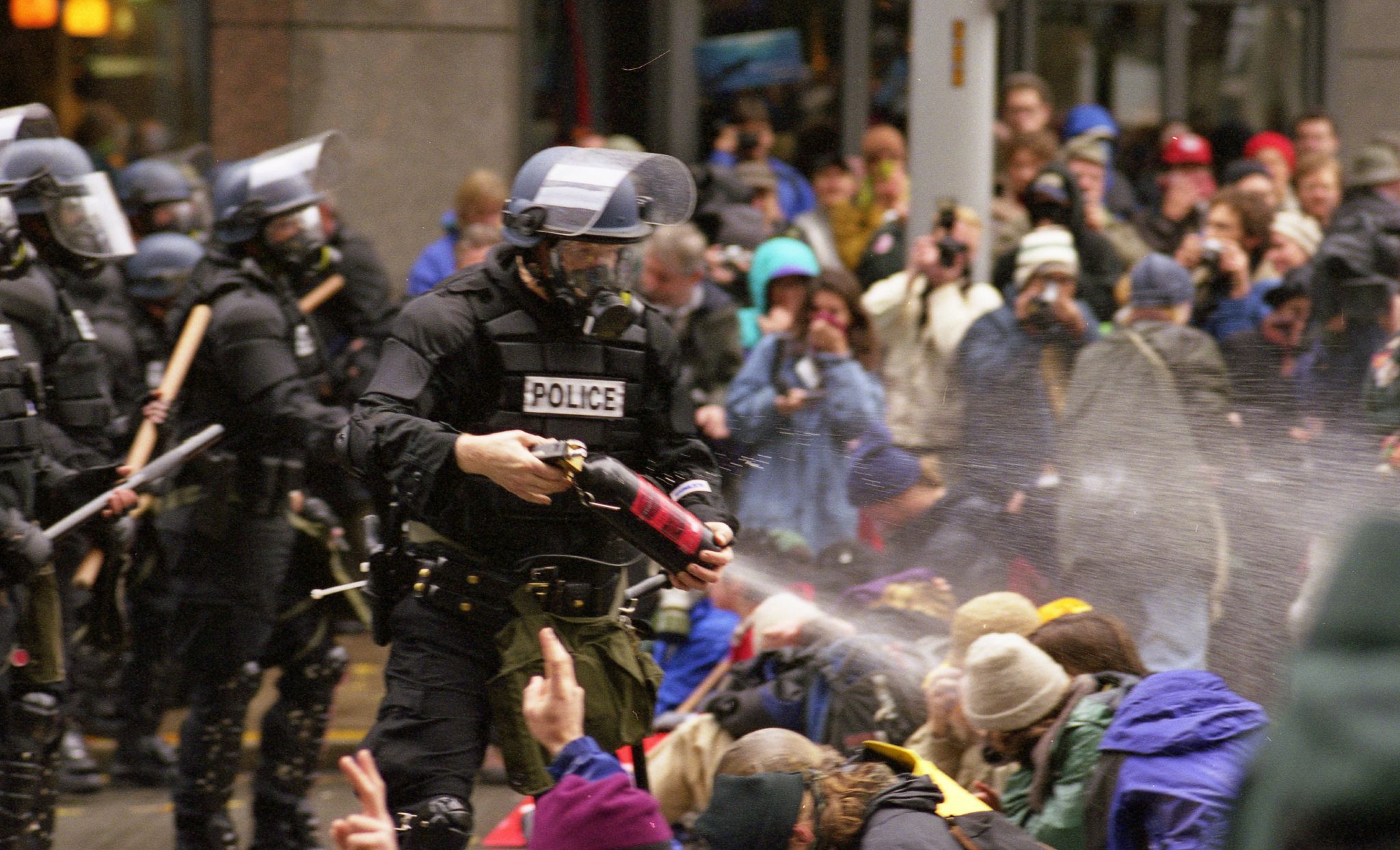
In the 1990s and into the early 2000s, a global movement against corporate globalization and neoliberal capitalism developed, with anti-authoritarian and anarchist politics at it’s head. In 1994, the Zapatista insurrection in Chiapas, Mexico against NAFTA made the world sit up, as indigenous people began self-organizing their communities after taking land back from the State in an armed uprising, blending indigenous Zapatismo with Mexican anarchism. Soon, a tidal wave of actions, indymedia projects, and grassroots groups began to be formed across the US, which fed into the growing anarchist movement. When the protests in Seattle of 1999 hit in November against the World Trade Organization, they famously popularized the black bloc tactic, however in truth the anarchist movement in North America had already been growing for years and exploded within the ascending anti-globalization movement, and was much bigger than simply one single tactic. Regardless, along with the anti-globalization movement, anarchism and its ideas grew.

Paid terrorists attack volunteer revolutionaries in the service of global capitalists.

The anti-globalization movement became in many regards, de-facto anarchist; from the ways that people made decisions to how people organized themselves to take action. Moreover, the mobilizations in Seattle were also important because it saw thousands of people join in confrontational demonstrations that disobeyed the leadership of union bureaucrats and NGOs, to say nothing of the Democrats in power or the police. As the government called for a curfew on demonstrations and even brought in massive amounts of body bags, and President Clinton demonized the black bloc as only wanting to attack “small businesses,” the riots grew into popular revolts as whole neighborhoods stood up against the police and began looting stores. Moreover, the combination of street clashes and blockades shut down the WTO meeting; the protesters won. Seattle set in motion a chain of events, as the anti-globalization upheavals continued, not only in size and scale, but also as popular confrontations between the State, it’s security forces, and the general population. While the events of September 11th in many ways sunk the movement, it remains a high point of anarchist organizing in recent memory.

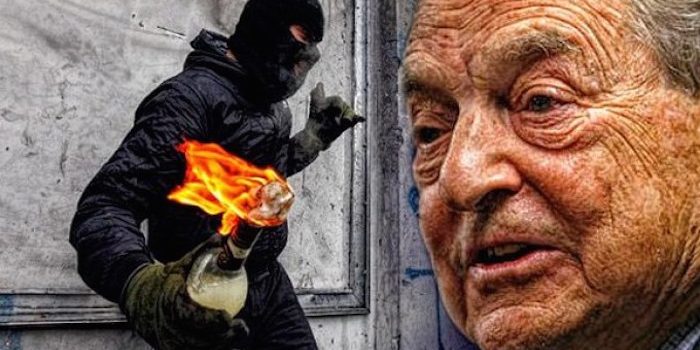
Ironically, when large scale demonstrations like this break out across the social terrain in today’s world, as they often have in the last several years under another Democratic President, Obama, the far-Right simply writes them off. But how and why the write them off is very telling. Generally this first takes the path of conspiracy, as one section of the Right dismisses any kind of popular uprising or resistance as the work of “paid protesters,” almost always under the direction of billionaire George Soros. Another section of the Right will take this even further, and claim that those facing felonies and military grade police weapons are in fact soldiers of the “Zionists,” and are the foot soldiers of the “globalist” order.

But the far-Right did not always see things this way.

As the riots of 1999 in Seattle against the WTO played out, many on the far-Right actually saw what was happening in a favorable light. Beyond that, they even chastised their own movement for failing to live up to the same standard as the people that rioted and shut down the WTO meetings. Although the far-Right framed these actions in terms of conspiracies of the “Zionist Occupied Government, or “New World Order,” they still strangely enough, supported it. Matthew Hale, then the leader of the World Church of the Creator, stated in an essay after the riots:

What happened in Seattle is a precursor for the future—when White people in droves protest the actions of world Jewry not by ‘writing to congressmen’, ‘voting’, or other nonsense like that, but by taking to the streets and throwing a monkey wrench into the gears of the enemy’s machine.

Did the right wing hinder the WTO? No. They were too busy ‘writing their congressmen’—congressmen who were bought off a long time ago, or waiting for their ‘great white hope’ in shining armor who they can miraculously vote into office.No, it was the left wing, by and large, which stymied the WTO to the point where their meeting was practically worthless, and we should concentrate on these zealots, not the ‘ meet, eat, and retreat’ crowd of the right wing who are so worried about ‘offending’ the enemy that all too often, they are a nice Trojan Horse for the enemy’s designs.

Others agreed. Louis Beam, a former member of the Ku-Klux-Klan, and an almost a Subcomandante Marcos figure on the racist far-Right, as well as the person who popularized the concept of ‘leaderless resistance’ wrote:

…My heart goes out to those brave souls in Seattle who turned out in the thousands from both Canada and the U.S. to go up against the thugs of Clinton and those who put him in office. I appreciate their bravery. I admire their courage. And I thank them for fighting my battle…“Soon, however, there will be millions in this country of every political persuasion confronting the police state on streets throughout America. When you are being kicked, gassed, beaten and shot at by the police enforcers of the NWO you will not be asking, nor giving a rat’s tail, what the other freedom lovers’ politics ‘used to be’—for the new politics of America is liberty from the NWO Police State and nothing more.

We mention this history, just as Don Hammerquist did in Fascism and Anti-Fascism, not to imply that there can be some sort of ‘unity’ between white supremacists and anarchists, but simply to point out that the far-Right, at this time, recognized that one of their enemies – anarchists, were actually political agents in a battle against the State and the economic system it is designed to protect. They also understood that this struggle made their own movement appear weak due to inaction and reformism. Also, keep in mind that this was happening at a time of increased anti-fascist organizing, mostly under the banner of Anti-Racist Action (ARA), the very group that were breaking up meetings and beating the shit out of Matt Hale’s Nazi supporters, so these comments were not made without hesitation or reflection.

Things are much different now. For instance, when the African-American community of Ferguson rose in revolt against the police in the summer of 2014, the far-Right across the board condemned the uprising as the work of paid Soros protesters, or an example of the black threat to white civilization. One far-Right group actually even went to Ferguson to help put down the rebellion, the Oath Keepers, a Patriot/militia group, and attempted to act as an auxiliary force to the police. However, upon arrival, some in the group decided they instead wanted to march with guns with the protesters in order to show the police that the citizens were not afraid of them. This about face in position among some members, from wanting to support the State to wanting to support the black citizens of Ferguson, caused a split in the group. Needless to say, the march never happened, but the point remains clear: stand up to the State and its police, especially if you’re black, and the far-Right does not support you. In fact, it demonizes you as the enemy for doing so, or portrays you as a stooge to powers far beyond your control.

The current myths around Soros as the “Puppet Master” mirror the previous views of groups such as the John Birch Society and the American Nazi Party.

These extreme simplifications go back to the 1950s on the far-Right, where anti-communist groups like the John Birch Society painted a world where communists in the service of the USSR infiltrated every group with sizeable influence that was trying to change conditions for poor, working-class, and oppressed people. Moreover, they strongly opposed the civil-rights movement because they saw it as a stepping stone to socialism. Neo-Nazis like George Lincoln Rockwell took these ideas a step further, and proclaimed that civil-rights groups such as the NAACP were actually run by the Jews. African-Americans, Rockwell argued, were not smart enough to organize their own organizations, and thus had to have Jewish leadership. Such leadership, he went on, was proof of Jewish communist plans to ‘race-mix’ white people out of existence. Such ideas continue today on the far-Right, as Neo-Nazis like Matthew Heimbach repeat the same tired lines, while also heralding black nationalist groups such as the Nation of Islam. For the Right it seems, black struggle and organization is always dismissed, unless those involved have anti-Semitic and nationalist politics which mirror their own.

Despite downplaying grassroots resistance, community organizing, and revolt of any kind, the far-Right in the past 8 years has growly increasingly militant and at times, even insurrectionary. It called for Obama to be tried as a traitor. It called for Hillary to be fired and jailed as well. In an armed occupation of a federal wildlife refuge, a far-Right militia occupation in Oregon called for the end of the federal government and the replacing of the State with the power of the Sheriff and the opening up of all federal lands to mining, ranching, and resource extraction. At the same time, the racist far-Right grew in street militancy, clashing with anarchist and left-wing demonstrators, leaving several people injured, and in some cases, even attempting to kill them.

Throughout it all, if the far-Right was sure of one thing, it was the illegitimacy of any resistance that did not come from the Right itself. Any grassroots mobilization, any strike action, occupation of land, or insurrection against State authority was seen as suspect; written off as the act of provocateurs in the service of globalist elites. While it is easy to laugh off these ideas as the fantasy of twitter warriors, or tin-foil hat Alex Jones fans ranting about “the Lizards,” with Trump now echoing many of these positions, they become less easy to dismiss with a slight of hand.

From Globalization to “Globalism”

“Globalism” has now replaced “communism” and even Islam, as the boogeyman of the Right, while at the same time, still encapsulating both of them as threats within its worldview. The far-Right, and the Right in general is very good at taking very complex systems and reducing them down to simple problems caused by a select group of people. As we will show, the idea of globalism both seeks to attempt to appear populist or even revolutionary, while at the same time, singling out select groups of people who the Right claims further the ‘globalist agenda.’

But where did the idea of globalism come from and what the hell does it mean? After NAFTA was passed, and globalization allowed capital to move freely across national borders while locking workers behind them, as structural adjustment programs slashed social services, took away land, and restructured economies in the service of international capital, the mood began to change in the US among everyday workers against globalization. This anger helped feed into the anti-globalization movement, as large segments of labor joined the fight against free-trade deals. But it wasn’t long until sections of the right began to bring critiques of globalization into their talking points as well, Pat Buchanan being a key example.

On the Right, discussion of global capitalism was turned on its head; into a conversation on the problem of “the globalists.” In short, the problem wasn’t a system, but a set of people, and this problem is almost always described along the lines of a conspiracy. In short, those on the far-Right framed the problem in terms of American nationalism, sovereignty, and power, pitted against the “globalist agenda.” Furthermore, the far-Right, of whatever stripe, always described the elite globalist system as being supported and maintained by a set of non-State actors, which work in it’s service to destabilize sovereignty and attack the ‘Native’ population. For some this is immigrants, for others Muslims, for the racist far-Right, it means black people being controlled by Jews, among others. But for all, it means anti-capitalists and grassroots communities in struggle which fight against the dominant social order and power structure. As Liam Stack wrote:

Globalism is often used as a synonym for globalization, the system of global economic interconnection that has been critiqued for decades by liberal groups like labor unions, environmental organizations and opponents of the International Monetary Fund and the World Bank. But for the far right, the term encapsulates a conspiratorial worldview based on racism, xenophobia and anti-Semitism…

The term also often explicitly rejects any sort of anti-capitalist analysis of the systems of power and moreover, and instead replaces a class analysis with racial and national overtones:

Lauren Southern, a host on the right-wing Canadian media site Rebel Media, explicitly rejected its use as a synonym for globalization in a video she posted online in September. She said the word meant rule by autocrats — such as President Obama, former President George W. Bush and the United Nations — who value “the false flag of diversity” and “unchecked immigration from the third world.”

Hope Hicks, Trump’s spokesperson defined globalism as such:

An economic and political ideology which puts allegiance to international institutions ahead of the nation-state; seeks the unrestricted movement of goods, labor and people across borders; and rejects the principle that the citizens of a country are entitled to preference for jobs and other economic considerations as a virtue of their citizenship.

For the ‘anti-globalists’ then, the major problems facing everyday people are not pollution, repression, or poverty, but the pooling of State power into umbrella organizations, such as the United Nations, and “the flooding” of countries by immigration. For the Right, this results in a perceived attack on Western Civilization.

And for some on the far-Right, these ideas take extreme forms. For example, Alex Jones (who called globalism “the ultimate form of slavery”) contends that the globalists ultimate plan is a one world government and that they use immigration to flood sovereign States in order to destroy them and rig elections. Jones then goes on to contend that globalist elites also have plans to kill off a massive amount of the population through genocide and extermination for the sake of consolidating their power. Jones also preaches a set of even more hardcore conspiracy theories, some of which are paranormal in character and outright fucking crazy. But in the last year, Jones has crossed over as a Trump supporter, having Trump on his show, and we’ve even watched as Trump has parroted much of what Jones says in his radio broadcasts. It’s easy to laugh Jones off, but clearly his myth of ‘globalism’ is selling.

An image of George Soros from InfoWars’ article on globalism.

The Oath Keepers, one of the biggest Patriot groups also label globalism and globalists as their chief enemy. From the Oath Keeper page:

Arising out of the writings of Immanuel Kant and Georg Wilhelm Friedrich Hegel (the Hegelian dialectic), and even further back to Plato, Globalism is a belief in a Utopian world run by wise men who care for the masses with a kind, benevolent hand. This we know is a bunch of crap, because those who are leading, (and have led), the world into this collective dystopia have murdered, “collectively”, hundreds of millions of people, through wars, genocide, ethnic cleansing and eugenics.

Fascism, socialism, communism and crony capitalism are all globalist at their core. meaning the collective is supreme over the individual. It is the battle between collectivism and individualism that we should be focused on, not left versus right,republican versus democrat, or fascist versus communist, but, rather, the collectivists vs. the individual, for collectivists hide in all the political persuasions. If someone wants to take your Creator-given, natural rights from you “for the greater good”, you can be assured they are collectivists. Those who would create the New World Order, are collectivists.

In many ways this critique of globalism simply continues cold-war opposition to communism, or inserts new enemies, such as immigrants or Islam, to make it fit into this idea of globalism as anything that threatens American nationalism and ‘sovereignty.’ The Conservativpedia post on globalism again makes this point:

Globalism is the failed liberalauthoritarian desire for a “one world” view that rejects the important role of nations in protecting values and encouraging productivity. Globalism is anti-American in encouraging Americans to adopt a “world view” rather than an “American view.”

Globalists oppose nationalism and national sovereignty, and instead tend to favor on open borders, free trade, interventionalism, and foreign aid. Globalists virulently opposed Donald Trump in 2016. Instead, globalists preferred Marco Rubio and Ted Cruz for the nomination, both of whom have voted in favor of the globalist agenda as senators.

Liberals support globalism because it leads to centralized power, thereby providing liberals with an easier way to gain control. It is far easier for liberals to persuade a handful of people in centralized government to rule in their favor than it is for liberals to push their agenda on a decentralized form of government.

The conspiracy theories of Alex Jones and his critique of “globalism” has been mainstreamed by Trump, who not only came on Jones’ show, but parrots much of his talking points.

This is why immigration is such a huge point on the far-Right, because they see it as “a tool of the globalists” to destroy State sovereignty. Of course, this myth hides the fact that mass migration of people is caused largely by the globalization of the capitalist economy, US involvement in the drug war and foreign policy, and now, climate change and lack of access to water. As The National Interest expands the far-Right position clearly:

Nationalists believe that any true nation must have clearly delineated and protected borders, otherwise it isn’t really a nation. They also believe that their nation’s cultural heritage is sacred and needs to be protected, whereas mass immigration from far-flung lands could undermine the national commitment to that heritage. Globalists don’t care about borders. They believe the nation-state is obsolete, a relic of the 1648 Peace of Westphalia, which codified the recognition of co-existing nation states. Globalists reject Westphalia in favor of an integrated world with information, money, goods and people traversing the globe at accelerating speeds without much regard to traditional concepts of nationhood or borders.

The overall logic of those opposed to globalism can best be reiterated and understood in simplicity by the Neo-Nazi Matthew Heimbach, who stated that the coming period will be defined by a war between globalism and nationalism, where nationalists of all stripes will fight against the globalist elites, which in Heimbach view, are manifested as a racialized Jewish global ruling class. If the nationalists are successful Heimbach contends, they will then create fascist States for each of their own races. While Heimbach’s position would be seen as extreme even on the Right, in many ways, this is just the logical conclusion on an idea founded on anti-Semitism. As Stack wrote:

Far-right groups in the United States began to refer to globalism at the end of the Cold War, when it replaced communism as an idea that was an ever-present danger to the nation, Mr. Pitcavage said. They have also referred to it as the New World Order, and soon they saw its tentacles everywhere.

The shape of that conspiracy had distinctly anti-Semitic overtones, in part because many of communism’s foes had historically seen communism as inextricably linked to Judaism, Mr. Pitcavage said. Members of the far right became fixated on prominent Jews like the businessman and philanthropist George Soros.

Those conspiratorial beliefs were bolstered when former President George Bush celebrated the end of the Cold War in a 1991 speech by saying it was the dawn of a “new world order.” His use of the phrase was taken as proof by many that a globalist conspiracy really was afoot.

The problem with all of this talk of ‘globalism’ vs nationalism is that it holds half-truths and full lies. Neoliberal finance capitalism is a global system. Neoliberalism and globalization have left behind billions of people, destroyed the environment, and attacked the living standards of the majority of people at the benefit of a small set of elites. However this is not conspiracy, it is not the creation of a cabal of Jews, and moreover, globalization is not designed to destroy the power of national States in order to create a one world government, nor is it the project of ideological liberal/Jewish/Islamics/Communists, or ‘globalists.’ Globalization and capitalism in general needs States. It needs them to manage and control their populations and lock them in place, even as capital and goods move freely. Finally, States are needed by elites on a variety of levels in order to bring about stability and prevent revolution when revolt and crisis break out. Moreover, just because capital is more globalized, does not mean that there are not competing visions among elites themselves.

But while the myth of globalism exists to explain the world in a way that allows the Right to actually make sense to people, and moreover, to make themselves appear to actually have political agency, it has other myths to describe everyone who resists in the here and now.

The Myth and Reality of George Soros

If there’s one thing Right loves to throw around, it’s the idea that George Soros is behind any sort of social movement, organized protest, or dissent in general against the status-quo. This is something that is held dear by all parts of the far-Right and even the center right-wing. It seeks to make sense of popular struggles and dismiss them as simply the work of people who are paid off by an evil financial capitalist. The myth has links back to anti-Semitic works such as the original fake news piece, The Protocols of Zion, and Soros being Jewish only adds icing to the far-Right’s cake. Moreover, it also side steps the issue of the very real stranglehold that non-profits and foundation money does play in resistance movements, which is negative, that seeks to channel social movements back into politics and the State, as opposed to building autonomous power on a community level.

But who is Soros? George Soros is the chairman of Soros Fund Management and is one of the 30 richest people in the world, making billions on hedge funds and currency speculation. Far from being an anti-capitalist or revolutionary, he’s most known for as “the man that broke the bank of England,” after he neted over $1 billion in currency speculation. Along with being one of the richest capitalists alive, Soros also donates to and funds many liberal non-profits that promote the Democratic Party and it’s bureaucrats. Soros has also backed many Democratic candidates, such as Hillary Clinton and Barack Obama. In 1984, Soros set up the Open Society Foundation that acts as a grantmaking network, further expanding the amount of non-profits who took on the role of providing social services; filling gaps that were created after Reagan began slashing various programs.

Because Soros does have expansive wealth, donates to what the far-Right describes as “left-wing” groups such as MoveOn.org (a front for the Democratic Party), the ACLU, Human Rights Watch, and MediaMatters.org (a large liberal non-profit), along with Democratic career politicians, on top of coming from a Jewish background, those on the Right love to use the image of Soros as a wealthy Jewish elitist to further a wide range of anti-Semitic conspiracy theories and in the eyes of the far-Right, every riot, strike, occupation, and disruption ultimately has one man behind it: Soros.

This is also a myth that like The Protocols of the Elders of Zion or shows like Ancient Aliens, gets ratings, clicks, and votes. One of Donald Trump’s last campaign adds attacked Soros, along with the head of Goldman Sachs (where ironically Trump’s top advisor Steve Bannon formerly of Brietbart used to work), and the Federal Reserve, along with Clinton, in what many described as having anti-Semitic undertones. In 2010, Glenn Beck released a two part series on Soros, calling him “The Puppet Master,” claiming that he wanted a one world government and for himself to rule it. Again, this reduction of struggle, dissent, and unrest boils down complex situations into easy solutions; and Soros as a wealthy Jew makes an easy devil for the far-Right.

soros-leaks-575x575

The far-Right portrays Soros as behind the organic struggles of poor, especially black people, as a way to demonize and downplay them. This plays into the myth that a Jewish cabal controls the world and moreover, that black people are unable to organize themselves without “puppet masters.”

For instance, during the fall of 2014, the far-Right again used the myth of Soros to claim that he was behind the Ferguson riots, and paid people tens of millions of protesters to “riot” in the wake of police murder of Mike Brown, Jr. Later, as black insurgency spread to Baltimore, the far-Right again pushed the line that Soros was bank-rolling the Black Lives Matter movement, which many on the Right simply equated part and parcel with the self-organized uprisings that were organically coming from the black community itselves. As the Movement for Black Lives (in many ways the “official” Black Lives Matter organization) tried to reign in the expanding movement that was becoming more and more militant, it also became awash in grants from the Ford Foundation as Soros’ Open Society Foundation. Not surprisingly, some of the leaders of the official organizations of Black Lives Matter, and its push for policy reforms, Campaign Zero, and ended up endorsing Clinton.

For those on the far-Right, this is evidence that the entire movement was itself funded by Soros, and that the rebellions, protests, mass organizing, and uprisings were all his doing. But what this really shows is that wealthy liberals and powerful non-profits were trying to bring popular and self-organized movements back into politics; to smother them of any revolutionary potential. For instance, in a recent article on Left Voice by Julia Wallace and Juan Ferre argues that this relationship between wealthy donors (like Soros) and non-profits actually moved revolt out of the streets and back into more ‘acceptable forms’:

We may ask ourselves, how did a platform of a movement that swept the streets throughout the US become a set of policy briefs meant to lobby Congress? The undersigned names and organizational affiliations give us a hint: most belong to the world of nonprofits, many are sponsored by the Ford Foundation, George Soros, the Black-Led Movement Fund, and other capitalist funders.

Wealthy philanthropists like George Soros are not friends of popular struggles, foolishly bankrolling their own demise. Organizations like the Ford Foundation are not interested in “liberation,” but rather, appeasement and co-optation. There is a long history of US capitalists intervening in social movements (ie., the Civil Rights movement) with the effect of steering them away from militancy and towards compromise. Philanthropy is a strategy of the rich, who may give up some wealth to fund progressive projects in order to quell social unrest, maintain their position of power, and maintain the capitalist order.

Many organizations that form part of the M4BL have taken donations from corporations, including a $500,000 grant from Google (Ella Baker Foundation). There is plenty of lip service to opposing capitalism, but how much challenge is really being made when the same organizations are accepting money from millionaire capitalists and billion-dollar corporations?

The ever-burgeoning nonprofit industry has a key role to play in contemporary US society. It contains the outrage of the disenfranchised, the most exploited and oppressed. It diverts the thrust of militant activism from disruption to civic procedures. The money and logistics funneled into these movements have a determining influence. In exchange for precious resources, they shape the demands and methods of the organizations they fund to fit the likes of the funders. As progressive as it may seem, the generous influx of money into these movements causes terrible harm. A significant layer of activists becomes “professionalized,” embraces the modus operandi in these settings and reproduces a strategic framework and discourse that leads nowhere.

The far-Right portrays Soros as behind popular revolt because it wants to paint grassroots organizing and resistance as illegitimate.

In short, Soros along with a host of other wealthy and powerful liberals were part of a push to pacify and contain Black Lives Matter and bring it back into the Democratic Party, but had nothing to do with “funding riots,” as the far-Right likes to imagine. The elites that attempt to control social movements with money want them to be political not disruptive.

But these are also myths that aren’t going away anytime soon. Recently, far-Right social media accounts proclaimed that Soros would “use black hate groups to bring down America.” Not surprisingly, these quotes were quickly shown to be completely made up and false. Most recently, the far-Right claimed that Soros owned various electronic voting machines in a variety of states, and thus was possibly rigging the election, while these myths were quickly exposed as simply “fake news.”

Why the Right Needs These Myths

At the end of the day, the myth of Soros and the globalists is helpful to the far-Right because quite simply it explains why people revolt; for the Right, it’s simple: they are paid to and on their own, are too dumb or incapable of organizing anything. This myth goes back to the anti-Semitic and racist views of old, and the anti-communist lines held by the John Birch Society that a select group of puppet masters are playing the good workers and poor in an elaborate scheme for world domination.

But most importantly, the Right has a direct and real need to explain why revolt comes out of human communities because by attacking and discrediting it, it makes itself appear to be revolutionary and at the forefront of a worldwide struggle against “globalism” and overall, justifies themselves taking State power (or supporting it). This combination of dismissal of the capacity of human beings to run their own affairs and struggles, especially the poor and the colonized, while at the same time valorizing one’s own need to rule over those people, runs throughout both the authoritarian Left and the Right, and should recognized as the filth that it is and attacked.

In fighting the far-Right we can’t simply dismiss these ideas, we need to confront them head on.

Donald Trump and the ‘Populist International’

kkk-trump

KKK newspaper endorses Donald Trump

Article by Annie Applebaum, reprinted from the Washington Post (where it was printed under the title ‘Trump is a threat to the West as we know it, even if he loses‘).

This was written before Donald Trump’s shock election as US President, and the Washington Post is far from a typical source for a socialist group.

However, the article provides a useful overview of the recent international rise of right-wing populism, manifested in the USA as Trumpism.

Trumpism taps into a reservoir of nationalist resentment, which is unfortunately the most significant current challenge to neoliberal discourse.

The Democrats failed to provide a convincing alternative, offering a ‘business as usual’ candidate in unusual times. The #BlackLivesMatter and #StandingRock movements offer the only way forward: an anti-racist, anti-capitalist direct action movement built from the ground up. Leftists must articulate a progressive internationalism, as an alternative to both neoliberal centrism and racist nationalism.

They share ideas and ideology, friends and funders. They cross borders to appear at one another’s rallies. They have deep contacts in Russia — they often use Russian disinformation — as well as friends in other authoritarian states. They despise the West and seek to undermine Western institutions. They think of themselves as a revolutionary avant-garde just like, once upon a time, the Communist International, or Comintern, the Soviet-backed organization that linked communist parties around Europe and the world. Now, of course, they are not Soviet-backed, and they are not communist. But this loose group of parties and politicians — Austria’s Freedom Party, the Dutch Party for Freedom, the UK Independence Party, Hungary’s Fidesz, Poland’s Law and Justice, Donald Trump — have made themselves into a global movement of “anti-globalists.” Meet the “Populist International”: Whoever wins the U.S. election Tuesday, its influence is here to stay.

Although it is often described (by me and others searching for a shorthand) as “far-right,” the Populist International has little to do with the “right” that has thrived in Western countries since World War II. Continental European Christian Democracy arose out of a postwar desire to bring morality back to politics; Gaullism came out of a long French tradition of statism and secularism; Anglo-Saxon conservatives had a historic preference for free markets. Most of them shared a Burkean small-“c” conservatism: a dislike of radical change, skepticism of “progress,” a belief in the importance of conserving institutions and values. Most of them emerged out of particular local and historical traditions. All of them shared a devotion to representative democracy, religious tolerance, Western integration and the Western alliance.

By contrast, the parties that belong to the Populist International, and the media that support it, are not Burkean. They don’t want to conserve or preserve what exists. Instead, they want to radically overthrow the institutions of the present to bring back things that existed in the past — or that they believe existed in the past — by force. Their language takes different forms in different countries, but their revolutionary projects often include the expulsion of immigrants, or at least the return to all-white (or all-Dutch, or all-German) societies; the resurrection of protectionism; the reversal of women’s or minorities’ rights; the end of international institutions and cooperation of all kinds. They advocate violence: In 2014, Trump said that “you’ll have to have riots to go back to where we used to be, when America was great.”

Sometimes they claim to be Christian, but just as often they are nihilists and cynics. Their ideology, sometimes formalized and sometimes not, opposes homosexuality, racial integration, religious tolerance and human rights.

The Populist International holds these goals to be more important than prosperity, more important than economic growth, more important than democracy itself. Like the parties that once formed the Comintern, they are eager to destroy existing institutions — from independent courts and media to international alliances and treaties — to obtain them. This week, Britain’s Daily Mail, a newspaper that propagates the ideas of the Populist International, actually denounced three high-court judges as “Enemies of the People” because they decreed that Britain’s exit from the European Union would require parliamentary consultation. Trump is only one of many politicians — Poland’s Jaroslaw Kaczynski, Hungary’s Viktor Orban — who have launched attacks on the principles of their own constitutions.

Like their Comintern predecessors, the Populist International also understands that there is much to be gained by mutual support. German Christian Democrats would never have dreamed of campaigning on behalf of British Tories. And although they had much in common, Tories didn’t intervene directly on behalf of U.S. Republicans. By contrast, Nigel Farage, the leader of the UK Independence Party, has openly campaigned for Trump, even appearing in a “spin room” to plug the Republican nominee after one of his debates with Hillary Clinton. Geert Wilders, the xenophobic Dutch politician, showed up at the Republican National Convention, where instead of observing, as a Dutch Christian Democrat would have done, he agitated on behalf of Trump, too. All of the populist parties and newspapers use the narratives put out by Sputnik, the Russian news service that serves as an endless source of conspiracy theories and fake news. This week, a fake account of a refugee in Austria acquitted of raping a child — originally broadcast on Russian state TV — was repeated by Russian President Vladi­mir Putin and then across Europe, including (again) in the Daily Mail.

All the signs are that the movement is still growing. If Trump loses, the story isn’t over: His campaign will no doubt metastasize into a television channel and a news network, and will continue to spread. But his failure will encourage the antidotes — the citizens’ parties, based on ideas rather than charisma, the independent journalists, the democracy movements — that have begun to emerge.

And if Trump wins? The Populist International will be invigorated, not just in the United States but around the world. Trump will be its leader, his daughter Ivanka will be its heir apparent, and liberal democracy, and the West as we know it, may cease to exist. Think about that before you vote.