Poem: Cassandra warns of climate change

Poem solicited for publication in Fightback’s upcoming Climate Crisis magazine issue.

Tam Vosper lives in Christchurch and is currently working on his Master of Arts (in English) at the University of Canterbury. He also, among sundry other distractions, reads and writes poems.

For my discomforting prophecies
I was harried past all asylum
to the very limits of discomfiture
by those whom I had told out of love
to do otherwise than trace headlong paths
past the rubicon of my wretched vision.

They saw to it I was silenced
and all memory of me effaced
beyond recognition.

Now, when children point at me,
questioningly, in the street,
they are bustled off by their guardians
at double pace
who readily assure them
that I am a nobody,
that I am, in fact, illusory –
a nameless, voiceless,
trick of the light:

as with the spectacular
pink and gold plasma
of a sunset seen through smog.

Editorial: Fightback ‘Internationalism’ Issue Out Now

2015-10-05 17.22.27

For our fourth magazine issue of 2015, Fightback is publishing an international-themed issue. This includes a number of reprints from international sources, aswell as original content. As we go to print, images of dead Syrian refugees have prompted international outcry, with some concessions won already – the New Zealand government recently announced plans to let 100 more refugees in. Fightback supports international working-class solidarity, including open borders and full rights for migrant workers.

What do we mean when we say ‘international’? Is it the same thing as global, or worldwide? Internationalism implies the existence of ‘nations.’ Nation-states, borders, in the sense we know them have only existed for a relatively short period of human history. Contemporary nation-states are a product of the emergence, and global expansion, of capitalism. Expansion, of course, meant bloody colonisation – although the same violent alienation of land that would later be inflicted on indigenous peoples was first inflicted on European peasants.

With the colonisation of the US in particular, the ‘colour line’ was drawn between white and black workers, a conscious attempt to undermine working-class unity. White workers received a “psychological wage,” in African-American theorist W.E.B. Dubois’ words; limited privileges in exchange for supporting the regime that exploited them.

Modern racism is therefore deeply connected to the global expansion of capitalism. Unfortunately, this has also run through ‘left’ and social-democratic politics; the NZ Labour Party supported the White New Zealand policy in the early 20th Century.

When we speak of internationalism, or international workers’ solidarity, it’s a struggle on multiple fronts. It’s a struggle against imperialism, an international military, economic and political system; a struggle against ‘free trade’ agreeements like the TPPA and military occupations; for the self-determination of communities. It’s a struggle against the global hierarchy, with a minority of mainly white billionaires on one pole, and the global majority on the opposite pole.

Many are somewhere in the middle, particularly in a nation like Aotearoa / New Zealand, a nation-state that tends to stand with the imperialist ‘Anglosphere’ – Britain, the US, Australia. 85% of this country identifies as ‘middle-class.’ Those of us in the middle must pick a side.

The forces stacked against us are immense, as Greece’s Syriza has demonstrated (see Greek Crisis, 3. P10-11). The fight will not be easy or quick. It will have to come from many places, many worldviews, but it will also require strategy – we can’t underestimate our enemies. Fightback hopes that this magazine issue will provide solace and assistance for our side.

Two options are available for subscribing to the print edition of Fightback. $10 a year will get you our six bi-monthly issues, or a sustaining subscription is available for $10 a month, a sustaining subscription offers financial support beyond the costs of printing and postage covered by the regular subscription.

Use the buttons below to pay via credit or debit card (please note ‘Shipping Address’ is the address you would like your magazine sent to)

regular

sustaining

For Internet Banking set up an automatic payment of the appropriate amount to 38-9002-0817250-00 and email the address you would like your subscription sent to ian.ndrsn@gmail.com. Also use this email address for inquiries about paying by cheque or other means.

You may also contact your local branch for copies of the latest issue.

A Son Samoa (Voices of Women and Gender Minorities)

Article originally published in Fightback magazine’s special issue dedicated to paid radical writing by women and minorities.

By Falenaoti Mokalagi.

Content Warning: sexual assault.

Yesterday a son of Samoa was jailed

25 years after the fact

I sat next to your daughter Samoa

Birthed in Aotearoa

I READ OUT ALOUD  the impact of this son

UP ON  your daughter Samoa

UP ON her mother

UP ON her siblings

UP ON her lineage

UP ON her genealogy

I heard at the age of 5 Samoa she lay on top of her mother to protect her from the heavy steel coffee table being rained on her by your son.

The memory recounted vividly as if it were only yesterday

She was 5, her sibling 2 when they took responsibility for the safety of their mother from your son Samoa, their father.

They were  all 3 hospitalised

Their records read that there had been an accident in their home and the 2 year olds injuries were sustained as a consequence of the toddler falling head first into the fireplace.

It was read in Court Samoa that by the age of 11 she knew what oral sex felt like what digital penetration, and lubrication were.

I READ OUT ALOUD  she felt disgusting

I READ OUT ALOUD  she felt she was a whore

I READ OUT ALOUD  she wanted to kill herself every day

Her constant pre-occupation

I READ ALOUD she survived

BY taking drugs

BY drinking alcohol

BY seeing endless counsellors

SHE leaves town

SHE has un-lasting relationships

SHE does not trust any Samoan man Samoa

I READ ALOUD he gave her gifts, and money

Received in silence and guilt

An exchange for her silence

He told her Samoa that no one would believe her

I READ OUT ALOUD she just lay there.

Yesterday a son of Samoa was jailed

He walked into the Court room as if he had done no wrong

I heard he continued to deny what his hands had shaped

I heard he continued to deny even after being found guilty by a jury of his peers

The judge said out aloud there is no other suitable penalty but jail

He leaves the dock assisted

He is visibly stunned Samoa

I HEARD ALOUD that after 25 years he had changed his ways

I HEARD after 25 years he read his Bible every day

I HEARD after 25 years he should be allowed to stay at home

Under detention

THE JUDGE SAID ALOUD there is no other suitable penalty, but jail.

THE FOG LIFTS from the head of your daughter Samoa, who is born is Aotearoa.

SHE is heard,

SHE is seen,

SHE is believed and some responsibility for her is taken

SHE frees her mother, her siblings

And the process of restoration of the spaces that were trampled

The spaces defiled

Starts

I CELEBRATE her courage Samoa

HER generosity

And her wholeness Samoa

Your daughter Samoa

Born in Aotearoa

Ma lou faaaloalo lava

‘Flag debate’ – Still an expensive distraction

hopkinson nz flag burns hopkinson

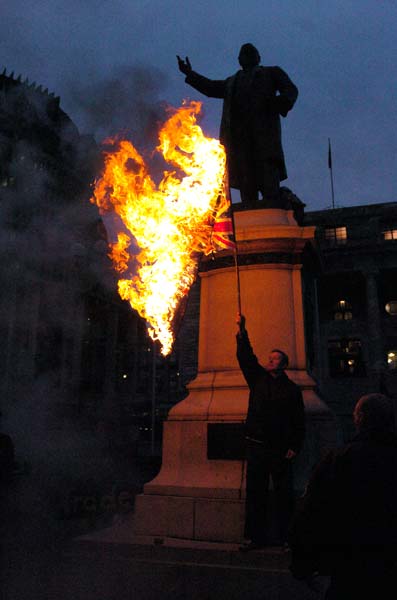
Paul Hopkinson burns NZ flag in opposition to military occupations, 2004.

By Ian Anderson, Fightback.

It’s not news that New Zealand Prime Minister John Key has arbitrarily announced a ‘flag debate,’ consisting of two referenda in November-December 2015 and March 2016. Or rather, the ‘flag debate’ is news; reports circulate daily on the latest developments. However, in all the debate about which design is best, or why certain designs were picked and not others, the debate about why this process is happening has largely been left behind.

Critics of the process come from a range of perspectives. Some defend the existing flag, featuring the Union Jack. The Union Jack has also been termed the ‘Butcher’s Apron’ – covered in blood as it waved over a bloody process of global colonisation (including in Aotearoa / New Zealand) which has only recently ebbed.

One conspiracy theory, circulated widely on social media, holds that changing the flag would change New Zealand’s constitutional relationship with the British Crown, laying the basis for the secretly negotiated Trans Pacific Partnership Agreement (TPPA). This theory invokes terms like “due authority,” a term which has no legal constitutional meaning. Proponents of the theory hold that the TPPA is an attack on sovereignty. This has an element of truth to it – transport giant Veolia is currently suing the Egyptian government under a similar trade agreement, for raising the minimum wage. However, sovereignty of this kind, the chance of justice and self-determination, rests with the people. The Crown is no defender of popular sovereignty. The forces that imposed capitalism by force will not defend against its excesses. In any case, most flags of the British Commonwealth do not have a Union Jack – the flag design does nothing to alter our constitutional status.

If the flag design were as important to New Zealand capitalism as the TPPA, Key and National would not offer this level of democratic oversight – compare two expensive referenda with secret negotiations. Granted, the ‘democratic’ process is arbitrary and more than a little corporate. Asking for a preferred alternative before asking if voters want to change the flag is manipulative and unnecessary. Key’s obvious preference for the corporate Silver Fern symbol was cemented by a corporate panel, with 3 out of 4 finalists featuring the Silver Fern.

However, it didn’t take much of a fight for National to add the popular Red Peak design to the list of finalists. After a petition with 34,000 signatures and some parliamentary rumblings, Key backed down expressing democratic sentiments:

“I don’t want to be the one that stands in people’s way of having a choice. If people want me to alter the process, I’ll be happy to alter the process – I would have preferred to stick to the one the officials wanted, but you know.”

Compare this with the TPPA, which is opposed by trade unions, criticised by local councils and parliamentary opposition (albeit in a tokenistic way – considering Labour initiated the process), by tens of thousands mobilising in the streets nationwide – and Key has dismissed this opposition as ‘misinformed.’ Popular input on trade deals would much more fundamentally undermine Key’s power base than popular input on an isolated symbol.

The problem with the ‘flag debate’ is precisely that it doesn’t have anything to do with our constitutional status. Te Tiriti will continue to be dishonoured in favour of the English Treaty, a document intended to ensure Crown sovereignty and a stable basis for capitalism. Governments will continue to rush for ‘settlement,’ while the previous settlements haven’t even begun to address the historical violence that has impoverished indigenous communities. Successive Labour and National governments will continue to entrench integration with ‘free trade’ and US-led military occupations. The flag design, on its own, makes little difference.

In fact, the incorporation of the Red Peak, by some degree of ‘popular demand,’ can be considered a kind of victory for Key. Opponents of the process previously called it a $26 million dollar distraction, with public money that could be better spend on feeding or housing people. Now, a particular design has attracted the support of Key’s critics (among others). This is an ironic success for Key’s arbitrarily announced nation-building process. If Red Peak succeeds, the symbol used to justify troops in Syria and Iraq, used as a brand for international trade, will better represent progressive aspirations.

In a widely circulated blog entry entitled ‘Why I Support the Red Peak Flag,” Oxford philosophy professor Josh Parsons (who once graded every flag in the world) articulated this desire:

“New Zealand needs a flag that represents the bicultural nature of our society (never mind whether biculturalism or multiculturalism is more desirable); that reflects the historic contract between Māori and Pakeha that founded our society (whether just or unjust); that represents the unique geography and land-forms that have played an important part in our history and shared culture. It also needs a flag that is not revolutionary, but shows continuity with the past; that is independent of any sports code, and most important of all, is simple, iconic, and unique.”

Parsons’ phrase “whether just or unjust,” perhaps accidentally, echoes the old slogan “my country, whether right or wrong, but my country.” Parsons articulates a form of liberal patriotism, founded on the myth of reconciliation between settlers and indigenous people. Many on social media have similarly expressed a preference for the tino rangatiratanga flag, which represents the struggle for Māori sovereignty. While these intentions are probably noble, there is one fundamental problem – ‘we’ haven’t earned such a flag. In lieu of justice for indigenous and oppressed people, a bicultural flag would represent another kind of rebranding for capitalism, colonisation and imperialism. Reconciliation is impossible without justice

A serious movement for constitutional transformation could challenge this historical, continuing injustice. This movement may demand land redistribution, rather than paltry financial settlements for corporatised iwi; may demand a relationship of kaitiakitanga, or guardianship, with resources, rather than exploitation; may demand a true partnership between tau iwi and tangata whenua, collective self-determination, the end of domination by financial elites (including the unelected Brown Table). Fightback also advocates that such a movement should articulate an alternative kind of internationalism – on the basis of solidarity and mutual aid, rather than economic competition. Recent popular sentiments supporting Syrian refugees represent this possibility of an alternative internationalism.

While the movement for constitutional justice occasionally explodes from the potential into the concrete; the 1975 Māori Land March; the re-occupation of Bastion Point (supported by a trade union green ban); hikoi against the Foreshore and Seabed legislation, against asset sales and the TPPA; this is an interrupted, discontinuous process. In the words of Marxist theorist Walter Benjamin, “the history of the oppressed is a discontinuum.” Radical organisations support and prepare for these outbursts of historical possibility, which offer far more than a rebrand for ‘Team New Zealand.’ A movement for constitutional transformation may demand a flag change, but this would have to be connected to further-reaching demands for justice and resources. Without these more far-reaching changes, a better design for our national flag amounts to rebranding injustice. The ‘flag debate’ remains an expensive distraction.

UK: Pessimism after Corbyn

corbyn points

Article reprinted from Salvage (UK).

By The Editors, 14th September 2015.

Anyone, of any politics, who does not start by acknowledging the profundity of this shock is a bullshitter. For the first time since George Lansbury, the Labour Party has a leader who is both a socialist and an experienced activist. He did not win by the skin of his teeth, nor by fluke: his crushing 59.5% first-round win – coupled with a miserable 4.5% for the hard Blairite Liz Kendall – is a demolition job on the entrenched Labour elite. Nor is his win merely due to support in the unions, or from the influx of registered supporters – though he won 57.6% and 83.8% of these votes respectively – he also gained 49.6% of votes from full members; a full 26.9% ahead of his nearest rival. In a few short months, Corbyn has radically shifted the balance of power that has obtained in the Labour Party since the end of the Miners’ Strike.

This is not a shallow electoral victory. It was evident after the first month of the Corbyn campaign that something was up. The crowds he drew, the social media buzz, suggested that he might make a heroic attempt not to end last. By the time of the first poll, he was in first place. The second poll had him winning by almost as handsome a margin as he ultimately achieved. As he zig-zagged across the country to address packed halls, his stunned rivals struggled and failed to reclaim the initiative, their empty babble attesting to the ideological vacuity and political enervation of the New Labour project and its various progeny.

For now, we dine on #blairitetears. We savour the astonishing victory, even as the Blairite media rabble incontinently deluges us with bitterness, spite and panic. We glory in the dismay of the political class and its media circuit, from the feeble right-wing fearmongering (‘Corbyn scary man woooo’) to the mannered liberal drollery attempting to devalue the outcome by means of a stolen and bowdlerised anti-oppression politics. We see you, Blairites, crying crocodile tears over ‘brocialism’, and you do not fool us.

We stand with Labour Party members who, sick of the contempt of their betters, of being treated as an inconvenience to be shushed while the grown-ups are talking, have hit the undemocratic, managerial caste running their party squarely where it hurts. We unstintingly celebrate this ‘Oxi’ to austerity, to triangulation, to managed politics, to Project Fear, to the neoliberal consensus. In a political field engineered for the endless recursion of the same, where any surprise stands out, this is an actual victory.

However, as the reference to ‘Oxi’ implies, this is also a moment for sobriety. We will not be equal to the challenges to come if we once again lurch from despondency to bad hope – we have seen where this ends. Salvage’s answer to such unproductive careening remains a hard-won pessimism. This is neither cynicism nor hopelessness: it is about our clear-sighted analysis – of capitalism, of the class system, of the centrality of this antagonism to our lives – that we refuse to gloss over the scale of the difficulties we continue to face. Our pessimism, far from the libidinised wallowing in despair that characterises the emos of the ultra-left, is historically founded. It is grounded in a realistic appreciation of the limits of the Left’s institutional, social and organisational power, the erosion and destruction of the traditional loci of working class power. And it is grounded in a recognition of the influence of neoliberalism on popular ideology. These factors have not disappeared, even if they are obscured by the magnitude of Corbyn’s victory.

There is war coming in the Labour Party. Already, the bad-faith resignations and rumour-mongering of leading right-wingers signals the scale of resistance Corbyn will face. And that struggle will refract through its own institutional and ideological character the conflict that cleaves society as a whole, that between exploiter and exploited, between oppressor and oppressed. And the odds in that conflict remain stacked heavily in favour of the habitual victors. The Labour right have been caught off-guard, exhausted, and weakened by the loss of a major bastion of their power the size of Scotland. Ironically, the very processes of Pasokification that threaten the survival of Labourism as a serious force are also responsible for the chinks in the armour of the old guard, which have allowed Corbyn and his allies to make this audacious dash for power. But, also ironically, Corbyn’s very victory, in its shattering of their complacent, internalised claim that There Is No Alternative (to them and their project), will galvanise the Labour right. They will not forgive this humiliation. Numb inertia is no longer their instrument: they will have to remember how to fight again. And remember they very soon will.

When their onslaught begins in earnest, they will be fighting with the party machinery at their disposal. They will be fighting with the press on their side, with the Tories as tacit allies, with business at their backs. They will have the support of the civil service and the state apparatuses. They will undoubtedly benefit from Clockwork Orange-style deep-state intrigue. But, far more fundamentally, they will benefit from the fact that Corbyn is obliged to work with a parliamentary party that is overwhelmingly hostile to what he wishes to achieve, and is apt either to force him to make damaging compromises, or to engineer habitual crises for him, or both. For his part Corbyn, being committed to the ‘broad church’ conception of the party, has already signalled through his cabinet appointments that he is aware of this balance of forces and the relative isolation of he and his allies in the places where it counts.

The task that Corbyn and his supporters face, like that which faces the Left more generally, is not just a question of taking advantage of the occasional opportunities that present themselves, as important as they are, but is a matter of having a realistic appraisal of the overwhelming forces arrayed against us, our historical weakness, and our need to tenaciously and patiently reconstruct the forces of the working-class movement from the grassroots up. The weakening of the representative link and the erosion of traditional forms of political control in neoliberalised democracies will occasionally – and unexpectedly – give rise to unique opportunities for weakly rooted forces to make dramatic advances – as with Syriza, as with Podemos, as with Corbyn. But the ground for these occasional leaps must be prepared, in order that they be sustainable. In Greece we are witnessing what happens when that is not the case.

It is natural and healthy that, having been apprised of the Left’s supposed death since 1989 – ‘End of History’ and all that – many on the Left are anxious to break the coffin lid. But one of the worst aspects of traditional Left boosterism is that, in failing to acknowledge the scale of our previous defeats and their legacy, it prepares every hopeful new recruit not for years of patient work, but for rapid burn-out and demoralisation. At such moments of real victory, the philistine and panicked ‘optimism’ of the unreflective Left, the Bad Hope that, in its moralized hyperactivism, so often enables the very short-cuts that undermine the necessary work, is prone to instant phase-shift into Bad Despair. There is no point in surging to life, only to fall back more permanently and numerously into the sepulchres.

Salvage cleaves to the necessity of a pessimism that is not a nostrum but a result of analysis, and urges others on the left to approach this battle with the same sober caution. Aspiring to such rigour is not merely a responsibility in these circumstances, it is energising. Salvage counsels a pessimism that has the humility to be surprised, to celebrate the shocks of our victories without surrendering the caution we – all – need. And we proceed in the utter and committed desire – theSehnsucht – to be proven wrong.